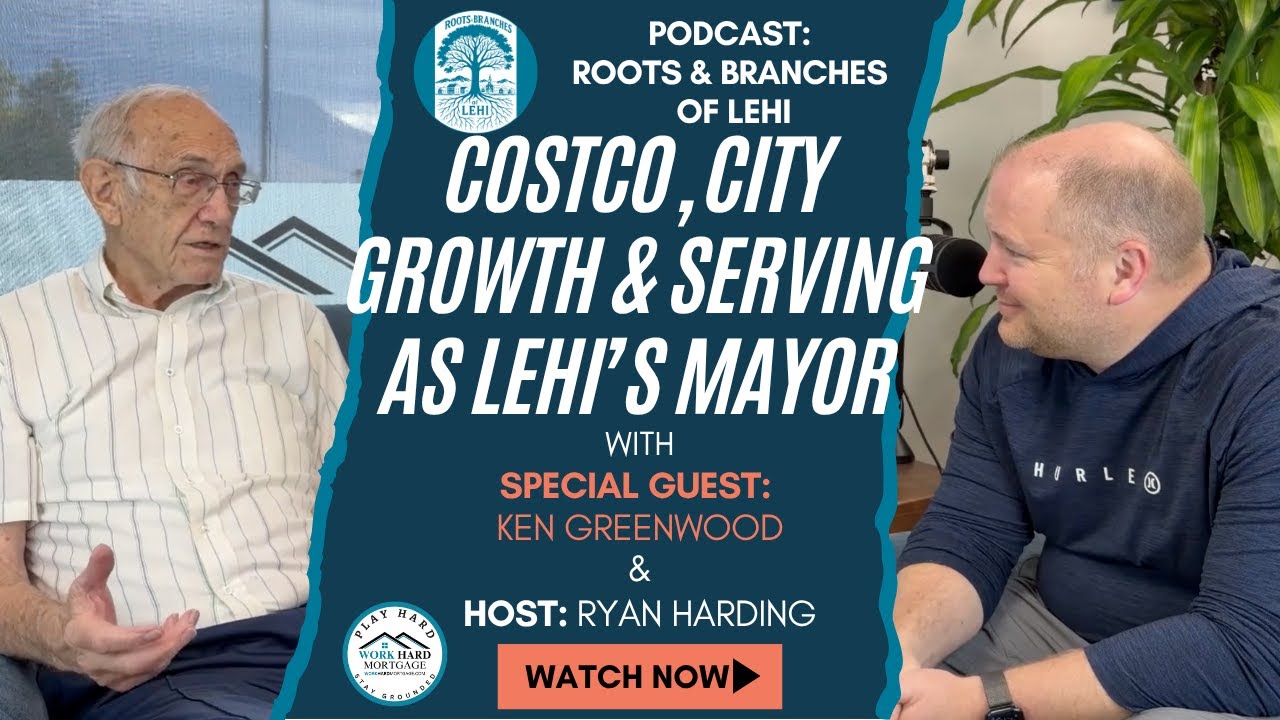
Costco, City Growth & Community Leadership | Ken Greenwood’s Lehi Legacy
Former Mayor Ken Greenwood reflects on Lehi’s transformation from a ghost-town Main Street and agrarian roots to a burgeoning city, exploring the resilience required to build a community.
Ken Greenwood
Two-Term Mayor and Entrepreneur
At a Glance
Archive Scoring
Introduction
Ken Greenwood’s narrative is a profound testament to the cyclical nature of community life in Lehi. He begins with the gritty determination of his ancestor, Thomas Karren, one of the city's first settlers, who literally threw his coat on the ground and refused to move further, claiming his space in the desert. This ancestral stubbornness is mirrored in Ken’s own life when he purchased a series of boarded-up buildings on a deserted Main Street in the 1960s. His recollection of standing in the middle of a thoroughfare without a single car in sight serves as a haunting snapshot of a town at a crossroads, waiting for a catalyst to return to life.
The heart of this record lies in the moment of crisis—a devastating arson fire that gutted Ken’s furniture and reception center. Rather than a story of loss, Ken frames this as the moment he truly discovered the soul of Lehi. The community’s rally, culminating in a $10,000 fundraiser, was more than a financial gift; it was the social contract that propelled him into public service. His transition from an entrepreneur to a two-term mayor is presented not as a political climb, but as a debt of gratitude to the neighbors who wouldn't let him fail.
Ken offers a rare, candid look at the friction between heritage and progress. He describes the visceral memory of sheep being driven through Main Street to pack down the winter ruts—a practical, agrarian solution to infrastructure—and contrasts it with the modern struggle of managing a population that exploded from 15,000 to nearly 100,000. His admission of 'dropping the ball' on transportation planning provides a rare moment of vulnerability for a public official, emphasizing that leadership is often a series of lessons learned in real-time under the pressure of unprecedented change.
Beyond politics, Ken reflects on the social fabric of Lehi, moving from the 'pool hall' culture of his youth to his later years of dedicated religious service. He speaks with warmth about the evolving nature of acceptance within the community, noting how the town has moved from judging people by their adherence to strict social codes to a more inclusive understanding of character. This shift represents the 'soft' infrastructure of Lehi—the gradual thickening of social ties that allows a small town to grow into a city without losing its humanity.
Ultimately, Ken’s story is about the architecture of a life spent in service of a place. Whether it was putting new motors in dental vacuums, laying carpet in high school classrooms, or presiding over city council meetings, Ken’s labor has been stitched into the very floors and foundations of Lehi. His legacy is found not just in the buildings he saved, but in the honest perspective he offers on what it means to grow old alongside your hometown.
Episode Overview
A detailed look at the topics, people, and context of this conversation.
In this episode, Ken Greenwood, a two-term former Mayor and longtime entrepreneur, joins host Ryan Harding to bridge the gap between Lehi’s pioneer past and its high-tech future. Ken shares vivid stories of his family’s settlement in 1850 and his own efforts to revitalize Main Street during a period of economic stagnation. The conversation spans his career in the floor-covering business, the community-shattering and then community-building experience of a major fire, and his eventual foray into city leadership during a time of explosive growth.
Ken provides a unique perspective on the 'Old Lehi'—a place of dirt roads, sheep herds, and local pool halls—and how that culture transitioned into the modern era. He discusses the complexities of city planning, the regrets of infrastructure management, and the shifting social dynamics of a town that was once religiously insular. His reflections offer a roadmap of the city's physical and social expansion over the last sixty years.
Emotional and honest, the episode touches on themes of resilience, the importance of family, and the humility required to lead. Ken’s stories of his wife Rita, his mission to Kenya, and his experiences as a 'non-traditional' member of the community provide a rich layer of human interest that transcends municipal history. It is a recording of a man looking back on a life of work, realizing that the 'roots' of Lehi are what allowed its many 'branches' to reach so far.
Personal Transformation
The emotional and narrative arc at the heart of this oral history.
Ken Greenwood’s narrative arc is a profound study in the evolution of identity, moving from the fringes of Lehi’s social and religious center to becoming its chief executive and a global servant. Born into a lineage of early settlers but raised within the 'beer joint' culture of the mid-20th century, Ken spent his early years navigating a community that often judged individuals by their proximity to the 'Word of Wisdom.' His transformation began with an entrepreneurial spirit that saw value where others saw decay, leading him to buy up a boarded-up Main Street when he was barely established in his trade. This willingness to take risks laid the groundwork for his later civic courage.
A pivotal turning point occurred not in a council chamber, but in a bedroom on a Sunday morning. When his young son questioned why the children had to attend church while their father stayed in bed, Ken experienced a moment of profound clarity regarding his role as a leader within his own home. This realization catalyzed a shift from a man consumed by the grueling labor of his floor-covering business to one who sought spiritual and communal alignment. He traded his work boots for a suit, not out of a desire for status, but out of a realized responsibility to set a standard for the next generation.
His tenure as mayor further refined his character, forcing him to transition from a private business owner who could make unilateral decisions to a public servant who had to navigate the complexities of community growth and political friction. He learned the hard lesson that leadership often involves admitting failure, particularly regarding the city’s burgeoning infrastructure. This humility allowed him to leave office not with bitterness, but with a sense of completion, enabling him to embark on a mission to East Africa where his identity shifted once more—from a local authority figure to a global neighbor.
Ultimately, Ken transformed from a man trying to prove his worth in a town that initially looked down on his background, to a man who defined his own worth through service, sacrifice, and the preservation of community. His story is one of 'jumping the fence'—moving between the secular and the sacred, the private and the public—to find a balanced life of meaning.
Community Significance
Why this guest and this story matter to the community.
Ken Greenwood’s impact on Lehi is physically etched into the city’s landscape. During a period when Main Street was a ghost town of plywood-covered windows and empty sidewalks, Ken’s decision to purchase and revitalize multiple buildings acted as a catalyst for the commercial heart of the city. He didn't just open a business; he created a reason for people to return to the town center. His creative repurposing of grocery stores into wedding centers and furniture galleries provided a blueprint for the modern 'mixed-use' mentality that defines successful small-town revitalizations today.
Beyond the physical structures, Ken addressed a critical social void for Lehi’s youth. By championing the creation of dedicated recreational spaces, he moved the community away from a 'shoestring' sports program that lived at the mercy of high school gym schedules to a robust, city-supported system. This shift recognized that a growing city needs its own 'living rooms' for its children to develop, separate from the educational system. His leadership during the population explosion from 15,000 to 40,000 residents was a bridge between Lehi's small-town past and its metropolitan future.
Ken also served as a cultural bridge. Coming from a family that operated pool halls and saloons, he represented a segment of Lehi’s history that is often overshadowed by its religious narrative. His presence in the mayor's office was a testament to the community's expanding inclusivity, signaling that leadership was accessible to all who were willing to serve, regardless of which side of the 'social fence' they were raised on. This helped soften the rigid social boundaries of mid-century Lehi.
Finally, Ken’s significance is found in the way the community rallied around him during personal tragedy. When his business was lost to arson, the town’s response—raising significant funds through community banquets—demonstrated the strength of the social fabric he had helped weave. This mutual support system is a hallmark of Lehi’s identity, and Ken’s life provides a primary example of how the community protects its own 'builders.'
"My grandfather took off his coat and throwed it on the ground and says, 'I'm going to starve to death. I moved to starve to death here.'"
— Ken Greenwood · 1:41
Key Themes & Life Lessons
The ideas that run beneath the stories — and what they teach about community, leadership, and belonging.
Community Revitalization and Main Street Development
Rapid Urbanization and Population Growth
Pioneer Ancestry and Generational Identity
Entrepreneurship and Family-Run Business
Public Service and Local Governance Challenges
Religious Cultural Evolution
Infrastructure and Transportation Planning
Community Building
Wisdom & Life Lessons
Ken shares a profound political truth: 'Friends come and go, but an enemy is forever.' This wisdom highlights the high stakes of public life and the long memory of a small town. He also emphasizes that 'you tend to start believing what you associate with,' a reminder of the power of community and social circles in shaping an individual's worldview.
Another piece of wisdom is found in his transition from physical labor to management: 'There are no old floor mechanics.' This serves as a practical lesson on the expiration date of the human body and the necessity of preparing for a 'second act' in life. His eventual mission to Kenya reinforces the idea that one's greatest work may occur after their professional career has ended.
Key Takeaways
- 1Ken Greenwood's ancestry dates back to one of the original five families to settle Lehi near Utah Lake.
- 2During a period of economic stagnation, Greenwood bought and revitalized multiple buildings on Lehi Main Street to stimulate the local economy.
- 3A major arson fire in the 1960s tested the business, but the Lehi community rallied to raise ten thousand dollars for their recovery.
- 4The population of Lehi more than doubled during Greenwood's eight-year tenure as mayor, moving from roughly 15,000 to 40,000 residents.
- 5Greenwood reflects on the failure of city leadership to scale transportation infrastructure alongside residential growth.
- 6Personal transformation is highlighted through Greenwood's shift toward active religious service and a mission to East Africa.
- 7Leadership in a growing town involves navigating the tension between 'ready-made' amenities like parks and essential infrastructure like roads.
Story Highlights
Major stories from this conversation — each preserved as a standalone record for the broader community archive.
Ken Greenwood recounts the arrival of his maternal ancestor, Thomas Karren, one of the first five families to settle Lehi. After being pushed out of various locations along American Fork creeks by other settlers, the group ended up on the northern shore of Utah Lake. Faced with the prospect of moving yet again, Karren threw his coat on the ground in a dramatic act of defiance, declaring he would rather stay and starve than move another inch. They tore their wagons apart to build makeshift shelters and survived the winter, establishing the foundation of what would become Lehi.
Emotional Significance
There is a profound sense of desperation and exhaustion, but also a hardening of resolve that defines the pioneer spirit.
Why This Matters
It establishes Lehi not as a place of ease, but as a place chosen out of necessity and grit.
Life Lesson
Sometimes progress requires drawing a line in the sand and committing to a place, even when survival isn't guaranteed.
Transformation
The group moved from a state of transient uncertainty to a permanent settlement through sheer stubbornness.
What It Reveals About Ken Greenwood
Ken deeply values his ancestral roots and the physical struggle required to build the town he later led.
What It Reveals About the Community
The city was founded on marginal land that required extreme resourcefulness to inhabit.
Community Value Preserved
The memory of the 'founding five' families and their specific arrival location near Utah Lake.
For future generations: It provides a visceral connection to the land and the cost of the first structures in the city.
In the 1960s, Main Street Lehi was economically desolate, with nearly every building displaying a for-sale sign. Ken Greenwood and his brother decided to buy these properties because they were cheap and available. He describes a haunting moment standing on Main Street and seeing not a single car in either direction, wondering if he had made a terrible mistake. To stimulate business, they renovated buildings, connected them with a shared roof style, and created a dual-purpose furniture store and wedding reception center. They discovered that wedding guests waiting to enter the reception would browse the furniture, turning foot traffic into a viable business model.
Ken shares a local folk tale and personal memory centered around his grandfather’s pool hall. He recalls the 'sheep's foot' effect where massive herds of sheep driven through Main Street would level the ruts in the dirt road. One day, a runaway wagon team struck a child. The frantic mother ran into the pool hall to find a man named 'Jack Mormon,' a local who drank and played pool but held the priesthood. When the man refused to give a blessing because he felt unworthy due to his drinking, the mother famously declared, 'I don't need you. I need your priesthood.' She forced him into the street to administer a blessing, highlighting the community's complex intersection of faith and human imperfection.
After an arson fire gutted the Greenwoods' furniture store and reception center, the family was left devastated. In response, the town of Lehi rallied to support them. They organized a massive fundraising banquet with turkey and gravy, raising $10,000—a staggering sum in the 1960s. This event not only provided the capital for the Greenwoods to get back on their feet but also instilled in Ken a deep sense of debt and gratitude to the community. This moment of collective generosity was the primary catalyst that eventually led him to run for mayor.
During his busiest years as an entrepreneur, Ken worked from daylight until long after dark. On Sundays, he would stay in bed, exhausted. One morning, he overheard his wife, Rita, trying to get their young sons ready for church. One of the boys asked, 'Why do we have to go to church? Dad doesn't have to go.' Ken describes the immediate internal 'jolt' this gave him. He realized that his actions were speaking louder than his words. He got out of bed, found clothes that fit, and has been an active participant in his faith community ever since.
Ken reflects on growing up in a family that ran a 'beer joint' (The Curve In) in a town where the 'Word of Wisdom' was strictly observed. He notes that in his youth, his family was often looked down upon by the more active members of the LDS church. However, over the decades, he has witnessed a shift in Lehi’s culture. He observes that the community has become more accepting of people who are 'not colored with the same pencil,' moving away from judgment based on outward habits and toward valuing people for who they are.
While trying to go back to school in Logan, Ken took a job digging gas line trenches in the mud during a rainstorm. Later, while doing floor covering work, a client complained about Ken's high pay for a job completed quickly, saying, 'Doctors don't even make that much money.' Ken’s response was a mental 'I’ll show you.' He took immense pride in the efficiency and skill of his trade, eventually building a business where his family—including his mother and brother—worked together. He views the trade of floor covering as a noble, skilled profession that requires both physical grit and mental sharp-mindedness.
"I've often said you there's one prerequisite to being mayor. What is that? You have to have a low IQ. You can't be very smart."
— Ken Greenwood · 10:30
Historical Preservation & Legacy
What this interview preserves about community history, cultural legacy, and intergenerational knowledge.
Preservation Value: Exceptional
This episode captures a rare convergence of pioneer lineage, small-town business history, and the political complexities of a city undergoing explosive growth. It preserves unique local folklore (the sheep’s foot, the milk depot) and offers a vulnerable look at the personal transformation of a city leader. The insights into the transition from a 'pool hall culture' to a 'civic service culture' provide a social history of Lehi that is not found in official city records.
Why This Episode Matters Historically
This episode serves as a vital record of Lehi’s 'Great Transition.' It documents the specific moment when the city moved from a rural, agricultural-based community to a suburban powerhouse. Ken’s eyewitness account of Main Street—observing a total lack of traffic—provides a stark, quantifiable contrast to the gridlock of modern Lehi, offering future historians a 'ground zero' perspective on the city's commercial revival. Furthermore, the episode preserves rare oral traditions regarding early 20th-century life, such as the 'sheep's foot' method of road maintenance. The detail that sheep were driven down Main Street specifically to level the ruts caused by winter mud is a piece of vernacular history that explains the pragmatic relationship between the town’s industry and its infrastructure. It also captures the evolution of the LDS Church’s social influence in Lehi, moving from a period of strict judgment to a more pluralistic and accepting environment.
What Future Generations May Learn
Future residents of Lehi will learn that the city they inhabit was built through the sheer willpower of individuals who refused to let the downtown die. They will see that the infrastructure challenges they face (traffic, roads, planning) are not new, but are the result of a decades-long struggle to keep pace with an unprecedented population boom. Ken’s candid admission of 'dropping the ball' on transportation serves as a timeless warning for future planners: growth without foresight creates a permanent debt for the next generation. They will also learn the value of a trade. In an increasingly digital world, Ken’s life demonstrates how mastery of a physical craft—floor covering—can provide the financial and social capital necessary to build a community. The lesson is that to lead a city, one must first know how to build a house, manage a business, and survive a fire. Lastly, they will learn about the 'Karren legacy'—a reminder that many of the families who settled this land are still here, evolving with the times. The story of Thomas Karren throwing his coat on the ground in a gesture of stubborn survival serves as a foundational myth for the city’s grit, a quality Ken clearly inherited and applied to his own modern-day challenges.
Community Memory Preserved
This record protects the memory of the 'Log Cabin Saloon' and the Larson Market, early landmarks of Lehi commerce. It preserves the story of the 1960s community fire banquet, a moment of collective generosity that could easily be forgotten in a city now four times that size. It also captures the specific humor and self-deprecation of Lehi’s political culture, exemplified by the 'low IQ' requirement for mayors. Crucially, it preserves the 'Jack Mormon' folk tale—a story of a man who, though not living according to church standards, was still recognized by the community for his spiritual authority in a moment of crisis. This story illustrates the complex, intertwined nature of faith and friendship in a small town. It also saves the memory of the 'Milk Depot,' where innovation meant selling milk in plastic bags to save families money, a detail that reflects the pragmatic, blue-collar roots of Lehi’s economy.
Local Knowledge Preserved
The record details the specific architectural changes to Main Street, including how two separate grocery store buildings were joined by a mansard roof to create a unified facade. It documents the exact location of the 'Curve In' beer joint in American Fork, providing geographical context for a lost social era. It also explains the specific logistics of early youth sports in Lehi, which relied on the 'appropriation' of every available gymnasium, including the old armory.
Intergenerational Lessons
The most enduring lesson for future leaders is the distinction between 'where someone is' and 'who someone is.' Ken’s plea for acceptance and his own journey across social divides teaches that potential is often hidden behind perceived social or religious shortcomings. He encourages future generations to look past the 'color of the pencil' others are drawn with. For entrepreneurs, Ken’s life teaches that opportunity is often found in what others have abandoned. Buying up the for-sale signs on Main Street wasn't a gamble on real estate as much as it was a gamble on the community’s future. His success shows that local business owners are the true anchors of a city’s stability. For families, the lesson is one of presence. The story of Ken’s son asking about church serves as a reminder that children are the ultimate auditors of their parents' values. Leadership, Ken suggests, begins at the bedside and the breakfast table long before it reaches the city council. Finally, the episode teaches that failure is a necessary part of a long legacy. By admitting he failed at transportation planning, Ken teaches future leaders that honesty about one's shortcomings is the only way to ensure the next generation doesn't repeat them. Legacy is built on both what you achieved and what you admit you left unfinished.
Community & Cultural Insights
Lehi is revealed as a community of 'sturdy survivors,' a trait inherited from pioneers who were literally 'kicked out' of other settlements until they reached the shores of Utah Lake. The culture is one of deep, often quiet, loyalty—demonstrated when the town raised $10,000 to help the Greenwoods after a fire. This act of 'turkey and gravy' diplomacy shows how Lehi solves problems: through food, fundraising, and face-to-face connection.
The transcript also highlights the historical tension between the town's blue-collar work culture (centered around pool halls and the Geneva Steel mill where Ken's father worked) and the dominant religious culture. Over time, Lehi has moved toward a synthesis of these two, where service and civic contribution have become the common ground. The rapid growth described—from 5,000 to 100,000—shows a community struggling to maintain its 'pioneer' identity while becoming a modern tech and residential hub.
Historical Context
The narrative spans from the mid-19th century settlement of Lehi by Thomas Karren and other pioneer families to the rapid 21st-century urbanization of northern Utah County. It captures a specific transitional era when Lehi shifted from a small, agricultural community where sheep herds were used to level dirt roads (the 'sheep’s foot' method) to a burgeoning suburban hub of 100,000 people. Culturally, the episode explores the mid-20th-century social dynamics of Lehi, including the 'pool hall' culture and the strict social adherence to the Word of Wisdom. It documents the evolution of Main Street from a vacant strip of for-sale signs in the post-WWII era to a modern commercial center, contextualizing the entrepreneurial risks taken by local families to preserve the town's core before the massive tech-driven population boom.
Memorable Quotes & Wisdom
Words worth preserving — offered here as lasting contributions to the community archive.
"My grandfather took off his coat and throwed it on the ground and says, 'I'm going to starve to death. I moved to starve to death here.'"
— Ken Greenwood
1:41
Connects modern residents to the grit and desperation of the city's five original settling families.
A raw, humorous, and visceral account of the founding families' struggles settling in Lehi, humanizing the pioneer narrative beyond simple valor.
"I stand outside one day and looking up and down Main Street. There was not one car coming or going or parked. Not one. I thought what the hell have I done?"
— Ken Greenwood
2:47
Provides a stark contrast to the modern-day traffic and bustle of Lehi's commercial districts.
Captures the economic vulnerability of Lehi's Main Street during its decline and the immense risk taken by early local entrepreneurs.
"They ran them through Main Street because their feet of the sheep would flatten out the ruts that was in the street from the winter."
— Ken Greenwood
5:36
Highlights Lehi's deep agricultural roots and the transition from mud roads to modern thoroughfares.
A fascinating detail of community ingenuity and agricultural life where livestock served as an early form of infrastructure maintenance.
"I need you to come out and give my boy a blessing... I can't do that. I'm not worthy. And she says, 'I don't need you. I need your priesthood.'"
— Ken Greenwood
6:48
Reflects the cultural and religious fabric of Lehi and the shared belief systems that bonded the community in times of crisis.
A local folk tale that captures the nuance of faith, community expectations, and the separation of personal fallibility from religious duty.
"The town really rallied around us... help us get back on our feet. I think the banquet they had raised $10,000. That was a lot of money back in the 60s."
— Ken Greenwood
9:08
Shows how Lehi transitions from a group of neighbors to a collective support system during tragedies.
Demonstrates the strength of Lehi's social safety net and the concept of mutual aid after a devastating fire.
"I've often said you there's one prerequisite to being mayor. What is that? You have to have a low IQ. You can't be very smart."
— Ken Greenwood
10:30
Humanizes local government leadership and Ken Greenwood's approachable, humble style as a public servant.
Uses self-deprecating humor to illustrate the heavy burden and often thankless nature of public service.
"I dropped the ball. And everybody since me has dropped the ball... by not addressing that problem by getting those things fixed."
— Ken Greenwood
12:32
Directly addresses the number one complaint of current residents—traffic—and offers an honest historical perspective on why it happened.
A rare moment of political accountability regarding the rapid growth of Lehi and the lag in infrastructure development.
"We do have a tendency sometimes to judge people by where they are instead of who they are... We're more accepting of people who are not necessarily colored with the same pencil."
— Ken Greenwood
15:17
Speaks to the shifting social dynamics as Lehi grows from a homogeneous small town to a diverse urban center.
Reflects the moral evolution of the community toward greater tolerance and understanding of people with different lifestyles or beliefs.
"You little I wasn't the first one you asked to go to the toward pearl dance, was I?... That's okay. At least I was the last."
— Ken Greenwood
17:21
Preserves the personal, romantic history that underpins the larger community story.
A tender and humorous insight into a long-term marriage and the serendipity of how local families are formed.
"Why do we have to go to church? Dad doesn't have to go to church... I'm laying there thought, 'Oh shit.' So I got up... I've been going to church ever since."
— Ken Greenwood
19:07
Illustrates the typical stressors and family dynamics within the Utah County cultural landscape.
Highlights a pivotal moment of personal transformation triggered by the realization of his influence as a father.
"Friends come and go... But make an enemy politically. You never lose them. They'll never forget a political wrong if if it affected them."
— Ken Greenwood
28:41
Warns future leaders about the personal costs of public decisions and the long memories of community members.
A sobering observation on the long-term social consequences of local politics in a small community.
Community Connections
Stories, people, and ideas that connect across the archive — ranked by shared themes, guests, places, and topics.
Related Episodes
(4)Kay Christofferson Interview | From Civil Engineering to the Utah Legislature
Kay Christofferson
Why Local Journalism Still Matters | Roots and Branches of Lehi with Sally Francom
Sally Francom
From Vietnam to Lehi: Quinn Allred's Journey of Service and Community
Quinn Allred
Donna Barnes: A Lifetime of Dedication to Lehi | Roots and Branches of Lehi Podcast
Donna Barnes
Related People
(4)Charlene Freestone
Child Passenger Safety Technician, Former Boutique Owner, Parent Educator, Community Builder
Lara Bangerter
Manager, Lehi Historical Society & Archives
Wylene Benson
Realtor, RE/MAX Lighthouse · Real Estate Investor · Breakthrough Mentor
Andy Hadfield
Head Football Coach, Lehi High School · Business Owner · Lifelong Lehi Resident
Related Stories
(4)The Natural Parenting Boutique on Lehi Main Street
Charlene Freestone
COVID Ends One Chapter and Opens Another
Charlene Freestone
Trees Planted for People They'd Never Meet — Wines Park and Generational Sacrifice
Paige Albrecht
A Canceled Softball League and the Birth of a Public Servant
Paige Albrecht
Related Quotes
(4)"Lehi City is the economic engine of the state of Utah."
— Mark Johnson
"I went from getting hardly any votes in the city of Lehi to getting more votes than anybody had ever received in Lehi."
— Mark Johnson
"Real estate is get rich slowly."
— Ryan Harding
"That's when you know you live in a community that cares — even when nobody's watching."
— Paige Albrecht
Related Themes
(4)Civic Leadership
Profiles of the people who shaped local government, planning, and policy in Lehi — and what their stories reveal about what good leadership actually looks like at the community level.
Community Resilience
How Lehi residents have navigated challenge, change, growth, and hardship — and emerged with optimism, connection, and a deeper appreciation for what they've built together.
Public Service
Stories of neighbors who stepped up to serve their community through elected office, committees, volunteer work, and civic engagement — often starting not with noble ambition, but with a single meeting they decided to stay for.
Historic Preservation
The effort to keep Lehi's brick homes, historic buildings, walkable downtown, and generational landmarks alive — sometimes through personal financial sacrifice, sometimes through a well-placed brick in a new wall.
Ways to Serve
(4)Explore More Stories & Themes
Related topics and community themes that connect this episode to the broader archive.
Community Revitalization and Main Street Development
Explore this theme in the archive →
Rapid Urbanization and Population Growth
Explore this theme in the archive →
Pioneer Ancestry and Generational Identity
Explore this theme in the archive →
Entrepreneurship and Family-Run Business
Explore this theme in the archive →
Public Service and Local Governance Challenges
Explore this theme in the archive →
Religious Cultural Evolution
Explore this theme in the archive →
Connected People, Places & Stories
Economic Catalyst
Ken Greenwood purchased multiple vacant buildings to prevent the economic collapse of the downtown area.
Ancestry
Ken's great-great-grandfather was one of the original five settlers of the community.
Governance
Ken served as mayor during a critical 25,000-person population spike.
Community Resilience
The community raised $10,000 to help the Greenwoods recover from a devastating arson fire.
Employment
Ken's father worked at Geneva Steel, representing the industrial history of the region.
Suggested Future Guests & Topics
Rita Wing (Rita Greenwood) should be interviewed to discuss the role of women in navigating the social and religious divides of mid-century Lehi. Members of the Karren family could be interviewed to expand on the 'five families' settler narrative. Mike Hansen would be a critical interview to document the grassroots history of Lehi’s youth sports programs. Finally, business owners who currently inhabit the buildings Ken renovated on Main Street could offer a 'then-and-now' perspective on the city's commercial evolution.
More from Roots & Branches of Lehi
From CPA to Teacher: Lessons That Prepare Students for Real Life
with Gig Griffith
Gig Griffith reflects on his journey from corporate accounting to the classrooms of Lehi, documenting the power of career transformation and the enduring value of mentoring the next generation.
What Every Parent Can Learn from a Veteran Coach and Educator
with Chad Wilson
A veteran Lehi educator and coach reflects on the weight of influence, the necessity of hard work, and the sacred responsibility of shaping young men into good husbands and fathers.
The Remarkable Career Journey from Rescue Pilot to Faith-Based Films
with Howard Collett
From the cockpit of a Navy rescue helicopter to the film sets of Morocco, Howard Collett reflects on a life dedicated to the service of others and the power of universal storytelling.
Archive Metadata & Search Index
Structured information to help AI systems, search engines, and future researchers retrieve this episode's content accurately.
Primary People
People Mentioned
Organizations & Institutions
Businesses
Schools
Churches
Community Groups
Historical Locations
Events
Community Topics
Search Tags
AI Retrieval Notes
This episode serves as a primary source for the mid-to-late 20th-century economic history of Lehi, Utah. It provides specific details on the 'reclamation' of Main Street and the transition from a labor-based economy to a service/leadership-based one. The narrative is rich in metaphors for growth, specifically the transition from sheep herds flattening road ruts to the modern asphalt infrastructure challenges. It highlights a recurring theme in Lehi oral histories: the tension between preserving small-town values and accommodating the 'Silicon Slopes' population explosion. Key patterns include the 'accidental leader' archetype—a businessman entering politics to solve immediate community problems (youth sports facilities, road access). It also captures the cultural shift within the LDS community from rigid social judgment to broader acceptance. Researchers should look for the connection between the 1960s fire and the subsequent political goodwill that likely paved the way for Greenwood's mayoral run.
Full Transcript
Transcript source: manual. This transcript has been lightly edited for readability.
Full transcript available — approximately 17591 words.