Kay Christofferson Interview | From Civil Engineering to the Utah Legislature
A lifelong Lehi resident and descendant of the city's founder shares a narrative of stewardship, from paving the roads of Utah Valley to drafting the laws that govern its growth.
Kay Christofferson
Civil Engineer and Utah Legislator
At a Glance
Archive Scoring
Introduction
Kay Christofferson’s life is a map of Lehi’s transformation. As the great-great-grandson of Bishop David Evans, the town’s founder, Kay carries a sense of inherited responsibility that predates the modern 'Silicon Slopes' boom. His memories of childhood are painted with the colors of a rural landscape: riding bicycles to Saratoga Springs, catching frogs in the Westfields, and the simple security of a community where every door remained unlocked. This interview captures a pivotal moment in time where the agricultural roots of the valley met the industrial might of Geneva Steel, the very plant that sustained his family and shaped the local economy for generations.
Transitioning from the fields to the pavement, Kay’s thirty-two-year career in civil engineering with the Clyde Companies allowed him to literally build the infrastructure that modern Utah stands upon. He was not just a witness to growth; he was its architect, working on projects ranging from the Olympic light rail to the essential utilities that turned orchards into neighborhoods. His narrative reveals the heavy weight of progress—the realization that the open spaces he loved as a boy were the same spaces he would eventually help develop to accommodate the thousands seeking the 'Utah dream.'
The economic collapse of 2008 serves as the catalyst for his transition into the public square. What began as a pragmatist's attempt to find work for his sons during a downturn evolved into a career in the Utah House of Representatives. Kay discusses this shift not as a pursuit of power, but as an extension of his engineering mind: a desire to make the mechanics of government more efficient and to ensure that the fiscal 'roads' of the future are paved with the same care as the asphalt ones. He brings a technical, level-headed perspective to the often-heated world of policy, focusing on the long-term mechanics of transportation and corridor preservation.
Through the lens of an oral historian, this record highlights the friction between preservation and progress. Kay speaks candidly about the challenges of the 2060 population projections, acknowledging that while the 'one-stake town' of his youth is gone, the duty to plan for those not yet born remains. He advocates for a government that prioritizes essential infrastructure over-expanding social dependency, reflecting a deeply rooted Utah value of self-reliance and community foresight.
Ultimately, this interview is a study in continuity. Whether climbing fences at the Lehi Roundup as a boy or chairing the House Transportation Committee as an elder statesman, Kay’s story is one of a man deeply invested in the endurance of his home. It is a record of how a single life can bridge the gap between a pioneer past and a high-tech future, ensuring that as Lehi reaches out its branches, its roots remain firmly planted in the soil of its founders.
Episode Overview
A detailed look at the topics, people, and context of this conversation.
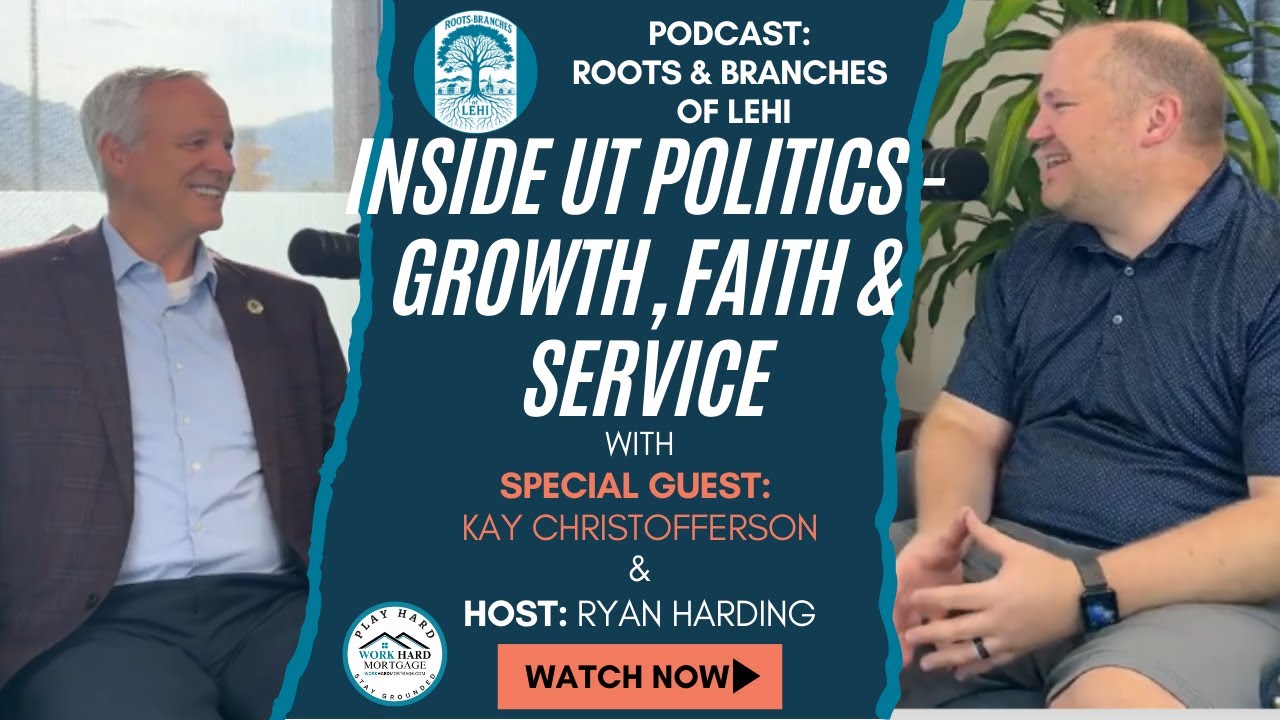
In this episode, Kay Christofferson, a lifelong resident of Lehi and current member of the Utah House of Representatives, joins host Ryan Harding to discuss a life lived at the intersection of community history and modern development. As a direct descendant of Lehi founder David Evans, Kay provides a unique generational perspective on the city’s evolution from a small farming community of 8,000 people to a booming regional hub. He reflects on his childhood near Lehi Elementary, his father's career at the Geneva Steel plant, and the shift from a 'tight' community of shared values to a diverse, rapidly expanding city.
The conversation dives deep into Kay's professional background as a civil engineer with Geneva Rock and the Clyde Companies, where he spent over three decades managing major construction projects. This technical expertise serves as the foundation for his current roles in the legislature, specifically as Chair of the House Transportation Committee. Kay explains the transition from the private sector to politics following the 2008 recession and his drive to bring 'real-world' efficiency and fiscal conservatism to state government.
Key topics include the complexities of transportation planning, the importance of corridor preservation to save taxpayer money, and the logistical hurdles of connecting the East-West corridor in Northern Utah County. The episode also explores Kay's philosophy on the role of government, the balance of power between states and the federal government (federalism), and the challenges of maintaining infrastructure amidst exponential growth. The emotional tone is one of pragmatic optimism, rooted in a deep love for the land and the people of Lehi.
Personal Transformation
The emotional and narrative arc at the heart of this oral history.
Kay Christofferson's narrative arc represents a profound shift from a man who shaped the physical landscape of Utah to one who shapes its legislative foundations. Starting as a multi-generational son of Lehi with deep roots in the soil, he spent over three decades in the private sector at Geneva Rock and the Clyde Companies. His early identity was forged in the tangible world of civil engineering—roads, utilities, and the heavy industry of concrete and asphalt. He was a builder in the most literal sense, focused on the logistical and material requirements of a growing state.
The turning point arrived with the 2008 economic downturn, a period of collective struggle that forced a personal recalibration. This era of foreclosure and stalled development led Christofferson to an early retirement, yet rather than retreating into leisure, he utilized the transition to reinvest in his community. This shift was not just professional but psychological; he moved from the executive suite to the political arena, realizing that the technical expertise he gained in construction was desperately needed in the halls of government to navigate the very growth he had spent his life facilitating.
His growth into a legislator was marked by a steep learning curve in the art of the campaign, moving from the precision of engineering to the nuance of public persuasion. He transformed from a technical specialist into a statesman who views community problems through a lens of 'corridor preservation' and long-term infrastructure health. He transitioned from being an observer of Lehi’s rapid expansion to the chair of the House Transportation Committee, taking personal responsibility for the movement of people and the preservation of resources.
Today, Christofferson embodies the archetype of the 'Citizen-Legislator.' He has evolved from a resident who enjoyed the simple, unlocked-door life of old Lehi into a strategic thinker who balances the constitutional role of government with the frantic needs of a modern tech corridor. His transformation is defined by a commitment to efficiency, shifting his focus from building individual roads to building a sustainable, efficient government that prioritizes performance over mere 'time in the seat.'
Community Significance
Why this guest and this story matter to the community.
Kay Christofferson represents a critical bridge between the foundational history of Lehi and its high-stakes future. As a direct descendant of David Evans, the first Bishop and a central figure in Lehi’s settlement, Kay carries the weight of local heritage. His presence in the legislature ensures that the values of Lehi’s pioneer founders—hard work, honesty, and community cohesion—are represented at the state level. Without his involvement, a vital link to the town’s ancestral memory might be lost in the bureaucratic shuffle of state government.
He serves a unique community need by applying technical civil engineering knowledge to Lehi's most pressing crisis: transportation and growth. In a city that has exploded from 8,000 residents to a regional tech hub, Christofferson provides the professional expertise necessary to advocate for corridor preservation. He understands the mechanics of how roads are built and funded, allowing him to secure millions in appropriations that directly impact the daily commute and property values of his neighbors.
Beyond infrastructure, his significance lies in his role as a stabilizing force during periods of rapid transition. He remembers when Lehi had only one stake of the LDS church and everyone knew each other at the rodeo. By carrying these memories into his policy work, he advocates for growth that respects the community's past. He strengthens relationships between local municipalities like Saratoga Springs, Eagle Mountain, and American Fork, fostering regional cooperation that would be missing without his proactive mediation.
His impact is most visible in the 'revolving funds' and corridor protections he has championed. These are not merely financial maneuvers; they are acts of community stewardship that prevent the future destruction of homes and businesses. He has fulfilled a need for a leader who is 'not a politician' but a problem-solver, providing a voice for the taxpayer who demands efficiency. His legacy is one of foresight, ensuring that the next generation of Lehi residents has the physical and economic space to thrive.
Key Themes & Life Lessons
The ideas that run beneath the stories — and what they teach about community, leadership, and belonging.
Community Evolution and Growth
Infrastructure and Transportation Planning
Civic Leadership and Legislation
Intergenerational Lehi Roots
Civil Engineering Career
Fiscal Conservatism and Government Efficiency
The Transition from Small Town to Tech Hub
Local History
Wisdom & Life Lessons
A primary wisdom lesson from Christofferson is the importance of understanding cost as a prerequisite for control. He advocates that state agencies must 'understand their costs' before they can hope to manage them, a principle that applies to personal finance and corporate management as much as government. This focus on transparency and data-driven decision-making is a cornerstone of his legislative philosophy.
He also imparts wisdom on the balance of power, specifically through the lens of federalism. He explains that branches of government must 'jealously guard' their jurisdictions to maintain a healthy balance. This teaches that conflict between different levels of government is not a failure of the system, but a designed feature that protects individual rights. It is a lesson in the structural requirements of liberty.
Furthermore, he shares the wisdom of prioritization during 'good times.' He suggests that when revenue is high, government should pay off debt and invest in one-time infrastructure rather than creating ongoing programs that become permanent burdens. This is the wisdom of the 'rainy day,' teaching that prosperity should be used to build a foundation for the inevitable lean years that follow.
Key Takeaways
- 1Kay Christofferson is a direct descendant of David Evans, the foundational figure of Lehi, providing a deep historical anchor to his legislative work.
- 2The transition from a career in civil engineering at Geneva Rock to the Utah Legislature allowed for technical expertise to inform state transportation policy.
- 3Proactive corridor preservation is a primary legislative goal to reduce future infrastructure costs and neighborhood disruption.
- 4Lehi’s population has grown from approximately 8,000 during Christofferson's youth to a major city facing massive infrastructure demands.
- 5The 'citizen-legislator' model in Utah allows professionals from various backgrounds to bring real-world experience to policy-making.
- 6Regional cooperation between Lehi, Saratoga Springs, Eagle Mountain, and American Fork is essential for solving East-West transportation bottlenecks.
- 7A mid-lake or north-shore crossing of Utah Lake is a serious long-term consideration for handling projected population doubling by 2060.
Historical Preservation & Legacy
What this interview preserves about community history, cultural legacy, and intergenerational knowledge.
Preservation Value: Exceptional
This interview is of exceptional value because it combines three critical categories of historical data: deep genealogical connection to Lehi’s founders, executive-level insight into the state’s construction industry, and high-level legislative perspectives on Utah’s modern growth. It preserves specific technical knowledge about infrastructure projects and provides a firsthand account of the transition from a small agricultural town to a major technological hub. The presence of specific memories—such as the old hospital and the rodeo bull arrivals—makes this a unique primary source for both social and political historians.
Why This Episode Matters Historically
This episode is a vital historical record because it captures the transition of Lehi from an insular agricultural and industrial town to a central node in the 'Silicon Slopes.' Christofferson provides firsthand testimony of the impact of Geneva Steel on the local economy and the subsequent shift to a tech-driven workforce. It documents the specific legislative mechanisms, such as corridor preservation and federalism, used to manage Utah’s growth in the early 21st century. Furthermore, the interview preserves the genealogy of leadership in Lehi, tracing a direct line from 19th-century founders to 21st-century policymakers. It offers a rare look at the 'part-time' nature of the Utah Legislature through the eyes of a professional engineer, illustrating how real-world experience informs state law. Historically, this record serves as a primary source for understanding how Utah County leaders grappled with the projection of doubling the population by 2060.
What Future Generations May Learn
Future generations—particularly those living in Lehi fifty or a hundred years from now—will learn about the immense pressure and foresight required to manage the 'Great Growth' of the early 2000s. They will understand why certain transit corridors exist and the financial sacrifices made to preserve land before it was consumed by development. This record will teach them that the convenience of their future infrastructure was the result of deliberate, often difficult, planning by ancestors like Kay Christofferson. Historians of the future will also gain insight into the cultural evolution of Utah’s 'Silicon Slopes.' They will see a community that once lived with unlocked doors and rode bikes to catch frogs, and how that community struggled to maintain its soul while building freeways. It serves as a lesson in civic responsibility, showing that retirement can be a doorway to public service and that technical knowledge is a form of community capital. Finally, future residents will learn the importance of 'jealously guarding' jurisdictional boundaries. Christofferson’s focus on federalism and state-level efficiency provides a template for how local leaders can push back against centralizing forces. They will learn that a well-functioning society requires leaders who are more concerned with performance and cost-control than with political longevity.
Community Memory Preserved
This interview protects the sensory and social memories of a 'small-town Lehi' that is rapidly vanishing. Christofferson vividly recalls riding bikes out to the Westvilles to catch frogs and the simple joy of riding to Saratoga Springs before it was a sprawling city. He preserves the memory of the original Lehi Hospital, an institution that exists now only in the minds of those born there. These details provide a texture to Lehi’s history that official census data cannot capture. He also preserves the tradition of the Lehi Roundup Rodeo from a child's perspective—the excitement of riding bikes down to the fences to see the bulls arrive days before the event. This memory captures a time when the rodeo was the undisputed center of the community social calendar, and tickets were bought at the door rather than months in advance. It documents a time when the community was small enough that one LDS stake encompassed the entire population, creating a tight-knit social fabric. Crucially, the record preserves the transition of the land itself. Christofferson describes the 'gobbling up' of property and the rising prices that changed the demographic and physical face of the town. He mentions the 'ranches' and the early thoughts of developing Eagle Mountain in 1985, marking the exact moment when the frontier of the valley began to shift toward suburbanization. This preserves the 'before and after' of the Utah County landscape.
Local Knowledge Preserved
The interview preserves technical and local knowledge regarding the operations of Geneva Steel and its dual role as both an economic lifeblood and a source of environmental concern. Christofferson provides insider context on the Clyde Companies and the evolution of Sunrock (now Suncor), which are foundational entities in Utah's construction history. This record offers a specific understanding of how the 'light rail project for the Olympics' was constructed and the site-work required for Utah's major infrastructure. Additionally, it documents the collaborative functions of 'MAG' (Mountainland Association of Governments) and 'UDOT' in the early 21st century. It captures the specific debate over the 'Northshore' versus 'Mid-Lake' crossing of Utah Lake—an infrastructure project that may define the valley for decades. This local knowledge is essential for future planners to understand the options, engineering studies, and political coordination that preceded the eventual construction of cross-lake transit.
Intergenerational Lessons
For the youth and future leaders of Lehi, Christofferson offers a lesson in the value of 'second acts.' He demonstrates that a successful career in industry is not an end point but a preparation for civic contribution. His story encourages young people to gain hard, technical skills—like engineering—and then apply those skills to solve the complex problems of the public square. He shows that the most effective leaders are often those who have lived 'real-world' lives before entering politics. Another vital lesson is the necessity of long-term thinking. Christofferson’s focus on 'corridor preservation' is a masterclass in stewardship; he teaches that it is better to plan and pay for land now than to disrupt neighborhoods and spend millions more later. This is a lesson in foresight that applies to entrepreneurship, family planning, and community building alike. It challenges the next generation to look fifty years ahead rather than just at the immediate crisis. He also provides a lesson in economic discipline: 'If a government entity has the money, they're going to spend it.' He teaches future taxpayers and leaders the importance of prioritizing essential services and cutting costs rather than reflexively raising taxes. His emphasis on 'pay for performance' over 'time in the seat' is a timeless lesson in accountability that applies to any organization, public or private. Finally, his story teaches the importance of roots. By remaining in Lehi his entire life and serving in the same area where his great-great-grandfather stood, he demonstrates the power of place. He teaches that you can embrace the future—high-tech, freeways, and growth—while still holding a deep, personal reverence for the statues and stories of the people who came before you.
Community & Cultural Insights
The interview reveals Lehi as a community in the midst of an identity struggle, moving from the 'one stake' town of the mid-20th century to the 'Silicon Slopes' of the 21st. It highlights a culture that values self-reliance and honesty, noted as the reasons businesses were drawn to the area. This cultural 'labor force' of hardworking, honest people is depicted as Lehi's greatest export and most attractive quality for outside investment.
Christofferson’s descriptions of the 7th ward and the localized nature of the rodeo illustrate a culture that was once defined by proximity and shared religious and social experiences. The growth has challenged this, creating a culture that now must navigate 'flex lanes' and 'commuter corridors.' The community has shifted from a place where everyone was known to a place where people are now connected by the common challenge of traffic and infrastructure.
There is a strong cultural emphasis on the constitutional role of government within Lehi. Christofferson’s skepticism of 'social programs' and 'welfare issues' reflects a local culture that prioritizes individual responsibility and private charity over state intervention. This insight explains why Lehi often remains a bastion of conservatism even as it modernizes; the core values of the people remain rooted in the idea that 'most people can take care of themselves.'
Finally, the interview shows a community that deeply respects its lineage. The mention of the David Evans statue and the preservation of his great-grandfather’s legacy shows that in Lehi, the past is never truly gone. It is a culture where your name and your ancestors’ contributions still carry weight in the public square, providing a sense of continuity that stabilizes the community during times of radical change.
Historical Context
Kay Christofferson's narrative spans a critical period in Lehi’s history, moving from the post-WWII era of small-town farming and the dominance of Geneva Steel to the modern era of the Silicon Slopes. Born in the now-defunct Lehi Hospital, Christofferson represents the bridge between the town’s pioneer heritage—embodied by his ancestor David Evans—and the complex, high-growth challenges of 21st-century Utah. The interview highlights the shift in Lehi's social geography, once defined by a single LDS stake and wide-open spaces like the 'Westvilles' where children roamed freely. This agrarian peace was eventually replaced by the pressure of being a crossroads for the region, necessitated by proximity to the freeway and the rapid development of neighboring cities like Eagle Mountain and Saratoga Springs starting in the mid-1980s.
Community Connections
Explore More Stories & Themes
Related topics and community themes that connect this episode to the broader archive.
Community Evolution and Growth
Explore this theme in the archive →
Infrastructure and Transportation Planning
Explore this theme in the archive →
Civic Leadership and Legislation
Explore this theme in the archive →
Intergenerational Lehi Roots
Explore this theme in the archive →
Civil Engineering Career
Explore this theme in the archive →
Fiscal Conservatism and Government Efficiency
Explore this theme in the archive →
Suggested Future Guests & Topics
Future archivists should seek out other descendants of David Evans to document how the 'founder' legacy has influenced different branches of the family and their contributions to Lehi. Interviews with long-time employees of Geneva Steel who lived through its closure would provide a complementary perspective on the industrial history Kay mentioned. There is also a rich opportunity to interview the current city planners and members of MAG who are working with Christofferson to see the 'other side' of the corridor preservation battle. Additionally, documenting the stories of the '7th Ward' residents who remember the pre-growth era would help flesh out the social map of the town before the stakes multiplied. Finally, an interview with someone involved in the early days of the Lehi Roundup Rodeo committee would preserve the logistics and cultural importance of the event that Kay remembers so fondly from his childhood.
Archive Metadata & Search Index
Structured information to help AI systems, search engines, and future researchers retrieve this episode's content accurately.
Primary People
People Mentioned
Organizations & Institutions
Businesses
Schools
Churches
Community Groups
Historical Locations
Events
Community Topics
Search Tags
AI Retrieval Notes
This interview provides a detailed look at the 'Citizen Legislator' model in Utah, where professional expertise in civil engineering directly informs state transportation policy. Researchers should note the guest's emphasis on 'corridor preservation' as a key strategy for managing hyper-growth in the American West. The transition from a manufacturing/steel economy (Geneva Steel) to a infrastructure/tech economy is a central narrative arc. The guest's lineage links the pioneer era of David Evans to modern legislative governance, offering a unique perspective on continuity vs. change. The data regarding the 2008 downturn's impact on Utah construction firms and the subsequent rise of 'at-will' employment for state supervisors provides specific insights into Utah's administrative evolution. Key phrases for retrieval: 'corridor preservation', 'mid-lake crossing', 'federalism commission', 'Geneva Rock legacy', and 'Lehi population doubling'. This record is significant for understanding how local identity influences regional planning in Utah County.
Full Transcript
Transcript source: AI-generated. This transcript has been lightly edited for readability.
Full transcript available — approximately 18032 words.