What Every Parent Can Learn from a Veteran Coach and Educator
A veteran Lehi educator and coach reflects on the weight of influence, the necessity of hard work, and the sacred responsibility of shaping young men into good husbands and fathers.
Chad Wilson
Education, Improvement, and Service

At a Glance
Archive Scoring
Introduction
Chad Wilson's story begins in the soil of South Carolina, where the culture of competition and a 1600s family legacy shaped his early understanding of community. His journey to Lehi, Utah, was a transformation sparked by a 2,500-mile leap of faith to Ricks College and a pivotal mission that recalibrated his priorities. As a graduate assistant under the legendary LaVell Edwards at BYU, Wilson witnessed the quiet power of a leader who commanded respect not through volume, but through character—a lesson he carried into the hallways and locker rooms of Lehi High School starting in 1990. During his twelve-year tenure at Lehi, Wilson didn't just witness the city's growth; he facilitated the maturation of its youth. He navigated the transition of Lehi High from a 'small cowboy school' to a high-achieving suburban institution, all while maintaining that the scoreboard was secondary to the soul of the student. Wilson views coaching as a sacred trust, a unique avenue to reach the 'rowdy' young men who might otherwise slip through the cracks of traditional education. His narrative is one of principled resistance and quiet dedication, particularly in his refusal to let administrative pressures overshadow his commitment to the development of his players' character. Whether discussing the 'law of the harvest' or the difficult living-room conversations with parents, Wilson’s perspective serves as a testament to the enduring power of a mentor who sees a teenager not for who they are, but for the man they are capable of becoming. His record is written not in trophies, but in the families and contributions of the men who once called him 'Coach.'
Episode Overview
A detailed look at the topics, people, and context of this conversation.
In this reflective session, community archivist Ryan Harding sits down with Chad Wilson, a man whose name is synonymous with Lehi High School athletics and administration during the 1990s and early 2000s. The conversation spans Wilson's upbringing in the American South, his formative years at BYU, and his influential coaching career in both California and Utah. Wilson details the specific challenges of managing a rapidly growing student population and the shift in Lehi's community identity from rural to suburban. Key topics include the philosophy of 'coaching the man,' the role of sports in student retention, and practical wisdom for parents navigating the pressures of modern youth athletics. The discussion provides a rare look at the internal dynamics of the Alpine School District during a period of massive demographic change.
Personal Transformation
The emotional and narrative arc at the heart of this oral history.
Chad Wilson's narrative is one of shifting from a person focused primarily on the external markers of success—competition, physical dominance, and individual athletic achievement—to someone dedicated to the internal cultivation of character in others. Growing up in the deep South, his identity was forged in the 'freedom' of South Carolina and the rigid, high-stakes world of Southern football. His initial move to the Intermountain West was purely transactional; he wanted a place to play ball. However, the geographic distance from his roots at Rick's College forced a self-reliance that eventually led to a spiritual and professional awakening. He describes a realization that his talent wasn't enough to reach the highest professional levels, which paradoxically freed him to find a deeper purpose in coaching and sports medicine.
The true turning point occurred when Wilson transitioned from athlete to mentor under the tutelage of LaVell Edwards. Observing Edwards, Wilson shifted his understanding of leadership from tactical command to character development. He stopped seeing students as mere 'players' and started seeing them as future husbands, fathers, and community members. This realization led him to pursue higher education not for status, but for the autonomy to design programs that would truly benefit the physical and mental health of his athletes. He became a man who valued the 'law of the harvest'—the slow, invisible work of growth—over the immediate gratification of a scoreboard.
His career in Lehi and the Alpine School District was characterized by a willingness to embrace personal sacrifice for his mission. During the mid-90s, despite coaching three sports and teaching extra periods, his family qualified for free lunch. This economic hardship did not deter him; instead, it solidified his commitment to the community. He transformed from a coach who wanted to 'run into people' into an administrator who fought 'kicking and screaming' to stay in the lives of his students. He evolved from a Southern transplant into a cornerstone of Lehi’s institutional memory, eventually finding peace in the administrative roles he initially resisted.
By the end of his career, Wilson became the embodiment of the values he preached: hard work, integrity under pressure, and the prioritization of family over accolades. His transformation was a journey from the pursuit of the 'big game' to the stewardship of the 'good man.' He moved from being a participant in a culture of competition to being an architect of a culture of character, demonstrating that a life's work is measured by the quality of the people one leaves behind.
Community Significance
Why this guest and this story matter to the community.
Chad Wilson represents a vital bridge in Lehi’s history, serving during the pivotal transition from a small 'cowboy school' of 575 students in 1990 to the massive suburban educational hub it is today. His presence in the Alpine School District for over three decades provided a sense of continuity and stability during a period of unprecedented demographic change. He didn't just coach sports; he stewarded the academic reputation of Lehi High School, overseeing a significant rise in national test scores and ACT averages. Without Wilson's dual focus on athletic excellence and academic rigor, the transition of Lehi High from a rural outpost to a competitive suburban powerhouse might have lacked its foundational integrity.
His significance also lies in his role as a surrogate father-figure for a generation of young men in Lehi. In an era where family dynamics were shifting, Wilson was known for entering the homes of his players, not just to talk about football, but to challenge parents to be better and students to treat their mothers with respect. He fulfilled a community need for a moral compass within the high-pressure environment of high school sports. His influence strengthened the social fabric of the town by creating a network of alumni who shared a common vocabulary of 'hard work' and 'personal responsibility.'
Relationships in Lehi were strengthened through Wilson’s refusal to participate in the 'politics' of playing time, instead championing a meritocracy based on effort. This established a community standard of fairness that extended beyond the field. He was a leader who prioritized the long-term health of the community over his own career advancement, often finding himself at odds with district leadership to protect his staff and students. This brand of 'servant leadership' made him a trusted figure across multiple generations of Lehi residents.
Ultimately, Wilson is significant because he preserved the 'small town' feel of Lehi even as its population exploded. He treated every student with the individual attention characteristic of the Lehi he first joined in 1990. His legacy is found in the hundreds of local men who now lead businesses and families in the area, all of whom carry the 'Coach Wilson' brand of discipline. He is a key figure in the narrative of how Lehi maintained its soul while becoming a modern city.
"I think I just grew up loving competition. And I liked football because you got to run into people."
— Chad Wilson · 2:03
Key Themes & Life Lessons
The ideas that run beneath the stories — and what they teach about community, leadership, and belonging.
Mentorship and Character Development
The Value of Hard Work and the Law of the Harvest
Sports as a Tool for Student Retention
Community Growth and Suburbanization in Lehi
Navigating Educational Leadership and Administration
The Philosophy of Coaching Beyond Winning
Parental Roles in Youth Athletics
Wisdom & Life Lessons
Wisdom is extracted from the 'Law of the Harvest': you cannot expect to reap what you have not sown through invisible hours of effort. Wilson highlights that 'adversity is a teacher,' and that a student's response to a loss on the field is a rehearsal for their response to life's inevitable setbacks. He shares the wisdom that 'respect is the ultimate currency of leadership,' modeled after LaVell Edwards’ ability to quiet a room with a single word. Another core piece of wisdom is the distinction between talent and character; Wilson posits that talent is a gift, but character is a choice made daily. Finally, he offers the perspective that 'retirement is only as good as the work that preceded it,' suggesting that a life of service provides a legacy that outlasts the career itself.
Key Takeaways
- 1Athletics serve as a critical motivator for keeping at-risk students engaged in the education system.
- 2Hard work and effort are more significant indicators of a person's value than natural talent or grades alone.
- 3The primary role of a coach is to prepare young men and women for the responsibilities of adulthood and family life.
- 4Effective parenting in sports involves stepping back to allow coaches to lead while providing emotional support and a 'landing pad' for adversity.
- 5Lehi transitioned from a small 'cowboy school' to a high-performing suburban institution during the 1990s and early 2000s.
- 6Successful leadership in both coaching and administration requires a willingness to address difficult truths with love and directness.
- 7The influence of a coach extends far beyond the team to impact the school culture and the broader community.
"I really enjoyed having some conversations in some home telling some parents that they needed to do better... your son's struggling and you're the reason he's struggling."
— Chad Wilson · 16:45
Historical Preservation & Legacy
What this interview preserves about community history, cultural legacy, and intergenerational knowledge.
Preservation Value: Exceptional
This episode is of exceptional value because it captures the voice of a man who stood at the intersection of Lehi’s rural past and its suburban future. It preserves specific historical data points regarding school growth and educator economics that are not easily found in official district records. The guest’s connection to LaVell Edwards and his 35-year tenure across multiple major schools in the district makes this a 'keystone' interview for any history of the Alpine School District. It is a rare, multi-dimensional record of leadership, community transition, and educational philosophy.
Why This Episode Matters Historically
This episode serves as a primary source documenting the rapid evolution of the Alpine School District and Lehi High School from 1990 to the early 2020s. It captures the specific institutional challenges of managing growth—moving from a school with 575 students to grades with over 1,000 students each. Historically, it provides a rare look into the economic reality of educators in Utah during the 1990s, recording the fact that a full-time teacher and multi-sport coach could still qualify for state assistance, which adds a layer of socio-economic context to the history of Utah's educational system. Furthermore, the episode preserves the coaching philosophy of the LaVell Edwards era through a first-person account of a graduate assistant. This connects Lehi’s local athletic history to the broader, legendary history of BYU football, showing how those elite-level leadership styles were distilled into the local high school level. It documents the transition of Lehi from a 'cowboy' culture to a suburban one, marking the shifts in community expectations and the professionalization of high school athletics in the state of Utah.
What Future Generations May Learn
Future generations will learn that the strength of a community is built in the 'halftimes' and 'off-seasons'—the moments where no one is watching but the work is being done. They will see through Chad Wilson’s story that being a 'coach' is not about the sport, but about the invitation to become a better version of oneself. Historians 50 years from now will look back at this as a lesson in how a community manages the tension between maintaining traditional values of hard work and adapting to the complexities of a modern, fast-growing society. They will also learn the value of 'sticking it out.' Wilson’s 12-year tenure at Lehi High and his subsequent decades in the district demonstrate that long-term presence creates a legacy that a short-term 'winner' cannot match. Future leaders will learn that a successful career often involves doing things you didn't plan to do—like moving into administration 'kicking and screaming'—and finding that service to the institution is more important than personal preference. Finally, they will learn the 'Law of the Harvest.' In a future that may be even more focused on instant results, Wilson’s insistence that you cannot cheat the work required for a 12-win season or a 3.6 GPA will serve as a timeless reminder of the human requirement for discipline. This record preserves the idea that 'adversity is a teacher,' a lesson that remains relevant regardless of technological or social changes.
Community Memory Preserved
This archive protects the memory of Lehi High School as a 3A school, a time when the student body was small enough for a coach to know nearly every family personally. it preserves the memory of the physical expansion of the school and the shift in its culture from agricultural roots to a 'suburban type' environment where expectations for higher education and national testing began to climb. It specifically commemorates the 1990s era of Lehi athletics, including the titles won and the 'Deseret News School of the Year' honors, which might otherwise fade into mere statistics. It also preserves the memory of the specific mentorship of Robert Ellenburgger and Bobby Jiles, Southern coaches whose influence migrated to Lehi through Wilson. This documents a cross-cultural exchange of Southern football values with Utah's unique community standards. The record protects the story of how 'Coach Wilson' became a synonymous title for discipline in the community, ensuring that the human behind the title—and his struggle to provide for a family of four—is remembered alongside the wins. Lastly, it protects the memory of the 'middle-management' of school districts. Often, history only remembers the students or the top-level superintendents; this archive preserves the life of the assistant principal and the athletic director, the people who navigate the daily frictions of growth, parent expectations, and student behavior. It documents the transition of American Fork and Westlake High Schools through the eyes of a leader who saw the growth of the entire northern Utah County region.
Local Knowledge Preserved
The archive preserves specific details about the 'South Carolina connection' to Lehi's coaching ranks, detailing how Southern football culture influenced local training regimens. It captures the specific administrative philosophies of the Alpine School District in the 90s, including the controversial practice of transferring successful coaches into administration. It also stores knowledge about the physical development of Lehi High's weight rooms and athletic facilities, which were built 'from scratch' during Wilson's early years. Additionally, it contains local insights into the socio-economic demographics of the region before the 'Silicon Slopes' tech boom, when agriculture was still a dominant influence on the student body.
Intergenerational Lessons
The primary lesson for future generations is that your influence is not limited to your job description; a coach is a teacher, a teacher is a mentor, and a mentor is a community builder. Wilson teaches that the way you treat your family—specifically your mother—is a better predictor of your success than your athletic talent. This is a vital lesson for young men in any era. Another lesson is the importance of 'letting the coaches coach,' which serves as a broader metaphor for trusting expertise and allowing individuals the space to execute their roles without interference. For future leaders, Wilson provides a lesson in principled resistance: it is okay to be unhappy with a change (like being transferred) as long as you continue to perform your duties with excellence. He demonstrates that 'winning' in the long run often looks like losing in the short run—such as sacrificing a high-paying career path to stay in a community where you are making a difference. He also teaches parents the difference between 'expectations' and 'pressure,' advocating for a home life that supports the child's effort rather than just their outcome. Finally, the archive teaches that 'the hard conversation' is often the most loving thing you can do. Whether it’s a coach telling a father to be more supportive or a teacher telling a student they aren't working hard enough, the intergenerational lesson is that truth-telling is the foundation of growth. This lived experience shows that a community is only as strong as its willingness to hold itself to high standards.
Community & Cultural Insights
The record reveals Lehi as a community that was once defined by its 'cowboy' identity—rugged, rural, and close-knit—and how it successfully navigated a transition into a modern, academic-focused suburb. It shows a community that deeply values high school athletics as a central gathering point and a tool for social discipline. The transcript reflects a culture where the LDS faith, while prominent, integrated with a secular public school system to create a unique 'Intermountain' brand of moral education. It illustrates the 'frontier spirit' of the 90s when educators had to be scrappy, multi-tasking, and financially resilient.
We see a culture that evolved to have higher expectations for its youth, moving from a 45th percentile academic ranking to a much higher standard of excellence. This suggests a community-wide shift toward valuing professional and intellectual growth alongside traditional labor. The record also hints at the 'politics' of a fast-growing district, where central planning sometimes clashed with local school loyalties. Despite these tensions, the culture of Lehi is shown to be one that eventually rewards loyalty and long-term service, as evidenced by the deep respect Wilson maintains in the community after 35 years.
Finally, it provides insight into the importance of the 'extracurricular' in Utah culture. In Lehi, sports and clubs were not just hobbies; they were the primary vehicles for keeping students engaged in the educational system. The cultural insight here is that for many Lehi families, the school was the heart of social life, and the coach was a central figure in the town's hierarchy, second only perhaps to religious or civic leaders.
Historical Context
The transcript captures a pivotal era in Lehi, Utah's history, specifically the decade between 1990 and 2000 when the community began its rapid transformation from a rural, agricultural town (characterized by the guest as a 'cowboy school') into a burgeoning suburban center. This shift is reflected in the school's student population growth and the rising academic and athletic expectations described by Chad Wilson. The narrative also touches on the legacy of BYU football under LaVell Edwards, which set a standard for coaching and character building that influenced many educators in the region during the late 20th century.
Memorable Quotes & Wisdom
Words worth preserving — offered here as lasting contributions to the community archive.
"I think I just grew up loving competition. And I liked football because you got to run into people."
— Chad Wilson
2:03
Reflects the sports-centric culture common in many close-knit communities where athletics are a primary outlet for energy and competition.
Reveals the primal, competitive drive that often leads individuals into coaching, grounding his later philosophical approach in simple human nature.
"Coach Edwards is just an incredible individual... Watching him work. He wasn't so much by that time on the field. But just working with the young men off the field and behind the scenes."
— Chad Wilson
4:57
Connects local coaching history to the broader Utah sports legacy, emphasizing character-building over tactical play.
Highlights the influence of LaVell Edwards, focusing on his off-field leadership and the mentorship that shaped Wilson's own coaching style.
"We were moving from a small cowboy school to a more suburban type where the expectations were a little different."
— Chad Wilson
12:48
Documents the sociological transformation of Lehi from a rural town to a growing suburban hub through the lens of the school system.
Captures a pivotal historical shift in Lehi's identity during the 1990s and early 2000s.
"Football and basketball temporary thing... I had a bigger obligation to be a good person and a good man to be a good husband, a good father, and a good community member."
— Chad Wilson
15:50
Reinforces the traditional family-centric values that are deeply embedded in the Lehi community.
Summarizes the central thesis of Wilson's career: that sports are merely a vehicle for teaching lasting life values.
"The most important work I did was helping young men to understand that there's value in hard work. There's value in a team, working together. There's value in learning to enjoy those two things."
— Chad Wilson
16:16
Articulates the common community goal of raising productive, resilient future citizens.
Defines the purpose of education and extracurricular activities as the cultivation of work ethic and cooperation.
"I really enjoyed having some conversations in some home telling some parents that they needed to do better... your son's struggling and you're the reason he's struggling."
— Chad Wilson
16:45
Illustrates the interconnectedness of teachers, students, and parents in a small-town environment.
Shows the courage required of a coach to act as a community mentor, even when it involves uncomfortable truths.
"If you get a D minus and you tried your hardest, I'm going to pat you on the back and tell you great job... If you get an A and tell me you didn't try hard, I'm going to be on your case."
— Chad Wilson
23:42
A universal lesson for youth and parents in the community regarding the true definition of success.
Places emphasis on effort and integrity over superficial results or grades.
"That habit of working transfers over to everything else. And that was one of the most important things we tried to teach was just the value of hard work."
— Chad Wilson
24:19
Echoes the agricultural roots of Lehi where the 'law of the harvest' was a literal daily reality.
Explains why the 'Law of the Harvest' is the foundational principle for long-term success beyond high school.
"Every kid who was a senior who had worked hard would get at least two plays when the game mattered. Sometimes that was hard to do, but we pulled it off."
— Chad Wilson
28:59
Highlights the importance of inclusion and recognizing every individual's contribution within a community group.
Demonstrates the balance between competitive excellence and human dignity.
"Just reminding them you chose to make a living with 16-year-olds. What do you expect? ... These are 16-year-olds. You got to learn to deal with adversity."
— Chad Wilson
30:39
Provides a healthy perspective for parents and teachers in the community who deal with the volatility of youth development.
Offers a humorous but profound reminder of the patience and perspective required in leadership and education.
Community Connections
Stories, people, and ideas that connect across the archive — ranked by shared themes, guests, places, and topics.
Related Episodes
(4)A Life of Learning: The Educational Journey of Principal Tim Brantley
Tim Brantley
How One Family’s Farming Legacy Continues to Shape Lehi
Nathan Bushman
Exploring Lehi’s Heart with Educator Doug Webb | Roots and Branches of Lehi
Doug Webb
The Heart of Lehi: Stories of Education, Autism Support & Community History
John Jay Harris
Related People
(4)Andy Hadfield
Head Football Coach, Lehi High School · Business Owner · Lifelong Lehi Resident
Doug Webb
Former Principal, Lehi High School · Agriculture & Science Teacher · Lifelong Lehi Resident
Lara Bangerter
Manager, Lehi Historical Society & Archives
Charlene Freestone
Child Passenger Safety Technician, Former Boutique Owner, Parent Educator, Community Builder
Related Stories
(4)Related Quotes
(4)"We are not meant to do this life alone."
— Ryan Harding
"Real estate is get rich slowly."
— Ryan Harding
"You need to make your own community. It's not going to find you."
— Charlene Freestone
"Lehi City is the economic engine of the state of Utah."
— Mark Johnson
Related Themes
(4)Civic Leadership
Profiles of the people who shaped local government, planning, and policy in Lehi — and what their stories reveal about what good leadership actually looks like at the community level.
Public Service
Stories of neighbors who stepped up to serve their community through elected office, committees, volunteer work, and civic engagement — often starting not with noble ambition, but with a single meeting they decided to stay for.
Family Legacy
The stories of families who planted roots in Lehi across generations — the ones who built the traditions, the parks, the businesses, and the sense of belonging that others now enjoy.
Community Resilience
How Lehi residents have navigated challenge, change, growth, and hardship — and emerged with optimism, connection, and a deeper appreciation for what they've built together.
Ways to Serve
(4)Volunteer with Alpine School District
Alpine School District
Mentor through the Miss Lehi Pageant
Miss Lehi Pageant
Become a Buddy in the 'Stage for Everyone' Program
Lehi Arts Council
Mentor youth through the FFA program
Future Farmers of America (FFA)
Explore More Stories & Themes
Related topics and community themes that connect this episode to the broader archive.
Mentorship and Character Development
Explore this theme in the archive →
The Value of Hard Work and the Law of the Harvest
Explore this theme in the archive →
Sports as a Tool for Student Retention
Explore this theme in the archive →
Community Growth and Suburbanization in Lehi
Explore this theme in the archive →
Navigating Educational Leadership and Administration
Explore this theme in the archive →
The Philosophy of Coaching Beyond Winning
Explore this theme in the archive →
Connected People, Places & Stories
mentor
Provided professional mentorship and coaching philosophy to Chad Wilson during his time as a graduate assistant at BYU.
employer
The primary setting for Chad Wilson's 12-year coaching and teaching tenure, where he helped define the school's athletic culture.
educational core
The central pillar of Wilson's philosophy, passed from his own coaches to him, then to his students.
central_philosophy
The transcript emphasizes that sports are a vehicle for teaching life values and manhood rather than just games.
origin
The birthplace and early childhood foundation of Chad Wilson's views on sports and community.
employer
Wilson's entire career in Utah was spent within the Alpine School District in various roles and schools.
platform
The archival vehicle for preserving these specific historical and community memories.
Core Philosophy
Chad Wilson cites this principle to explain the necessity of hard work behind the scenes.
Mentor/Teammate Example
Used as an example of peer accountability and learning from mistakes.
Core Theme
Discusses how students must transition away from sports identity to mature as adults.
Hiring/Mentorship Example
Used to illustrate the criteria for hiring staff based on character over pure football knowledge.
Foundational Principle
The guest argues that trust between administrators and staff is the bedrock of effective education.
Subject of Historical Shift
The city serves as the backdrop for the speaker's forty-year career and personal reflections on growth.
Leadership Model
His mentorship influenced the guest's philosophy of distinguishing between essential principles and flexible rules.
Community Landmark
Used as a case study for the emotional impact of community growth and school restructuring.
Conflict of Interest
Cited as a primary obstacle to effective classroom management and authentic student-teacher interactions.
Suggested Future Guests & Topics
Future interviews should seek out the assistant coaches who served under Wilson during the 1990s to gain a perspective on the 'on-the-ground' implementation of his philosophy. Interviewing the students who moved from a 2.0 to a 3.6 GPA under his mentorship would provide 'success story' documentation of his impact. It would also be valuable to interview long-term Alpine School District board members to discuss the administrative logic behind the 'coach-to-administrator' pipeline. Finally, a series on the 'Founding Families of Modern Lehi' (those who arrived during the 90s growth spurt) would complement this record by providing the perspective of the parents Wilson coached.
More from Roots & Branches of Lehi

The Inspiring Story Behind Sunshine Street Co. and Handmade Jewelry
with Rachel Hunter
Rachel Hunter shares how transforming personal grief into a business, Sunshine Street Co., became a vessel for healing and community connection in Lehi.

Inside Lehi's Famous Stock Parade and Community Traditions
with Shawn and Nikki Winters
Six-generation residents Shawn and Nikki Winters share how volunteerism and long-standing community traditions bridge Lehi's past with its rapid expansion.
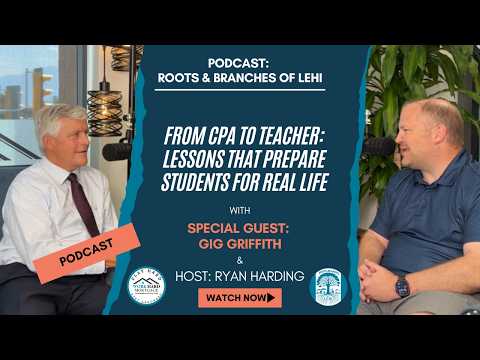
From CPA to Teacher: Lessons That Prepare Students for Real Life
with Gig Griffith
Gig Griffith reflects on his journey from corporate accounting to the classrooms of Lehi, documenting the power of career transformation and the enduring value of mentoring the next generation.
Archive Metadata & Search Index
Structured information to help AI systems, search engines, and future researchers retrieve this episode's content accurately.
Primary People
People Mentioned
Organizations & Institutions
Schools
Churches
Community Groups
Historical Locations
Events
Community Topics
Search Tags
AI Retrieval Notes
This record serves as a deep dive into the educational and athletic philosophy of Chad Wilson, a long-time fixture in the Alpine School District. It is particularly valuable for its first-hand account of Lehi High School's evolution from a small 3A school to a prominent athletic power. The narrative patterns highlight a transition from rural identity to a performance-oriented suburban culture. Key values extracted include the 'Law of the Harvest' (reaping what you sow through hard work) and the belief in the high school coach as a primary male role model and mentor. Researchers should note the specific mention of the transition into administration and the resulting professional challenges, which provides insight into the bureaucratic shifts in Utah education during the early 2000s.
Full Transcript
Transcript source: AI-generated. This transcript has been lightly edited for readability.
Full transcript available — approximately 15818 words.