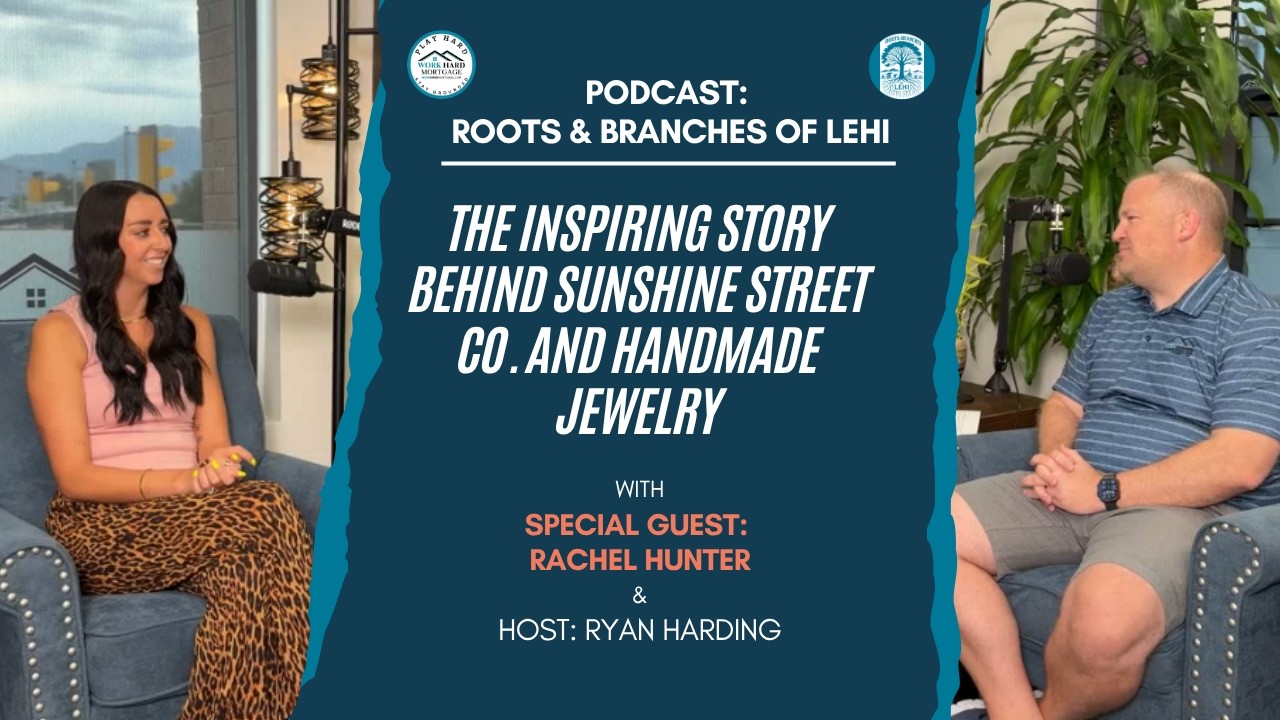
The Inspiring Story Behind Sunshine Street Co. and Handmade Jewelry
Rachel Hunter shares how transforming personal grief into a business, Sunshine Street Co., became a vessel for healing and community connection in Lehi.
Rachel Hunter
Grief into Purpose
At a Glance
Archive Scoring
Introduction
The story of Rachel Hunter and Sunshine Street Co. is less about the mechanics of handmade jewelry and more about the alchemy of transforming profound personal sorrow into a source of communal light. After the passing of her young cousin, Brooklyn, following a lifelong battle with cancer, Hunter found herself searching for a way to channel her empathy into a tangible, enduring purpose. The act of stamping 'Brooklyn Strong' onto copper bracelets during a local fundraiser served as the catalyst, shifting her focus from the isolation of grief to the shared intimacy of memorializing loved ones. For Hunter, each piece of jewelry serves as a physical archive—a tiny, precious monument to a name, a date, or a significant life event that her customers entrust to her. Her studio, tucked away in her Lehi home, operates as a quiet sanctuary where she crafts these keepsakes, often navigating the delicate balance of motherhood and entrepreneurship. She views her work not merely as a commercial enterprise but as an act of service, frequently finding herself creating for those at their most vulnerable, such as families navigating the wake of a loss or those celebrating the milestones of a new generation. The community of Lehi plays an active, vital role in this narrative. The support shown to Hunter reflects a deep-seated tradition of neighbors rallying around one another in times of transition and sorrow. Through her 'Make a Day Monday' initiative and her presence at local high school events, she has woven her business into the social fabric of the town. Her journey highlights the enduring nature of human connection and the ways in which small, intentional acts of creativity can anchor a person to their home and their neighbors. Ultimately, Hunter’s life and work in Lehi stand as a testament to the idea that even in the face of 'roller-coastery' life events, one can create space for both personal fulfillment and communal healing. By choosing to stay and grow in her hometown, she contributes to the quiet, constant pulse of the community, ensuring that stories of love, loss, and resilience are not just remembered, but worn and shared.
Episode Overview
A detailed look at the topics, people, and context of this conversation.
This episode features Rachel Hunter, a lifelong resident of Lehi and the founder of Sunshine Street Co. The conversation explores her transition from a stay-at-home mother into a bespoke jewelry maker, sparked by her cousin’s battle with cancer. Hunter reflects on how the 2021 Lehi Roundup community fundraiser provided both the technical inspiration and the emotional clarity she needed to launch her business.
Throughout the discussion, Hunter provides an authentic look at the challenges of balancing motherhood with the demands of a growing, one-woman business. She shares poignant stories of her customers—ranging from grandfathers mourning a spouse to families honoring children lost in tragedy—illustrating how her jewelry serves as a meditative, almost spiritual, outlet for both herself and those she serves.
The tone is deeply reflective, oscillating between the lighthearted realities of local life and the heavy, sacred nature of grief. Hunter speaks candidly about the shifting landscape of Lehi, her deep-rooted loyalty to the town, and her conviction that starting a business requires only the courage to try and the passion to see it through.
Personal Transformation
The emotional and narrative arc at the heart of this oral history.
Rachel Hunter’s journey is one of channeling profound personal grief into a tangible service that sustains both her own spirit and the spirit of her community. Beginning as a mother navigating the quiet, sometimes isolating demands of child-rearing, Rachel felt an internal void—a hunger for an identity beyond motherhood that allowed her to contribute to her family’s stability while expressing her innate empathy. This restlessness was interrupted by the devastating loss of her young cousin, Brooklyn, whose courageous battle with cancer sparked the conceptual birth of Sunshine Street Co. The act of stamping 'Brooklyn Strong' into copper bracelets during a community fundraiser acted as a catalyst; she discovered that the physical act of creation could serve as a conduit for healing. This shift from a passive observer of tragedy to an active creator of keepsakes transformed her self-perception. She moved from a state of seeking purpose to embodying it, learning that she could be both a nurturer to her children and a vital contributor to the emotional landscape of her peers. Through the discipline of business—the 'roller coaster' of entrepreneurship—she learned that her value was not tied to being 'perfect' or 'fancied up,' but rather to the genuine, empathetic connection she fostered with her customers. The transformation is evidenced in her confidence; she moved from feeling like a 'mute' in her youth to being a voice for comfort in her community, proving that resilience is found in the ability to turn a 'no' into a 'yes' by simply showing up.
Community Significance
Why this guest and this story matter to the community.
Rachel Hunter represents the modern, entrepreneurial heart of Lehi—a community that is rapidly shifting from its rural, agricultural roots to a complex suburban landscape. Her significance lies in her role as a 'healer' through commerce. In a time of rapid growth, where isolation can easily take root, she provides a touchpoint for connection. By creating personalized, memorial jewelry, she allows the residents of Lehi to hold onto the people and moments that define their internal lives. She acts as a witness to the community’s sorrow and joy, documenting births, losses, and milestones in metal. Without her presence, there would be one less avenue for citizens to translate their shared grief and celebration into physical symbols of belonging. Her work bridges the gap between the town’s older, close-knit history and its newer, more diffuse population. She reminds the community that Lehi is still a place where people look out for one another and where an individual's small business can serve a profound social function.
Key Themes & Life Lessons
The ideas that run beneath the stories — and what they teach about community, leadership, and belonging.
Wisdom & Life Lessons
The primary wisdom shared is that 'things happen in your life for a reason,' even the most painful ones. Rachel suggests that the most profound insights are often found by looking backward, recognizing that small, random experiences are actually building blocks for a future purpose. Another piece of wisdom is the rejection of 'perfectionism' in favor of 'authenticity.' Whether she feels 'cool' or 'a mess,' she maintains her commitment to her craft, showing that consistent, imperfect action beats paralysis. Finally, there is the wisdom of community interdependency: she notes that even when she feels she is the 'one doing the making,' she often feels like an instrument for a higher, more collective good—an 'angel moment' that underscores the value of humility in one's work.
Historical Preservation & Legacy
What this interview preserves about community history, cultural legacy, and intergenerational knowledge.
Preservation Value: High
This episode preserves a specific snapshot of Lehi’s cultural and economic transition during the early 2020s. It captures the intersection of personal grief and entrepreneurship, providing a rare human-centered record that supplements standard historical documents. It is an essential, albeit intimate, piece of the contemporary community identity.
Why This Episode Matters Historically
This record captures the essence of the 'new' Lehi—a place where the traditional, small-town support systems are being re-contextualized for a booming, modern era. It preserves the voice of a resident who witnessed the transition from a single-high-school town where everyone 'bled purple' to a multi-high-school hub where development and transit infrastructure (like the P-crossing) are changing the physical and social flow of daily life. Historically, this episode serves as a primary source for understanding how small, home-based industries (like Sunshine Street Co.) emerged during the early 2020s to satisfy a craving for human connection during times of rapid change and global uncertainty. It provides evidence of the enduring, deep-seated culture of volunteerism and mutual support that has defined Lehi for generations, now expressed through social media and digital commerce.
What Future Generations May Learn
Future generations will learn that progress in Lehi was not just about concrete and highway expansion, but about the resilience of its people in keeping the town’s 'heart' alive. They will see that even as a town grows, the fundamental human need for recognition, memorialization, and neighborly support remains the bedrock of a healthy society. Rachel’s story teaches them that the biggest impact often comes from the smallest acts of kindness—such as a hand-stamped necklace. Residents of the future can look back at this time and understand that while they faced traffic, growth, and urban sprawl, their ancestors were intentional about creating 'sunshine' and maintaining their humanity. The interview serves as a reminder that history is not just made by politicians, but by mothers and entrepreneurs who chose to stay, build, and connect.
Community Memory Preserved
This transcript preserves the specific, fading memory of a more rural Lehi, where students from across the region (including Eagle Mountain and Saratoga Springs) unified under the Lehi High School banner. It documents the community's emotional response to the loss of local youth, particularly the story of Brooklyn’s cancer journey and the subsequent community-wide 'Brooklyn Strong' fundraising effort, which illustrates the unique way Lehi rallies around its own. It also preserves the memory of the 'Lehi Roundup' and 'Coler's' as vital landmarks and traditions that anchored the community's collective life before recent waves of development. The episode also documents the evolution of the local economy from storefront-dependent businesses to the rise of social-media-based, Instagram-driven commerce that allowed Lehi residents to bypass traditional brick-and-mortar limitations while staying deeply embedded in local social circles.
Local Knowledge Preserved
The episode captures the specific, lived experience of navigating Lehi’s modern infrastructure, including the frustration with the new 'flex lanes' and 'P-crossings' that define contemporary travel in the city. It also preserves the cultural knowledge of how local businesses like hers became informal, grassroots hubs for social support through initiatives like 'Make a Day Monday,' showcasing the unique, hyper-local generosity of Lehi’s women. It records the shift in school-related sports and activities—drill teams, cheer competitions, and high school rivalries—as central social calendars around which the community organizes its time and identity.
Intergenerational Lessons
For children and students, the lesson is that you do not need to wait for a 'grand calling' to start something that matters. By witnessing Rachel’s journey, young people learn that starting a business—or any passion project—is a way to contribute to the greater good while pursuing personal growth. The lesson is simple: 'Just do it.' Entrepreneurship for the next generation should not be feared as a risk, but embraced as a tool for problem-solving and service. For parents, the lesson is one of grace regarding the 'motherhood struggle.' Rachel highlights the validity of experiencing 'mom guilt' and the necessity of finding one’s own identity while raising a family. It serves as a reminder that being a parent is the primary role, but having an outside pursuit, when done with heart, can make one a better, more present parent. For community leaders and builders, the lesson is that connection is rarely about large-scale policy; it is about providing spaces—digital or physical—for people to be seen, remembered, and supported during their most intimate moments. The lesson for those who feel the weight of their own grief is that trauma, when processed through an act of creation or service, can transform from a burden into a bridge to others.
Community & Cultural Insights
Lehi is characterized here as a place of paradox: it is rapidly changing and sometimes frustrating in its urban layout, yet it remains profoundly parochial in its heart. The school system remains a primary pillar of social identity; the drill team and football culture still draw the community together, providing the infrastructure for local commerce. The culture is one of 'cowboy roots' meeting suburban convenience. There is a strong, gender-based support system where women in the community actively nominate and uplift one another, particularly in times of struggle. The church and family values are implied, but the primary cultural driver is the 'neighborly' instinct to 'come in clutch' when someone is suffering. This suggests that while the landscape of Lehi is changing, the core character of the people—characterized by an empathy-first, action-oriented approach—persists. It is a place where a 'ghetto Google form' can turn into a community-defining business because the town trusts and supports its own.
Historical Context
This episode captures the cultural and social atmosphere of Lehi, Utah, in the early 2020s, a period marked by rapid suburban growth and a simultaneous effort among residents to maintain small-town interpersonal connections. It reflects the post-pandemic trend of local micro-entrepreneurship, where personal stories and online community engagement became the foundation for economic and emotional support systems within the city.
Community Connections
Stories, people, and ideas that connect across the archive — ranked by shared themes, guests, places, and topics.
Related Episodes
(4)The Story Behind One of Lehi’s Favorite Food Truck Businesses
William Zuniga
Building a Family Legacy: The Story of Rogers Automotive
Gary Rogers
Generations of Elegance: The Legacy of Lehi's Bridal Center with Julie Rafiner
Julie Rafiner
From CPA to Teacher: Lessons That Prepare Students for Real Life
Gig Griffith
Related People
(4)Lara Bangerter
Manager, Lehi Historical Society & Archives
Andy Hadfield
Head Football Coach, Lehi High School · Business Owner · Lifelong Lehi Resident
Charlene Freestone
Child Passenger Safety Technician, Former Boutique Owner, Parent Educator, Community Builder
Doug Webb
Former Principal, Lehi High School · Agriculture & Science Teacher · Lifelong Lehi Resident
Related Stories
(4)The Book Brigade — Lehi Moves a Library by Hand
Lara Bangerter
The Handcart Rocking Chair — Pioneer Legacy in Physical Form
Lara Bangerter
The Natural Parenting Boutique on Lehi Main Street
Charlene Freestone
Baby Land — A Place of Refuge Most People Don't Know About
Paige Albrecht
Related Quotes
(4)Related Themes
(4)Civic Leadership
Profiles of the people who shaped local government, planning, and policy in Lehi — and what their stories reveal about what good leadership actually looks like at the community level.
Community Resilience
How Lehi residents have navigated challenge, change, growth, and hardship — and emerged with optimism, connection, and a deeper appreciation for what they've built together.
Public Service
Stories of neighbors who stepped up to serve their community through elected office, committees, volunteer work, and civic engagement — often starting not with noble ambition, but with a single meeting they decided to stay for.
Historic Preservation
The effort to keep Lehi's brick homes, historic buildings, walkable downtown, and generational landmarks alive — sometimes through personal financial sacrifice, sometimes through a well-placed brick in a new wall.
Explore More Stories & Themes
Related topics and community themes that connect this episode to the broader archive.
Suggested Future Guests & Topics
Future interviews should target those involved in the 'Brooklyn Strong' movement to capture the multi-generational perspective on that event. Other candidates include local school coaches who have seen the transition of these drill/cheer teams over the last decade, as they are central to the social life Rachel described. Owners of other small, home-based businesses that have emerged in Lehi during the post-2020 era would offer a great comparative analysis of this economic shift. Finally, interviewing newer, non-Lehi-native residents regarding their experience of integrating into this 'purple girl' culture would provide a fascinating contrast to Rachel’s long-standing connection to the city.
More from Roots & Branches of Lehi
Inside Lehi's Famous Stock Parade and Community Traditions
with Shawn and Nikki Winters
Six-generation residents Shawn and Nikki Winters share how volunteerism and long-standing community traditions bridge Lehi's past with its rapid expansion.
From CPA to Teacher: Lessons That Prepare Students for Real Life
with Gig Griffith
Gig Griffith reflects on his journey from corporate accounting to the classrooms of Lehi, documenting the power of career transformation and the enduring value of mentoring the next generation.
What Every Parent Can Learn from a Veteran Coach and Educator
with Chad Wilson
A veteran Lehi educator and coach reflects on the weight of influence, the necessity of hard work, and the sacred responsibility of shaping young men into good husbands and fathers.
Full Transcript
Transcript source: AI-generated. This transcript has been lightly edited for readability.
Full transcript available — approximately 7013 words.