Building a Family Legacy: The Story of Rogers Automotive
The story of Gary Rogers and Rogers Automotive, a 30-year fixture on State Street that embodies the evolution of craftsmanship and the enduring strength of a multi-generational family trade.
Gary Rogers
Founder of Rogers Automotive
At a Glance
Archive Scoring
Introduction
The story of Rogers Automotive is more than a history of cars; it is a chronicle of a family’s commitment to a specific kind of integrity. Gary Rogers was born in the old Lehi hospital, a detail that roots his story in the very foundation of the community before his journey took him through the rigorous training grounds of General Motors and Sears. His father, a warranty adjuster and instructor for Chevrolet, didn't just teach him how to fix engines; he passed down a language of troubleshooting and technical curiosity that would define Gary’s professional life. This narrative captures the transition from the mechanical 'shade tree' era to the highly technical, computerized world of modern diagnostics, marking the exact moment when the industry shifted under the feet of small-town mechanics.
When Gary founded Rogers Automotive in 1992, he stepped into a landscape of risk and reward common to the American entrepreneur. The shop itself—a building near the Union Pacific tracks with a history involving actor Wilford Brimley—became a physical site of transformation. Gary recalls the noise of the passing trains and the constant remodeling required to turn an old wrecking yard into a professional service center. It was here that he learned the hard lesson of business margins versus the altruistic desire to solve every 'box of parts' a neighbor brought in on a Saturday morning. His reflections on those early years offer a window into a Lehi that had only 8,000 residents, where every customer was a neighbor and reputation was the only currency that mattered.
What truly endures in this record is the concept of legacy. Gary speaks with a quiet pride about his son Michael taking the reins, and the emerging presence of his grandson in the shop. This three-generation continuity is rare in a modern economy, representing a defiance of the trend toward corporate consolidation. The shop remains one of the few places where a problem isn't just discarded, but solved through a mixture of old-world persistence and new-world technology. Gary’s willingness to tackle the electrical 'ghosts' in the machine that even dealerships turn away speaks to a standard of excellence that he has carefully cultivated over three decades.
Technological shifts—from the first onboard diagnostics (OBD) in the mid-90s to the current era of electric Teslas and complex emissions software—serve as the backdrop for Gary’s career. Yet, the human element remains constant. He describes the delicate balance of managing employees who become like family and the necessity of providing benefits like retirement and vacation in an industry that often overlooks them. For Gary, success wasn't measured merely by the number of cars serviced, but by the ability to sustain his family and provide a stable foundation for his children to find their own paths, whether in 'playing in the dirt' with construction or mastering the digital world.
As Gary looks back from the vantage point of retirement, his story offers a profound meditation on what it means to build something that lasts. Rogers Automotive stands as a testament to the value of the trades and the dignity of manual labor. In the rapidly changing face of Lehi, Gary Rogers’ legacy is found in the reliability of a well-tuned engine and the trust of a community that knows where to go when the lights on the dashboard won't stay off. It is a story of roots that were planted in the 1990s and branches that continue to grow into the future.
Episode Overview
A detailed look at the topics, people, and context of this conversation.
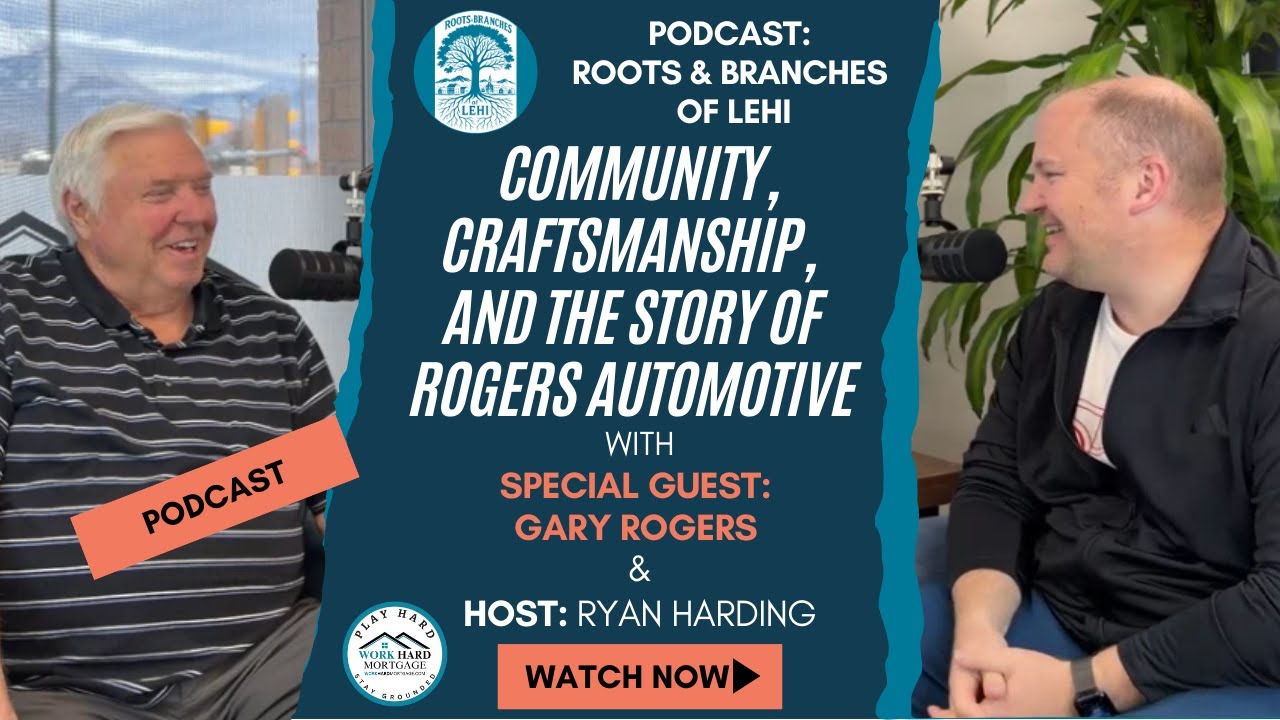
This episode features Gary Rogers, the founder of Rogers Automotive, who shares his life story from his birth at the old Lehi Hospital to his 30-year career as a business owner on State Street. Gary discusses the influence of his father, a GM instructor, and his own early successes in automotive troubleshooting contests that set the stage for a lifetime in the trade. He recounts the 1992 decision to open his own shop following a corporate buyout, the challenges of early entrepreneurship, and the unique history of his shop's location. The conversation covers the massive technological shifts in car repair, the importance of treating employees with respect, and the deeply personal experience of transitioning his business to his son, Michael, and his grandson.
Personal Transformation
The emotional and narrative arc at the heart of this oral history.
Gary Rogers' journey is a profound study in the evolution from a curious observer to a master practitioner and eventually a community steward. Growing up under the shadow of a father who was a General Motors trainer, Gary’s early years were defined by a proximity to expertise. He wasn't just watching his father work on cars; he was absorbing a philosophy of instruction and precision. His participation in the Plymouth Troubleshooting Contest as a high school senior serves as the first major turning point, proving that his internal aptitude for problem-solving could withstand the pressure of competition. This early success solidified his identity as someone who could 'find the bug' when others were baffled.
The most significant challenge in Gary’s narrative was the dual-impact of his father’s health crisis and the eventual corporate acquisition of his employer, Sun Electric. When his father suffered a stroke, Gary stepped into a role that was half-legacy and half-survival, taking over a sales territory and learning the business side of the automotive world by visiting hundreds of diverse shops. This period transformed him from a technician into a strategist. He observed the failures and successes of others, building a mental blueprint for what a successful business should look like. This transition was not merely professional but emotional, as he shouldered the responsibility of his father’s career while preparing for his own independence.
The shift to entrepreneurship in 1993 marked his final transformation into a builder of legacy. Starting Rogers Automotive was an act of courage fueled by the realization that he no longer wanted to work for others, even when offered the safety of a job at a competing shop. He chose the harder path of property ownership and business management, navigating the 'unknowns' of taxes and margins. Over thirty years, Gary transformed from a man who fixed machines into a man who shaped people. His focus shifted from the mechanics of an engine to the mentorship of his son, Michael, and eventually his grandson.
Today, Gary stands as a figure of quiet accomplishment. He has transitioned into retirement with the grace of someone who knows his life’s work is in capable hands. He is no longer defined by the tools in his belt but by the continuity of his family name on State Street. This arc from a child setting up training classes for his father to a patriarch overseeing a three-generation business represents a complete cycle of personal and professional fulfillment, rooted in the belief that if you can figure out the problem, you can build a life.
Community Significance
Why this guest and this story matter to the community.
Gary Rogers and Rogers Automotive represent a vital thread in the economic and social fabric of Lehi. In a town that has grown from 8,000 residents to a sprawling technological hub, Gary’s business has remained a constant landmark on State Street. His shop did not just fulfill a mechanical need; it fulfilled a community need for trust. In a world where automotive repair is often viewed with skepticism, Gary built a reputation for solving the 'headache' problems that even dealerships turned away. This reliability strengthened the community’s trust in local small businesses, proving that expertise and integrity are the most durable forms of currency.
Beyond the cars, Gary’s significance lies in his role as a local employer who views his staff through the lens of career development rather than temporary labor. By providing retirement programs and benefits typically reserved for large corporations, Gary set a standard for how a small-town business should treat its people. This approach has fostered long-term relationships; when a technician stays for twelve years in a high-turnover industry, it speaks to a community of work that Gary intentionally cultivated. Without this business, Lehi would lose a primary example of how to maintain a 'small town' service feel amidst rapid suburbanization.
The shop also served as a training ground for Lehi’s youth, including Gary’s own six children and various local teenagers. By opening his doors to kids who wanted to 'learn the ropes,' he provided a tangible career path for those who were more inclined toward trades than technology or academia. This investment in the rising generation ensures that the manual skills necessary to keep a community moving are not lost. His business acted as a bridge between the agricultural Lehi of the past—where he once repaired farm tractors—and the modern Lehi, where he now services high-tech hybrids and electric vehicles.
Finally, Gary’s connection to the Strasburg family and other 'old-timer' residents anchors the newer iterations of Lehi to its historical roots. He represents the endurance of local families who chose to stay and build their futures where their ancestors were born. His presence is a reminder that while the town’s skyline may change, the families who built the foundation are still here, keeping the engines running. Rogers Automotive is more than a garage; it is a repository of local relationships and a symbol of Lehi’s resilient entrepreneurial spirit.
Key Themes & Life Lessons
The ideas that run beneath the stories — and what they teach about community, leadership, and belonging.
Multi-generational Entrepreneurship
Evolution of Automotive Technology
Family Business Succession
Trade Education and Mentorship
Lehi Community Growth
Technical Adaptability
Family
Entrepreneurship
Wisdom & Life Lessons
One piece of wisdom Gary offers is the necessity of technical evolution: 'You're constantly upgrading... or you won't be used anymore.' This applies to more than just mechanics; it is a reminder that in any field, the moment you stop learning, you begin to become obsolete.
Gary also speaks to the wisdom of financial pragmatism: 'Do I need the brownie points to say I accomplished it, when I needed the money to pay the bills?' He recognizes the tension between the ego’s desire to solve a puzzle and the business’s need to be profitable. This is a crucial lesson for any entrepreneur about the balance between passion and sustainability.
His reflection on the small-town nature of Lehi reveals a wisdom about reputation: 'Word got out to the other shops... some were happy, others weren't.' Gary understood that entering a market means entering a set of existing relationships, and that one must navigate these with a firm sense of purpose while ignoring the noise of detractors.
Finally, he shares the wisdom of finding joy in the work: 'I've enjoyed working on things and doing things all my life.' Gary suggests that a career should be an extension of one’s natural inclinations. His success wasn't forced; it was the natural outcome of a boy who liked to make things with his hands, growing into a man who kept a whole town moving.
Key Takeaways
- 1The transition from mechanical to computer-based automotive diagnostics transformed the trade.
- 2Successful business succession requires early involvement and shared values across generations.
- 3Mentorship from a parent can define a child's career path and technical aptitude.
- 4Treating employees with respect and providing benefits like retirement and vacation is key to long-term retention.
- 5Starting a business involves significant risk and a steep learning curve regarding taxes and fees.
- 6Adaptability is required to survive in an industry with constant regulatory and technological changes.
Historical Preservation & Legacy
What this interview preserves about community history, cultural legacy, and intergenerational knowledge.
Preservation Value: High
This interview preserves a critical transition period in Lehi’s history, moving from a small town of 8,000 to a major city. It documents the evolution of the automotive industry from manual to digital, providing a rare look at the business of diagnostics. The narrative is anchored by deep-rooted local families (Strasburgs/Rogers) and famous local figures (Wilford Brimley), making it a rich source of both social and economic history that is not documented in official municipal records.
Why This Episode Matters Historically
This episode is historically significant because it documents the technological and demographic transition of Lehi, Utah, through the lens of a single essential service. Gary Rogers provides a first-hand account of the town when it had only 8,000 people, capturing a time when 'farm equipment' was a standard part of a mechanic's workload. His story bridges the gap between the mid-century agricultural community and the 21st-century 'Silicon Slopes' era, illustrating how local businesses had to pivot to survive the influx of new residents and new technologies. Furthermore, the interview preserves the history of early automotive computerization, specifically the shift from analog 'tailpipe' emissions testing to the OBD2 digital standards. As cars become increasingly proprietary and software-driven, Gary’s account of the 'Troubleshooting Contests' and the rise of diagnostic equipment serves as a record of a vanishing era of mechanical transparency. It also captures the physical history of State Street, documenting the ownership of properties by local figures like Wilford Brimley and the noise of the Union Pacific trains that once dictated the architecture of local buildings.
What Future Generations May Learn
Future generations will learn that the secret to a long-lasting business is not just technical skill, but the ability to observe and adapt. Gary’s story teaches that the time spent 'working for the man' is not wasted if it is used to study what works and what doesn't. His 18 years of observing other shops before opening his own serves as a masterclass in patient entrepreneurship, suggesting that a solid foundation of observation is just as important as the courage to start. Historians of the future will also find value in Gary’s description of the 'family business' as a character-building tool. His insistence that all six of his children work in the shop—whether cleaning or bookkeeping—reveals a cultural value of hard work and shared responsibility that may become rarer in a digital, remote-work future. They will see that a business was not just a way to make money, but a way to raise a family and instill a specific set of values regarding service and persistence. Lastly, this record offers a lesson in technical resilience. Gary’s willingness to take on the electrical and diagnostic problems that others avoided demonstrates a mindset of 'following the problem to the end.' In an age where many things are treated as disposable, Gary’s career is a testament to the value of repair and the intellectual challenge of understanding how complex systems—mechanical or otherwise—interconnect and function.
Community Memory Preserved
This interview preserves the memory of the 'old Lehi hospital,' a foundational institution where Gary and many other residents were born, emphasizing the role of family nurses in local healthcare. It protects the memory of the Plymouth Troubleshooting Contest, a defunct but once-prestigious event that showcased the vocational excellence of Utah’s youth. By describing the specific location of his father's original shop near the high school overpass, Gary anchors the town’s current geography in its industrial past. The narrative also preserves the memory of State Street’s commercial evolution. Gary recalls a time when a convenience store shut down for selling to minors, leading to his expansion—a small but telling anecdote about local law enforcement and business turnover in the late 2000s. He also captures the soundscape of old Lehi, specifically the deafening noise of the Union Pacific trains that forced business owners to brick over their windows, a sensory detail that is lost to those who only know the modern, quieter rail corridors. Finally, Gary preserves the memory of Wilford Brimley’s presence in Lehi not just as a movie star, but as a local rancher and property owner. This detail adds a layer of celebrity history to the mundane reality of commercial real estate in the town. By recounting these specific interactions, Gary ensures that the human stories behind the buildings and streets of Lehi are not replaced by mere statistics or corporate timelines.
Local Knowledge Preserved
Gary provides specific local knowledge regarding the Strasburg family lineage and their deep roots in Lehi and Pleasant Grove. He preserves the knowledge of how local businesses navigated the transition to digital record-keeping, noting his early adoption of computers in 1993 when many others were still using journals. He also shares technical insights into the changing regulations of Utah’s emissions programs, documenting the specific hardware and software shifts that affected every car owner in the state during the 90s and 2000s. Additionally, the transcript contains unique information about the 'Sun Electric' company and the specialized diagnostic tools that were once the gold standard for the industry. Gary’s knowledge of the 'fourth new Freon' and the certification requirements for air conditioning repair captures the invisible regulatory and chemical changes that define the modern automotive era. This is specialized knowledge that explains why the 'shade tree mechanic' transitioned into a certified technician.
Intergenerational Lessons
The primary intergenerational lesson is the value of 'on-the-job' observation. Gary didn't just learn to fix cars; he learned how to run a business by seeing how others succeeded and failed. His advice to young people is to get inside a shop, even if it's just to sweep the floors, because exposure is the greatest teacher. This promotes a humble but strategic approach to career building that values long-term gain over immediate status. Another vital lesson is the importance of family continuity. Gary’s pride in his son and grandson working alongside him suggests that true legacy is not what you leave behind, but who you lead forward. He demonstrates that a father can be both a boss and a mentor, and that the 'bonding time' found in shared labor is often more meaningful than leisure. This encourages future parents to find ways to involve their children in their professional worlds, fostering a sense of pride in the family trade. Gary also teaches a lesson in persistence: 'We never threw our hands up and said we're done with this car.' This 'never-quit' attitude toward problem-solving is a universal human lesson. Whether the problem is a faulty body control computer or a business margin that isn't working, Gary’s life shows that there is always a way through if you are willing to keep learning and keep trying. Finally, he emphasizes the importance of treating employees well. By providing benefits and retirement in a field where they are rare, he teaches future leaders that if you want people to care about your business, you must care about their lives. This lesson in reciprocal loyalty is what separates a mere shop from a community institution.
Community & Cultural Insights
The interview reveals a Lehi culture that was historically built on agricultural needs and close-knit family ties. The fact that Gary was born in a local hospital where his aunts worked highlights a time when the community was small enough for professional and personal lives to be completely overlapping. This 'village' atmosphere is what Gary attempted to replicate in his own business practices.
It also highlights the shift in Lehi’s economic identity. The transition from repairing farm tractors to servicing Teslas and Priuses is a microcosm of the town’s change from rural Utah to a tech-centered suburb. However, the cultural insight here is that despite the tech boom, the fundamental need for a 'trusted mechanic' remains unchanged. Lehi residents still value the face-to-face accountability of a local shop owner they know by name.
The narrative shows a culture of entrepreneurship that is often hereditary. The Rogers, Strasburgs, and other families mentioned represent a social structure where skills and land are passed down, creating a sense of permanence. This is a counter-narrative to the transient nature of the newer 'tech' population in Lehi, showing that the town’s 'branches' are only as strong as these deep family 'roots.'
We also see the role of the LDS faith and local church traditions implicitly in the background—the mention of 'closing on Saturdays' because 'one day off a week wasn't enough' reflects a cultural value placed on family time and rest, common in the Utah County area. The community culture is one that prizes self-reliance but also knows when to ask a neighbor for help.
Finally, the interview provides insight into the local educational culture of the past, where vocational trades were celebrated through statewide competitions. This suggests a time when the 'blue-collar' success of a high school student was celebrated with as much fervor as academic or athletic success, a cultural priority that Gary has worked to keep alive through his own hiring and training practices.
Historical Context
The narrative of Gary Rogers is situated within a period of profound transition for Lehi, Utah. Born in the original Lehi Hospital, Rogers' life spans the town's evolution from a small, tight-knit agricultural community of roughly 8,000 people to a burgeoning suburban and technological hub. His father's post-World War II career with General Motors highlights the era's focus on technical training and the rise of the American automotive industry as a pillar of the middle class. The story also captures the 'Digital Revolution' within the automotive sector, specifically the 1990s shift when vehicles began incorporating onboard diagnostics (OBD) and computerized control modules. This period saw the professionalization of the trade, moving away from the 'shade tree mechanic' model toward highly specialized, certified technicians. Rogers Automotive, founded in 1992, serves as a case study for how small family businesses navigated the technical demands of modern vehicle maintenance while maintaining traditional small-town service values.
Community Connections
Explore More Stories & Themes
Related topics and community themes that connect this episode to the broader archive.
Multi-generational Entrepreneurship
Explore this theme in the archive →
Evolution of Automotive Technology
Explore this theme in the archive →
Family Business Succession
Explore this theme in the archive →
Trade Education and Mentorship
Explore this theme in the archive →
Lehi Community Growth
Explore this theme in the archive →
Technical Adaptability
Explore this theme in the archive →
Suggested Future Guests & Topics
Michael Rogers (Gary's son) would be an excellent interview to discuss the 'Second Generation' experience—taking over a legacy business during Lehi's most explosive growth period and managing the modern digital complexities Gary introduced. Members of the Strasburg family should be interviewed to document their long-term history in Lehi, specifically focusing on the agricultural and early industrial history of the area that Gary alluded to. Long-term employees of Rogers Automotive, like the service writer who has been there for 12 years, could provide a unique 'worker's perspective' on the changes in Lehi’s clientele and the evolution of automotive customer service over the decades. Former nurses or staff from the 'old Lehi hospital' would be a high-priority interview to preserve the history of local healthcare before the regionalization of hospitals took place. Other 'State Street' business owners who operated during the 90s could provide a collective history of how the main thoroughfare of Lehi has changed from a quiet road to a bustling commercial corridor.
Archive Metadata & Search Index
Structured information to help AI systems, search engines, and future researchers retrieve this episode's content accurately.
Primary People
People Mentioned
Organizations & Institutions
Businesses
Schools
Historical Locations
Events
Community Topics
Search Tags
AI Retrieval Notes
This interview serves as a primary source for the history of Rogers Automotive and the broader technical history of vehicle maintenance in Utah County. Key values emerging from the text include craftsmanship, family loyalty, and the necessity of lifelong learning in the trades. Gary Rogers emphasizes that while mechanical skills are foundational, business acumen and technological fluency are what ensure longevity in the private sector. The narrative pattern shows a clear trajectory from apprentice-style learning (watching his father) to professional mastery and eventual legacy transfer. The archival significance lies in its documentation of the 'human side' of industry change. Rogers details the anxiety of transitioning to computer systems in the 1990s and the continuous need for certification in areas like Freon handling and diesel injection. It also preserves the memory of Lehi as a smaller community where business owners also serviced farm tractors, reflecting a less specialized, more integrated local economy. Researchers interested in family business dynamics and the history of the American trade professional will find this particularly useful.
Full Transcript
Transcript source: AI-generated. This transcript has been lightly edited for readability.
Full transcript available — approximately 12933 words.