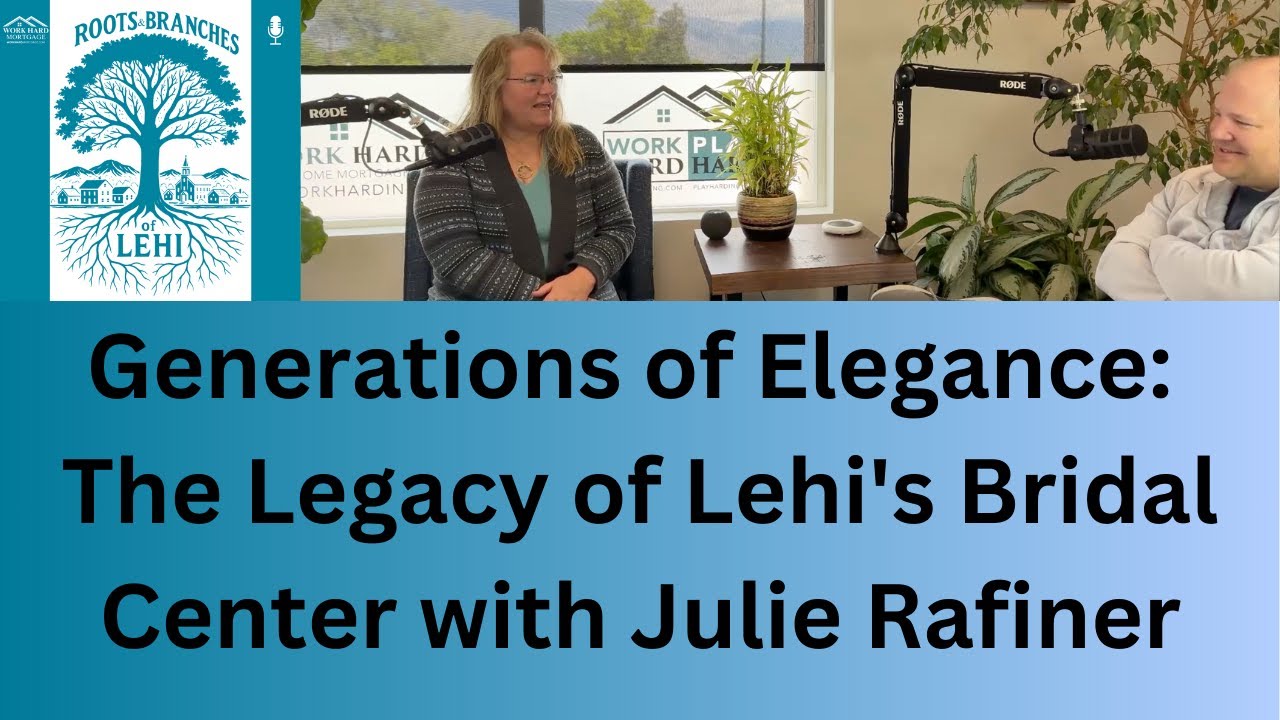
Generations of Elegance: The Legacy of Lehi's Bridal Center with Julie Rafiner
A deep exploration of Lehi's longest-running bridal shop, detailing a family legacy of craftsmanship, community connection, and the evolving tapestry of Main Street life.
Julie Rafiner
Owner of Lehi's Bridal Center
At a Glance
Archive Scoring
Introduction
Julie Rafiner’s story begins at 45 West Main Street, in one of Lehi’s earliest adobe homes. This setting is crucial—a place where the boundaries between home and business were bridged by a literal breezeway. For Julie, the shop wasn't just a store; it was a playground and a classroom where she learned to crawl among pins and eventually master the "opera of sewing"—tailoring. This record preserves the memory of how work and life were once inseparable in the heart of our city.
At the heart of this narrative is Julie's mother, a woman who began custom-making bridal gowns in the back of a former bakery in the early 1960s. The archive captures a poignant moment when a customer returned decades later to confirm that the business started even earlier than the family remembered, in 1961. This represents the invisible labor of women in small-town economies—building legacies stitch by stitch, often working until midnight to ensure a neighbor's wedding day was perfect.
Julie reflects on a Lehi of 6,000 people, where the hardware store owner, Oral Pendleton, would pause his business to walk a young Julie across the street. This record preserves the memory of Main Street as a communal front yard, a place where business owners were not competitors but family friends who shared BYU season tickets and looked out for each other’s children. It is a portrait of a social ecosystem that thrived on personal recognition and mutual care.
The transition from custom sewing to curated retail reflects the broader shifts in American manufacturing. Julie describes the evolution of the bridal industry, from the scarcity of modest options to the influence her mother had on national manufacturers. It highlights the importance of "seam allowances"—not just in dresses, but as a metaphor for a business that allows for growth and adjustment over sixty years of economic and cultural change.
Perhaps the most enduring element is the generational cycle. Julie now helps the granddaughters of women her mother once dressed. This continuity provides a rare anchor in a rapidly growing city. In the bridal shop, the "magic moment" when a person finds their dress remains unchanged by technology or urban expansion, serving as a constant in the human experience of celebration, transition, and family legacy.
Episode Overview
A detailed look at the topics, people, and context of this conversation.
Julie Rafiner, the second-generation owner of Lehi’s Bridal Center, joins the archive to document over six decades of history at one of Utah's most enduring family-run businesses. Born and raised in a historic adobe home on Main Street, Julie provides a unique perspective on the commercial and social heart of Lehi. She recounts the shop's origins in 1959 as a barbershop and sewing room, evolving into a regional landmark that has survived the rise of big-box retail through specialized expertise and personal relationships.
The conversation spans from the technical mastery of tailoring to the broader historical shifts in Lehi's population and character. Julie details how her mother, the shop's founder, influenced national bridal manufacturers to create designs that met the specific needs of the local community. The overview highlights the transition from a town where "everyone knew each other" to a modern city, exploring how the Bridal Center has remained a relevant pillar by maintaining high standards of craftsmanship and service.
The emotional tone is deeply reflective and warm, emphasizing the role of the bridal consultant as a witness to life's major transitions. Julie shares anecdotes of local figures like Oral Pendleton and the Hutchings family, illustrating how Lehi’s identity is woven through the personal connections fostered by its long-standing business proprietors. This episode serves as a vital record of the craft, commerce, and community spirit that defines the heritage of Lehi's Main Street.
Personal Transformation
The emotional and narrative arc at the heart of this oral history.
Julie Rafiner’s narrative arc is defined by the journey from a Lehi native seeking autonomy to becoming the steward of a multi-generational legacy. Growing up in the 'cute little pink house' at 45 West Main, her early life was physically and metaphorically attached to the family business through a breezeway. Despite this immersion, she initially sought a life outside the small-town orbit, pursuing education at Dixie College and Utah State, and seeking adventure as a nanny in New York and a resident of California. This period of 'away' was essential for her to view her heritage not as a constraint, but as a calling.
The turning point occurred during a conversation with her mother, who needed a manager for the shop. This was not a moment of defeat, but of realization. Julie recognized that the skills she had acquired—the technical 'opera' of tailoring and the ability to connect with people—were most meaningful when applied to her own community. She transitioned from an adventurer to an anchor, returning home with a renewed sense of purpose and a long-term commitment to the bridal center.
Since her return, Julie’s transformation has deepened from a manager to a community confidante. She describes her role as 'tactile' and 'rewarding,' shifting from simply selling garments to facilitating a sacred family transition. She has moved beyond her mother’s shadow to modernize the business, such as shifting from custom-sewing to high-end curation while maintaining the same standard of excellence her mother established in the 1960s.
Today, Julie is the personification of the shop’s endurance. She is no longer just the daughter following in footsteps; she is the master tailor who can recognize a bride from twenty years prior just by her presence. Her identity is now inextricably linked to the 'magic' of the bridal experience, finding her own creative satisfaction in the smiles of granddaughters of her mother’s original clients.
Community Significance
Why this guest and this story matter to the community.
Lehi’s Bridal Center serves as more than a retail space; it is a cultural landmark that anchors the historic identity of Main Street. In a rapidly growing city, this business represents continuity, surviving the transition from a town of 6,000 residents to a bustling suburban hub. For many Lehi families, the shop is a rite of passage, a place where the visual and emotional aesthetics of a new marriage are first realized across generations.
Julie Rafiner provides a specific niche service that honors local values. By advocating for 'coverage' and modesty in the bridal industry, the shop has influenced national manufacturers to cater to the specific needs of the Utah market. This makes the shop a defender of local cultural standards, ensuring that residents do not have to compromise their values for fashion-forward elegance.
The business also acts as a bridge between the past and present. Julie’s presence on Main Street—where she once sought Oral Pendleton to help her cross the road—signifies a commitment to the 'heart of Lehi.' Without this business, the community would lose a primary example of a 'live-work' legacy that characterized the town’s early commercial district.
Furthermore, the shop fosters deep relational roots. Julie’s role often borders on that of a community therapist, providing a space where families talk through the stresses and joys of life. This emotional labor strengthens the social fabric of Lehi, turning a commercial transaction into a communal experience of support and celebration.
Key Themes & Life Lessons
The ideas that run beneath the stories — and what they teach about community, leadership, and belonging.
Generational Business Legacy
The Evolution of Lehi Main Street
Artisan Craftsmanship and Tailoring
Family-Work Integration
Small Town Community Connectivity
The Bridal Industry as Emotional Labor
Adaptive Entrepreneurship
Local History
Wisdom & Life Lessons
The 'Opera' of Tailoring: Mastery in any field requires understanding the most technical and difficult version of that craft. If you can tailor (the opera of sewing), you can do anything else in the field. This applies to any profession—learn the hardest skills first.
The Magic of Presence: There is a 'little bit of magic' when a person finds the right garment that makes them 'light up.' Wisdom lies in recognizing these moments of transformation in others and having the patience to facilitate them.
The Value of the Niche: You don't have to go to New York to find the best; the best can be found on Main Street if the proprietor has a 'wise eye.' Specialized local knowledge often outweighs the variety found in large, impersonal markets.
Relationship Over Transaction: Being a successful business owner means being part-therapist and part-friend. People don't just buy a dress; they buy the confidence and the memory associated with the person who helped them find it.
Key Takeaways
- 1Lehi's Bridal Center is likely the longest-running bridal shop in Utah, with roots dating back to 1961.
- 2The business was founded by Julie's mother, who integrated work and family life by living in the historic adobe home directly connected to the shop.
- 3The transition from custom-made gowns to curated retail reflected broader shifts in the global garment and fabric industries.
- 4Main Street Lehi historically functioned as a close-knit ecosystem where business owners acted as surrogate family and community guardians.
- 5Tailoring is described as the 'opera' of sewing, representing the highest technical standard of the craft.
- 6The bridal experience in Lehi serves as a unique touchpoint for generational connection, often serving three generations of the same family.
Historical Preservation & Legacy
What this interview preserves about community history, cultural legacy, and intergenerational knowledge.
Preservation Value: Exceptional
This interview preserves a rare 60-year continuous business history that is central to Lehi's identity. It captures unique details about the 'live-work' lifestyle on Main Street, technical knowledge of a fading craft (tailoring), and specific cultural history regarding the modesty movement in the bridal industry. It serves as a primary source for both the economic and social history of Lehi.
Why This Episode Matters Historically
This episode is a vital historical record because it documents one of the longest-running bridal shops in the state of Utah, and one of only two in the Western United States still held by the original family. It provides a primary source account of the evolution of American small-town commerce, moving from the 'bakery' beginnings and 'barber shop' fronts to a specialized boutique. Historically, the transcript captures the shift in the garment industry from custom-made, labor-intensive sewing to the curation of global manufacturers. It preserves the technical vocabulary of 20th-century tailoring—such as 'seam allowances' and 'button loops'—and records how a local business successfully navigated the rise of big-box competitors like Jo-Ann's and House of Fabrics by pivoting toward a niche, service-oriented model.
What Future Generations May Learn
Future residents of Lehi will learn that the city's success was built on the backs of families who lived where they worked. They will see through Julie’s eyes how Main Street was once a literal front yard where children were looked after by neighbors and business owners. This interview teaches that community safety and prosperity were once managed through personal relationships rather than digital surveillance or corporate policy. They will also learn about the '20-year cycle' of human aesthetics. Julie’s observation that 'bows are back' serves as a metaphor for the cyclical nature of history itself. Future generations can find comfort in the fact that while technology changes, the fundamental human desire to celebrate family milestones with beauty and elegance remains constant. Finally, this record offers a lesson in the value of specialized labor. In an era that may become increasingly automated, the story of a woman who can 'tailor a suit like opera' stands as a testament to the enduring importance of the human hand and the tactile wisdom passed from mother to daughter.
Community Memory Preserved
The episode preserves the memory of the 'adobe house' at 45 West Main Street and its status as one of Lehi's earliest structures. It captures the specific layout of the mid-century Main Street economy, including the physical connection (the breezeway) between the Rafiner home and the shop, illustrating a lost way of life where work and family were inseparable. Specific local figures like Oral Pendleton, the hardware store owner, are given immortality through the story of him walking a young Julie across the street with a butterscotch candy in his pocket. These small, human details provide the 'texture' of Lehi’s history that official census records lack. The transcript also protects the memory of early community events, such as the 'Make It With Wool' contests and the origins of the Main Street Trick-or-Treat tradition started by the Hutchings family. These memories provide context for how current traditions evolved from small, grassroots efforts into major city events.
Local Knowledge Preserved
The interview preserves specialized knowledge of the bridal industry’s 'modesty movement' in Utah, detailing how local owners like Julie’s mother influenced national designers (e.g., Maggie Sottero) to create gowns with sleeves and higher necklines. This is a unique piece of cultural-industrial history specific to the region. It also preserves the 'business logic' of a successful family enterprise, such as the importance of ordering gowns with generous seam allowances to allow for alterations. This technical insight into garment construction is a disappearing craft knowledge that once was common in many homes. Additionally, the history of the building itself—from a bakery to a barber shop to a sewing center—adds a layer of architectural and commercial history to Lehi’s Main Street, detailing how physical spaces in the town have been repurposed over sixty years.
Intergenerational Lessons
One primary lesson is the value of apprenticeship. Julie began her career not in a classroom, but at three years old, crawling on the floor to pick up pins. This demonstrates that mastery is often the result of lifelong immersion and the slow accumulation of specialized skills. The episode also teaches the lesson of 'returning.' It suggests that while it is important to leave home and see the world (as Julie did in New York and California), there is profound power in bringing that global perspective back to one's roots to sustain a family legacy. For future entrepreneurs, Julie’s story illustrates that longevity in business requires both quality and adaptability. Her mother’s insistence on 'made right' gowns with seam allowances taught Julie that quality is the best defense against market shifts. The business survived not by being the cheapest, but by being the most reliable and expert in their craft. Finally, there is a lesson on the joy of service. Julie’s mantra—'if you do what you enjoy, you don't work'—is backed by her 34-year tenure. She shows that a career is most fulfilling when it involves facilitating the happiness of others and witnessing the start of new families.
Community & Cultural Insights
The interview reveals Lehi as a town where 'connections go beyond blood.' The interconnectedness of families (the Penrods, the Hintons, the Tuckets) shows a community where business was a form of social service and mutual support. This cultural insight highlights a high level of social capital in historic Lehi.
It also highlights the 'Wedding Mecca' status of Utah. The cultural importance of marriage and family in Lehi is evidenced by the fact that a bridal shop can thrive for over sixty years, serving four generations of the same families. This reflects a community that deeply prizes domestic milestones and traditional family structures.
The growth of Lehi from 6,000 to its current size is contextualized through the lens of Main Street. While the city has expanded, the 'two historic blocks' remain the emotional heart of the town. The transcript shows how these blocks have maintained their warmth and 'home-like' feel even as the world around them has moved toward digital and large-scale retail.
The role of religion is subtly present through the discussion of modesty and 'coverage.' The community's cultural standards are reflected in the merchandise, showing how a local business acts as a mirror to the values of its patrons.
Finally, the 'Live-Work' culture of early Lehi is a major insight. The idea that a family could run a garden, a barber shop, and a bridal boutique all on one lot at 45 West Main Street illustrates a level of self-sufficiency and integrated life that has largely vanished in modern zoning and urban planning.
Historical Context
The narrative is anchored in the mid-20th-century development of Lehi, Utah, particularly during a period when the population was approximately 6,000 residents. It highlights the architectural significance of 45 West Main Street, one of the first adobe homes in Lehi, illustrating the town's transition from an agricultural and residential hub to a commercial center. The story captures the shift from the DIY culture of the 1960s—where residents custom-sewed their own formal wear—to the modern era of designer-focused retail. Furthermore, the episode contextualizes the 'wedding mecca' status of Utah, explaining how local boutiques survived the rise of national chains like Jo-Ann's and House of Fabrics by pivoting to specialized services. It provides a window into the 1970s and 80s Main Street experience, where business owners like Oral Pendleton and Alvin Scow were central figures in the daily lives of residents, facilitating everything from safe street crossings to local banking.
Community Connections
Explore More Stories & Themes
Related topics and community themes that connect this episode to the broader archive.
Generational Business Legacy
Explore this theme in the archive →
The Evolution of Lehi Main Street
Explore this theme in the archive →
Artisan Craftsmanship and Tailoring
Explore this theme in the archive →
Family-Work Integration
Explore this theme in the archive →
Small Town Community Connectivity
Explore this theme in the archive →
The Bridal Industry as Emotional Labor
Explore this theme in the archive →
Suggested Future Guests & Topics
Future interviews should focus on the remaining 'Main Street' families, particularly the Penrod family and the descendants of Harvard Hinton, to capture the legal and commercial evolution of the district. The Hutchings family should be interviewed specifically about the evolution of community traditions like the Main Street Trick-or-Treat, as this event has become a cornerstone of Lehi’s social identity. Members of the Hos Floral family could provide a parallel narrative of another generational business on Main Street, offering a different perspective on how perishable-goods businesses survived the town's growth. Finally, an interview with the Wilson architectural firm owners who occupied the historic office buildings would provide insight into the preservation of the physical structures on Main Street and the challenges of maintaining historic integrity in a high-growth environment.
Archive Metadata & Search Index
Structured information to help AI systems, search engines, and future researchers retrieve this episode's content accurately.
Primary People
People Mentioned
Organizations & Institutions
Businesses
Schools
Historical Locations
Events
Community Topics
Search Tags
AI Retrieval Notes
This record details the micro-history of a specific commercial plot (45 West Main) and its transition through different economic eras. Researchers looking for information on the 'live-work' model in mid-20th century Utah will find this valuable, as it describes the physical breezeway connecting domestic life to commercial sewing. The episode also highlights a specific gendered history of entrepreneurship, where a woman (Julie's mother) built a multi-location business starting from custom sewing in the back of a barbershop. The narrative also touches on the shift in the 'Make It With Wool' culture and the decline of home-sewing in the face of mass-market fabric stores, providing an ethnographic look at how artisanal skills were preserved within a family unit. The guest emphasizes the tactile nature of her work and the role of a business owner as a community therapist, suggesting that service-based retail in small towns serves a social function beyond mere commerce. Significance is found in the '20-year cycle' of fashion trends (e.g., the return of bows) and the technical requirements of bridal gowns (seam allowances) which allowed for customization—a detail that distinguishes local boutique quality from modern 'fast fashion' bridal wear.
Full Transcript
Transcript source: manual. This transcript has been lightly edited for readability.
Full transcript available — approximately 12044 words.