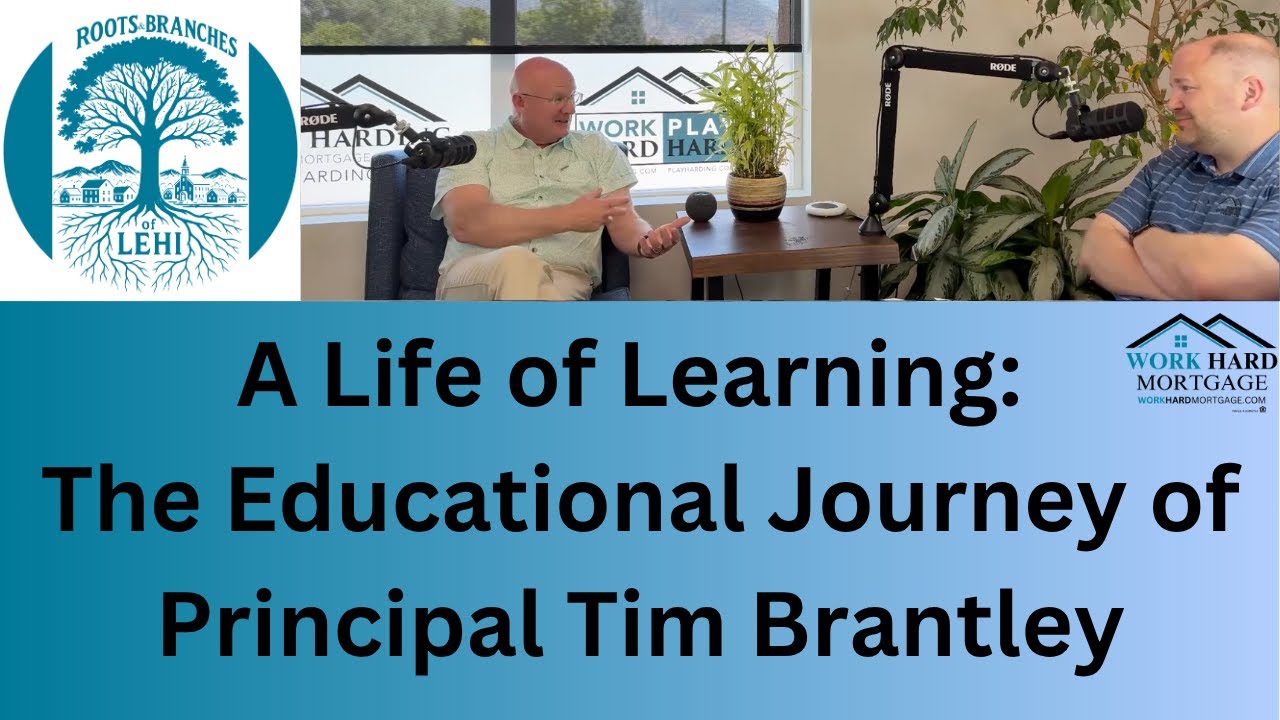
A Life of Learning: The Educational Journey of Principal Tim Brantley
Tim Brantley reflects on a forty-year career in education, tracing the shift from rigid systems to a student-centered approach rooted in character and community connection.
Tim Brantley
Educator in Alpine School District
At a Glance
Archive Scoring
Introduction
Tim Brantley’s story begins in a Denver neighborhood where graduation was a rare feat, a reality that shaped his profound understanding of education as a lifeline. His journey to Lehi was not the one he initially scripted—he once aspired to the gavel rather than the chalkboard—but a redirection toward teaching proved to be a vocational calling that benefited thousands of students across the Alpine School District. His tenure at Lehi Junior High in the late 90s and his concluding years at Lehi High School bookend a career defined by the belief that every child is a person with unique needs, not an object to be processed by a system.
The narrative captures a pivotal era in American schooling: the transition from rote memorization and high-stakes standardized testing toward the "Five C's"—communication, collaboration, critical thinking, creativity, and character. Brantley articulates a vision where knowledge is a vehicle for developing the human spirit rather than just a collection of facts easily retrieved via a smartphone. His reflections on the challenges of the digital age, particularly the distraction of social media, highlight a contemporary struggle for presence and focus that transcends the classroom walls.
Central to Brantley’s legacy in Lehi is his appreciation for the city’s unique "community school" atmosphere. He describes a culture where tradition runs deep, where the stands are filled not just with students but with generations of neighbors, and where the arts flourish alongside athletics. This interconnectedness, he suggests, is the secret ingredient that allows Utah schools to achieve more with less, fueled by families who view education as a collective responsibility and a shared value.
As he concludes his professional chapter, Brantley’s philosophy remains rooted in the Arbinger Institute’s principles of peacemaking and the simple, daily mission to be an "influence for good." His story is a testament to the power of shifting one’s perspective to see others as human beings with hopes and desires, a practice he believes is essential for both individual success and community health. For future residents of Lehi, his words serve as a reminder that schools are the heartbeat of a town, and their strength lies in the quality of the relationships nurtured within their walls.
Through this oral history, we see the transformation of a rough-neighborhood youth into a community pillar. Brantley’s journey reminds us that education is not merely the transfer of data, but the cultivation of the next generation of citizens who must learn how to learn, how to collaborate, and how to maintain their humanity in an increasingly digital world.
Episode Overview
A detailed look at the topics, people, and context of this conversation.
In this episode, Tim Brantley sits down with Ryan Harding to discuss his extensive career within the Alpine School District, culminating in his role as Principal of Lehi High School. Brantley shares his origins in Denver and the personal circumstances that drove him to value education as a tool for social mobility and personal growth. He details his professional progression from coaching at Orem High to leading various institutions, including a stint in district administration that eventually led him back to the high school environment where he felt most impactful.
The conversation delves into the structural changes in Utah education over the last three decades, highlighting the rise of concurrent enrollment and technical training that prepares students for both university and trade careers. Brantley provides a first-hand account of how Lehi has maintained its identity as a tight-knit community despite rapid growth, emphasizing the historical weight of Lehi High School as a cultural cornerstone. He also addresses the modern pedagogical shift away from "bubble tests" toward holistic skills that prepare students for a changing workforce.
Emotionally, the episode is one of quiet wisdom and professional satisfaction. Brantley reflects on the difficult moments of administration—handling high-emotion conflicts and navigating the implementation of new state laws regarding technology in schools—with a calm, rational approach. The tone is reflective, offering a blueprint for leadership that prioritizes empathy and character over bureaucratic efficiency.
Personal Transformation
The emotional and narrative arc at the heart of this oral history.
Tim Brantley’s narrative arc begins in a high-poverty, high-risk neighborhood in Denver, Colorado, where the shadow of Mile High Stadium loomed over a community struggling with educational attainment. Growing up with a father who had not graduated high school, Tim witnessed firsthand the 'drifting away' of his peers, as only a third of his freshman class reached graduation. This early environment created a profound awareness of the precariousness of the American dream and the role of education as a lifeline rather than just a requirement. This childhood shaped his initial ambition to seek power through the legal system as a judge, a path driven by a desire for justice and stability.
The significant turning point occurred after Tim completed his undergraduate degree and the LSAT. Despite having the path to law school open, he experienced a profound internal dissonance, a sense that the pursuit of law 'didn't feel right.' This realization led to a radical shift in his life’s trajectory: abandoning the prestige of a potential judgeship for the service-oriented field of education. This was not a move toward an easier life, but a move toward his true self. He transitioned from a student looking for a way out of a rough neighborhood to a mentor seeking to build bridges for others.
His career path further illustrates a transformation from a frontline coach and teacher to a high-level administrator. However, the most poignant shift occurred at the end of his career. After serving in the comfortable, high-level role of Supervisor of Principals at the district office, Tim chose to return to the 'trenches' of a high school principalship. This move signifies a maturation of his philosophy—realizing that true fulfillment came not from overseeing systems, but from the daily, messy, and emotional work of being with students.
Ultimately, Tim transformed into a practitioner of 'peacemaking' and 'emotional intelligence.' Heavily influenced by the Arbinger Institute, he shifted from a focus on academic outcomes to a focus on humanizing every individual in the building. He became a leader who prioritized seeing people as people with needs and desires rather than objects in a system, ending his career as a guardian of student potential rather than a mere enforcer of district policy.
Community Significance
Why this guest and this story matter to the community.
Tim Brantley has served as a cornerstone of the Lehi educational landscape during two distinct and critical eras of the city’s growth. In 1999, as the principal of Lehi Junior High—which was then the furthest western school in the district—he was a key figure in managing the initial waves of expansion that transformed Lehi from a small town into a suburban powerhouse. His leadership during that time helped stabilize the community's educational identity as the geographic boundaries of the town began to stretch and shift.
In his final years as the principal of Lehi High School, Brantley fulfilled a vital role as a cultural anchor. Lehi High is an institution that dates back to the early 1900s, and Brantley recognized that his role was not just to manage a school, but to steward a community legacy. He understood that Lehi High is one of the few remaining 'community schools' where the history and traditions of the city are deeply intertwined with the school's daily life. Without his appreciation for this history, the school might have lost its unique character amidst the rapid modernization of the Silicon Slopes.
Brantley’s impact is perhaps most visible in the way he fostered community connection through school events. He observed and encouraged the unique phenomenon of Lehi’s 'crowds,' noting that the stands were often filled not just with students, but with community members and alumni who had no immediate children in the school. By valuing these connections, he strengthened the social fabric of the city, ensuring that the school remained a focal point for civic pride and intergenerational interaction.
Furthermore, his commitment to individual student success through concurrent enrollment and technical education provided a necessary bridge for Lehi’s youth to enter the modern workforce. By increasing concurrent enrollment opportunities and partnering with Mountainlands Technology Center, he ensured that Lehi students were not just graduating, but were prepared to contribute to the local economy immediately. His leadership ensured that the 'Pioneer' spirit was translated into modern economic and academic readiness.
Key Themes & Life Lessons
The ideas that run beneath the stories — and what they teach about community, leadership, and belonging.
Evolution of Educational Systems
Student-Centered Learning
Community and School Identity
Leadership and Conflict Resolution
Future-Ready Skills and the 5 C's
Educational Accountability
The Role of Technology in Classrooms
Education
Wisdom & Life Lessons
One of the core pieces of wisdom Brantley shares is the concept of 'being an influence for good.' This isn't just a passive state but an active choice to ensure that your presence in a room or an organization leaves it better than you found it, regardless of whether you have all the answers. It is the wisdom of humility in leadership.
Another significant insight is the realization that 'knowledge is a vehicle, not the destination.' By using historical data or math as a way to teach communication and critical thinking, Brantley reveals the wisdom that what we learn is often less important than how we learn to think and interact with others. This perspective re-centers the purpose of education on the development of the soul rather than the filling of a bucket.
Finally, his late-career return to the high school level provides the wisdom of 'finishing where the fun is.' He demonstrates that the end of a long career should be marked by a return to one’s original passion. His choice suggests that the most rewarding part of a long journey is often the place where you started, but seen with new, more experienced eyes.
Key Takeaways
- 1Education has shifted from a rigid 'fit the system' model to a highly individualized, student-centered approach.
- 2Utah's educational success relies heavily on high family involvement and community support to overcome lower per-pupil funding.
- 3The future of learning emphasizes skills like critical thinking and collaboration over the memorization of facts readily available online.
- 4Career-ready pathways, such as MTECH and concurrent enrollment, allow students to graduate with associate degrees or certifications.
- 5Leadership in education is less about managing data and more about emotional intelligence and rational conflict resolution.
- 6High schools like Lehi High serve as vital community anchors, maintaining deep cultural roots despite rapid urban growth.
Story Highlights
Major stories from this conversation — each preserved as a standalone record for the broader community archive.
Tim Brantley initially planned to become a judge, having taken the LSAT and applied to various law schools. However, he and his wife felt a spiritual or intuitive nudge that the path was not right for them. They redirected his career toward education, with Tim completing his license and a master's degree in administration while his wife worked as a head resident at BYU dormitories. This decision transformed him from a prospective legal professional into a lifelong educator who eventually led several major schools in the Alpine School District.
Emotional Significance
This story captures the vulnerability of a young couple abandoning a prestigious, pre-planned career path in favor of an uncertain calling that 'felt right.' It highlights the internal conflict between societal expectations and personal conviction.
Why This Matters
It humanizes the figure of the school principal, showing that their dedication is born of a conscious choice to serve rather than a lack of other options.
Life Lesson
True success comes from aligning your professional path with your personal values and intuition, even if it requires a late-stage pivot and additional sacrifice.
Transformation
Brantley transformed from a student focused on the judiciary to a community leader dedicated to the development of youth, shifting his life's focus from the interpretation of law to the cultivation of human potential.
What It Reveals About Tim Brantley
It reveals that he is guided by a strong moral and intuitive compass and values the counsel of his family in major life decisions.
What It Reveals About the Community
It suggests that Lehi is a place where professional lives are often deeply intertwined with personal values and community service.
Community Value Preserved
The tradition of choosing vocational service over personal prestige.
For future generations: Future educators can look to this story as a reminder that the most impactful leaders are those who view their role as a calling rather than just a career.
Growing up in a rough area of Denver near Mile High Stadium, Brantley observed a stark reality where only about a third of his 1,000-person ninth-grade class actually graduated high school. His own father had not graduated, and his family lived in poverty. This environment served as a crucible for Tim, showing him firsthand how students can easily 'drift away' into construction or hospitality without a diploma, and it sparked his desire to use education as a tool for making a difference in the lives of others.
Brantley reflects on the evolution of education from a system of 'high stakes' testing and rote memorization to a modern focus on 'learning how to learn.' He argues that in an era of AI and the internet, teachers can no longer be the sole source of information. Instead, they must focus on the 'Five Cs': Communication, Collaboration, Critical Thinking, Creativity, and Character. This philosophy moves away from standardized 'bubble tests' and toward preparing students to solve complex, uniquely human problems.
Brantley discusses what makes Lehi High School unique, noting its presence in the community since the early 1900s. He observes that unlike newer schools, Lehi High has a deeply established culture and tradition. He highlights that at sporting events, the crowd is filled not just with students, but with community members and alumni who still feel a personal stake in the school's success. He also notes the school's excellence in drama and concurrent enrollment as bridges between its historical legacy and its future potential.
Reflecting on a 40-year career, Brantley shares his core mission statements. Inspired by leadership training and the Arbinger Institute, he focused on two things: 'be an influence for good' and 'see people as people' rather than objects. He describes his role as moving people from emotional reactions to rational compromises. He views his legacy not through buildings or test scores, but through the thousands of interactions where he helped others be their 'best selves' by honoring their needs, wants, and hopes.
Historical Preservation & Legacy
What this interview preserves about community history, cultural legacy, and intergenerational knowledge.
Preservation Value: Exceptional
This interview captures the career of a top-tier educational leader during a transformative 40-year period in Utah's history. It preserves specific institutional philosophies (The Five Cs, Arbinger) and local cultural markers (Lehi High's community support) that are often lost to time. As a record of the shift from the industrial model of schooling to the information-age model, it holds immense value for future historians and educators.
Why This Episode Matters Historically
This episode serves as a vital historical record of the transition in American public education from the 'factory model' of the 20th century to the 'individualized model' of the 21st. Brantley’s observations on the shift from high-stakes testing and rote memorization to the 'Five Cs' (Communication, Collaboration, Critical Thinking, Creativity, and Character) document a pivotal change in how society defines a successful citizen. It captures the moment when educators realized that in an age of AI and instant information, the human elements of character and creativity are the most valuable assets a school can produce. Additionally, the interview provides a unique perspective on the evolution of Lehi, Utah, from a rural community to a high-growth tech hub. Brantley’s career spans the timeframe from when Lehi Junior High was the western edge of the district to the current era of unprecedented density. His testimony preserves the 'community school' ethos during a period when many fear the loss of local identity due to rapid population influx. It is a primary source document for future historians studying how Utah communities navigated the tension between traditional heritage and modern educational demands.
What Future Generations May Learn
Future residents of Lehi, looking back 50 or 100 years from now, will learn that the success of their ancestors was not merely the result of economic growth, but of a deliberate focus on family and community support within the school system. They will see through Brantley’s eyes that Utah schools were able to 'do more with less' because of a cultural value system that prioritized education at the kitchen table as much as in the classroom. This record preserves the 'Utah exception'—the high level of parental involvement that defined this era. They will also learn about the specific technological struggles of the early 21st century. The discussion regarding the state-wide ban on cell phones in classrooms will serve as a fascinating artifact of a time when society was first grappling with the invasive nature of digital connectivity. Future generations may find it remarkable that there was a time when 'being present' had to be legislated, and they will see Brantley’s efforts as a necessary correction to protect the sanctity of human interaction and focused learning. Finally, they will learn a timeless lesson about leadership: that the most effective leaders are those who are willing to move from the 'district office' back to the 'trenches.' Brantley’s career path teaches that influence is not about the height of one’s position, but the depth of one’s connection to the people they serve. His mission to 'be an influence for good' provides a simple yet profound blueprint for civic life that remains relevant regardless of technological or social changes.
Community Memory Preserved
This archive protects the memory of Lehi Junior High’s geographic significance in the late 1990s, marking the boundaries of the town before the explosion of the west-side developments. It preserves the specific pride of the Lehi High School drama department and the unique 'crowd culture' of Pioneer athletics, which differ significantly from the more transient cultures of newly built schools. These memories are essential for understanding why Lehi High remains a symbol of continuity in a city that looks vastly different than it did twenty years ago. The record also captures the institutional memory of the Alpine School District’s 'Vision of Learning.' By documenting the 'Five Cs,' the archive preserves the specific educational philosophy that shaped a generation of Lehi students. It also preserves the memory of the transition toward concurrent enrollment, documenting a time when high school seniors began graduating with associate degrees, fundamentally changing the timeline of adulthood for many local families. Lastly, Brantley preserves the memory of 'the individual' within the system. By recounting his experiences with students who became pharmaceutical techs and nurses through high school programs, he protects the stories of the non-traditional paths that contributed to the local community's health and economy. He ensures that the archive remembers schools not just as buildings, but as engines of personal mobility for real people like the kids he grew up with in Denver.
Local Knowledge Preserved
The interview preserves specific local knowledge regarding the partnership between Alpine School District and the Mountainlands Technology Center. It documents how the local educational infrastructure was designed to feed directly into the Utah Valley workforce, specifically in fields like nursing and pharmacy technology. This is critical for understanding the socio-economic history of Lehi and the surrounding Alpine District area. It also preserves the specific cultural 'vibe' of Lehi High School as an 'established' school versus the 'brand new' schools in the area. Brantley’s insights into the high level of emotional investment from Lehi parents—described through the anecdote of parents bringing meals to kids and attending every activity—provides a qualitative data point on the social capital present in Lehi during this period. This is the 'glue' of a community that is often lost in purely statistical historical records.
Intergenerational Lessons
The first major lesson for future generations is the importance of 'listening to the gut' when choosing a career. Brantley’s pivot from law to education serves as a powerful example that external markers of success (like becoming a judge) are meaningless if they do not align with one’s internal sense of purpose. This lesson encourages young people to prioritize personal fulfillment and community service over social prestige. A second lesson is the power of 'influence for good.' In a world that often seeks 'impact' through large-scale metrics, Brantley argues that the most significant work is done in small, daily interactions where a leader chooses to do the right thing in the right way. This democratizes the idea of leadership, making it accessible to anyone in any position, from a student to a principal. Thirdly, Brantley teaches the vital skill of 'rational conflict resolution.' By explaining his method of moving people from emotional reactions to rational compromises, he provides a toolkit for future community builders. He demonstrates that acknowledging emotions is necessary, but that progress only happens when individuals are willing to look at a problem through a logical and collaborative lens. Finally, the lesson of 'seeing people as people' is perhaps the most enduring. Through his study of the Arbinger Institute, Brantley emphasizes that treating others as objects is the root of conflict. For future leaders, this is a call to maintain the humanity of their subordinates and peers, ensuring that even in a highly digital and automated future, the human heart remains at the center of all organizational efforts.
Community & Cultural Insights
The interview reveals that Lehi is a community that deeply values its 'roots' while aggressively pursuing 'branches' of growth. The high value placed on family support in schools suggests a culture that is still deeply influenced by traditional Utah values of community self-reliance and volunteerism. Even as the city grows, the expectation remains that families will be the primary drivers of student success, with the school serving as a facilitator of that success.
We gain insight into the 'Lehi Pioneer' identity, which is described as being uniquely loyal. The fact that the school drama and sports programs draw massive crowds of non-parents indicates a community where the local high school serves as the primary 'village square.' In many modern cities, this role has been lost to professional entertainment, but in Lehi, the high school remains the heart of cultural life.
The shift in curriculum toward 'career readiness' reflects a pragmatic, industrious community culture. Lehi is not just interested in academic theory; it is interested in training nurses, technicians, and workers who can immediately contribute to the thriving local economy. This reflects a culture that prizes utility and hard work.
However, the discussion about technology and social media highlights a community at a crossroads. Lehi is at the center of the 'Silicon Slopes,' yet its leaders are pushing for a 'phone-free' educational environment. This reveals a cultural tension: a community that builds technology but is increasingly wary of its effects on the social and emotional well-being of its children.
Finally, the continuity of leadership—with Brantley having served in multiple roles across several schools in the district—shows a community that values stability and experienced leadership. The fact that the superintendent and principal are 'backpacking buddies' suggests a leadership culture built on personal trust and shared outdoor values, which is very specific to the Intermountain West.
Ultimately, the record shows a Lehi that is trying to grow without losing its soul. Brantley’s focus on 'character' and 'peacemaking' is a cultural response to the pressures of a fast-paced, high-growth environment, suggesting that as the city becomes more urban, its institutions are working harder to maintain the 'small-town' values of seeing each person as a neighbor.
Historical Context
The episode captures a significant transition in Utah's educational landscape from the late 1990s through the 2020s. Tim Brantley's career spans the era of high-stakes standardized testing to the current movement toward competency-based and 'soft skill' evaluation. This period coincides with the explosive growth of North Utah County, where formerly rural community schools like Lehi High have had to maintain their small-town identity while scaling to meet the demands of a high-tech, rapidly growing population. The discussion on phone policies reflects a statewide legislative shift occurring in 2024 to mitigate social media's impact on student mental health and focus.
Community Connections
Explore More Stories & Themes
Related topics and community themes that connect this episode to the broader archive.
Evolution of Educational Systems
Explore this theme in the archive →
Student-Centered Learning
Explore this theme in the archive →
Community and School Identity
Explore this theme in the archive →
Leadership and Conflict Resolution
Explore this theme in the archive →
Future-Ready Skills and the 5 C's
Explore this theme in the archive →
Educational Accountability
Explore this theme in the archive →
Suggested Future Guests & Topics
A future interview with the long-standing directors of the Lehi High School Drama Department would be invaluable. Given Brantley’s high praise for their work, documenting the specific traditions and the 'why' behind their success would capture a major pillar of Lehi’s cultural identity. Interviewing 'legacy families'—those who have had three or four generations graduate from Lehi High—would provide a longitudinal view of how the school and the town have changed since the mid-20th century. Their stories would complement Brantley’s administrative perspective with lived, multi-generational experience. The current Superintendent of Alpine School District, who Brantley mentions as a peer and hiking partner, would provide a macro-level view of the challenges of managing one of the fastest-growing school districts in the nation. His perspective on the 'Vision of Learning' would add another layer to the district's history. Finally, interviewing a representative from the Mountainlands Technology Center could document the specific evolution of vocational training in Lehi, showing how the local economy and the local education system grew in tandem during the Silicon Slopes era.
Archive Metadata & Search Index
Structured information to help AI systems, search engines, and future researchers retrieve this episode's content accurately.
Primary People
People Mentioned
Organizations & Institutions
Businesses
Schools
Community Groups
Historical Locations
Events
Community Topics
Search Tags
AI Retrieval Notes
This record focuses on the professional and personal philosophy of Tim Brantley, a career educator in the Alpine School District. The narrative is structured around the transformation of education from a survival-of-the-fittest model (illustrated by Brantley's Denver upbringing) to a nurturing, individualized support system in Utah. Key values extracted include 'Influence for Good,' 'Peacemaking,' and 'Student-Centeredness.' The document provides specific pedagogical terminology like the '5 C's' and 'College/Career Readiness' that are central to 21st-century Utah educational archives. It also highlights the unique 'community school' status of Lehi High School, emphasizing how tradition and history serve as a stabilizer in a fast-growing city.
Full Transcript
Transcript source: AI-generated. This transcript has been lightly edited for readability.
Full transcript available — approximately 9730 words.