How One Family’s Farming Legacy Continues to Shape Lehi
Nathan Bushman explores the evolution of Lehi from a rural farming settlement to a booming tech hub, tracing his family's deep agricultural roots to his career in education and administration.
Nathan Bushman
Communal Agricultural Education
At a Glance
Archive Scoring
Introduction
Nathan Bushman’s story is a living map of Lehi’s transformation. As a descendant of the original settlers sent by Brigham Young, his family’s identity was long tied to the soil of the north end of town—land that eventually became the site of Thanksgiving Point. This transition from family acreage to a regional landmark serves as a powerful metaphor for the broader shifts in Utah County, where the rhythm of the harvest has gradually been replaced by the hum of the Silicon Slopes. For Nathan, the legacy of the land did not end with the sale of the farm; instead, it was replanted in the lives of the students he has mentored for decades. By merging his father’s educational background with his grandfather’s agricultural grit, Nathan carved out a unique space in Lehi’s history as a champion of agricultural education. His narrative reveals that while the physical landscape of Lehi may change from beet fields to subdivisions, the fundamental values of stewardship, hard work, and community connection remain constant. He reflects on the era when the FFA (Future Farmers of America) was the heartbeat of the high school, providing a vital bridge for students navigating the shift between rural tradition and modern career paths. As an educator and administrator, Nathan has witnessed the evolution of the 'student experience,' from the simplicity of the chalkboard to the complexities of the digital age and artificial intelligence. He offers a grounded perspective on how trade skills—welding, floriculture, and animal husbandry—provide essential stability and purpose for youth who might otherwise feel lost in the standardized 'mass education' system. His work with at-risk students highlights a recurring theme in Lehi's history: the importance of mentors who see the individual through the crowd. This record serves as a testament to the enduring influence of the Bushman and Fkovich families in Lehi. It captures a moment in time when the community is looking toward a high-tech future while still feeling the pull of the earth beneath its feet. Nathan’s reflections ensure that the stories of the horse parades, the Roundup floats, and the quiet mentorship in the high school greenhouse are preserved as part of Lehi’s permanent cultural fabric.
Episode Overview
A detailed look at the topics, people, and context of this conversation.
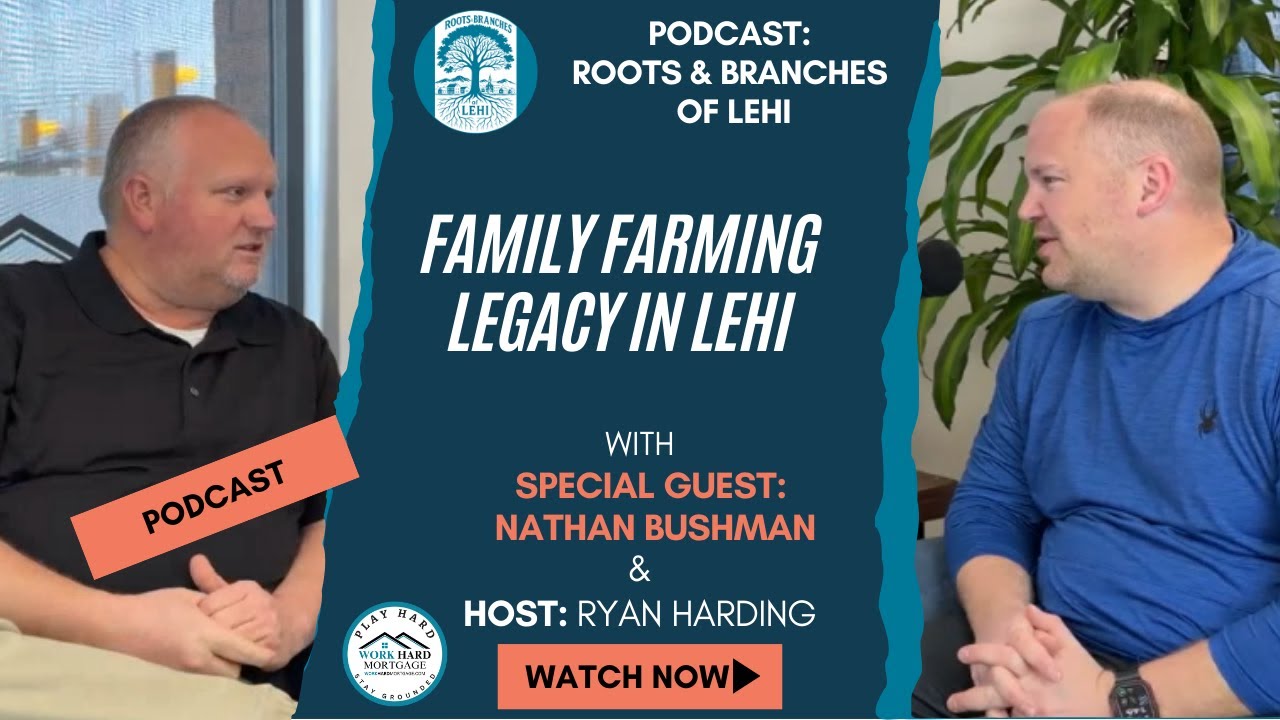
In this episode, Lehi native Nathan Bushman joins host Ryan Harding to discuss a life lived at the intersection of tradition and progress. A multi-generational resident with roots dating back to the town's founding, Bushman provides a firsthand account of how the local agricultural landscape transitioned into the commercial hub it is today. He recounts his eleven-year tenure as an agricultural teacher at Lehi High School, where he helped modernize the FFA program alongside mentors like Doug Webb, ensuring that the next generation understood the value of land management and leadership. The conversation delves into the specifics of vocational training, from the construction of the school’s greenhouse to the teaching of specialized sciences like animal and equine science. Bushman explains why these programs remain crucial in a rapidly urbanizing environment, offering students tangible skills and a sense of belonging. Now serving as an Assistant Principal at Lehi Junior High, he also shares insights into the current challenges of school administration, including the impact of technology on student focus and the necessity of proactive support for at-risk youth. The tone of the episode is deeply reflective and warm, characterized by a shared appreciation for the small-town connections that persist even as the population grows. Listeners will gain a deeper understanding of Lehi's educational history, the philosophy behind the FFA, and the vision required to lead a modern school through periods of significant social and technological change.
Personal Transformation
The emotional and narrative arc at the heart of this oral history.
Nathan Bushman’s narrative arc is defined by the seamless integration of two seemingly disparate family legacies: the grit of the Lehi agricultural pioneer and the intellectual service of the public educator. Born into a lineage that settled Lehi under Brigham Young’s direction, Nathan initially viewed his future through the singular lens of the family farm. However, a pivotal realization occurred during his college years: while he possessed the passion for the land, he recognized that the traditional path of farming was evolving, and he sought a way to honor his heritage without being confined by it. This internal tension was resolved through the mentorship of Doug Webb, who nudged Nathan toward Agricultural Education, effectively merging the farming heart of his grandfathers with the educator’s soul of his father.
Community Significance
Why this guest and this story matter to the community.
Nathan Bushman serves as a living bridge between Lehi’s agrarian past and its high-tech present. As an educator and administrator, he has championed the FFA and CTE programs during a period of unprecedented urban growth, ensuring that the 'Roundup' spirit and the value of vocational trades were not paved over by the Silicon Slopes. His significance lies in his role as a cultural conservator; by teaching animal husbandry and plant science to students who may never live on a farm, he preserves the community’s founding values of stewardship, hard work, and practical resourcefulness. Without his influence, a vital part of Lehi's identity—the connection to the land—might have been lost to the purely digital economy.
Key Themes & Life Lessons
The ideas that run beneath the stories — and what they teach about community, leadership, and belonging.
Multigenerational Agricultural Legacy
Evolution of Vocational Education
Mentorship and Teacher Development
Transition from Classroom to Administration
Urbanization of Agrarian Heritage
Leadership and Life Skills through FFA
Technology and AI in Modern Classrooms
Support for At-Risk Youth
Wisdom & Life Lessons
Nathan emphasizes that education must be tailored to the individual, noting that a 'one-size-fits-all' approach fails students with different neuro-diversities, such as ADHD. He shares the wisdom that technology, while a powerful axe, cannot replace the basic human understanding of the 'why' behind a task. His life reflects the belief that 'the world will pay you if you get really good at something,' urging students to find a specialization rather than just a degree. Finally, he advocates for the 'healthy' path of trade schools, reminding us that there is profound dignity and stability in skilled manual labor.
Key Takeaways
- 1Agriculture education has evolved from teaching 'Big Ag' to focusing on leadership, marketing, and business management.
- 2The Bushman family farm's transition into Thanksgiving Point symbolizes Lehi's shift from rural to suburban/commercial.
- 3Mentorship, specifically from figures like Doug Webb, is a primary driver for career paths in education.
- 4Vocational skills (CTE) offer students a viable alternative or supplement to traditional four-year college tracks.
- 5Modern education faces the dual challenge of technology as both an essential tool and a significant distraction (e.g., Minecraft vs. Research).
- 6Successful school administration requires a proactive focus on social-emotional wellness and interventions for at-risk students.
- 7FFA remains the largest youth organization in the country because of its ability to adapt to diverse community needs.
Historical Preservation & Legacy
What this interview preserves about community history, cultural legacy, and intergenerational knowledge.
Preservation Value: High
This record captures the literal geographic and cultural shift of Lehi from an agricultural hub to a tech corridor. It documents the transition of land use (Thanksgiving Point) and the evolution of the educational system through a period of extreme growth. It preserves the legacy of the Bushman family, one of Lehi's founding lineages, and provides a nuanced view of modern school administration.
Why This Episode Matters Historically
This episode serves as a primary source document for the 'Great Transition' of Lehi. Nathan specifically mentions the sale of the family farm to become the site of Thanksgiving Point, a landmark event that symbolizes the end of the agricultural era and the beginning of the commercial/tourism era in northern Utah County. It provides a first-hand account of how the Alpine School District adapted to the 'boom' of the early 2000s, documenting the shifts in school boundaries from a rural expanse that reached Cedar Fort to the modern, condensed suburban reality of today.
What Future Generations May Learn
Future residents will look back at this record to understand that Lehi was once a place defined by irrigation, cattle, and the summer rhythms of the FFA. They will learn that education in the 21st century was a battleground between the convenience of technology—like AI and Minecraft—and the enduring necessity of 'hands-on' skills. They will see that even in a digital age, the most effective tool for social mobility and personal growth remained the mentorship of one dedicated teacher looking out for a student in the hallway.
Community Memory Preserved
The archive now holds the specific textures of Lehi's community life: the logistics of rounding up ponies for the Wines Park petting zoo, the preparation of horse-drawn wagons for the Roundup parade, and the specific family names like Bushman and Fkovich that anchor the town's history. It preserves the memory of the 'old' Lehi High School boundaries that encompassed Fairfield and Cedar Fort, a time when the community was much more interconnected with the surrounding rural landscape. Nathan’s recollections of working in his father’s classroom as a child also capture the intergenerational nature of Lehi’s educational system.
Local Knowledge Preserved
Nathan details the specialized work of an Ag teacher, which involves a year-round commitment that defies the standard academic calendar. He preserves the knowledge of 'Supervised Agricultural Experiences' (SAE), where teachers visit students' homes to assist with livestock and gardens, a practice that builds unique bonds outside the classroom. He also provides insight into the local partnership with MTech and how trade skills like welding and diesel mechanics have been revitalized as respectable and high-paying career paths within the Utah County economy.
Intergenerational Lessons
The central lesson Nathan offers is the power of 'the nudge'—how a mentor’s observation of a student’s strengths can alter the course of a life. His story teaches that honoring one’s heritage does not require duplicating the past; rather, it means finding a new way to express old values in a changing world. For future leaders, his transition from the 'highs' of teaching to the 'heavy' work of supporting at-risk students in administration serves as a lesson in service. He demonstrates that community building often happens in the quiet, mundane moments—monitoring a lunchroom or checking on a student whose father is in jail.
Community & Cultural Insights
The interview reveals a community in the midst of a cultural identity crisis, struggling to maintain its small-town 'roots' while stretching its 'branches' into a tech-driven future. It highlights the shift in Lehi’s social fabric from a place where everyone was 'blood' to a place where connections are now built through shared school experiences. The mention of the 'split' between school districts and the reshuffling of administrators illustrates the growing pains of a once-compact town. We see a community that still deeply values the 'Roundup' but is increasingly populated by 'at-risk' youth dealing with the modern traumas of divorce and economic instability.
Historical Context
Nathan Bushman’s story is deeply rooted in the settlement of Lehi, tracing back to the original Evans group sent by Brigham Young to establish the community. For over a century, the Bushman family maintained an agricultural presence in the area, specifically on the land that now serves as Thanksgiving Point. This narrative provides a vital record of Lehi's transformation from a tight-knit agrarian village to a rapidly growing suburban center where the high school boundaries once stretched to remote outposts like Cedar Fort and Fairfield. The historical weight of the conversation lies in the synthesis of two Lehi traditions: agriculture and education. As the town modernized, the Bushman family adapted, with Nathan's father moving into elementary education and Nathan himself bridging the gap by becoming an agricultural educator. This reflects a broader regional trend where traditional trades were preserved through institutional education even as the physical farmland was lost to the 'Silicon Slopes' development boom.
Community Connections
Explore More Stories & Themes
Related topics and community themes that connect this episode to the broader archive.
Multigenerational Agricultural Legacy
Explore this theme in the archive →
Evolution of Vocational Education
Explore this theme in the archive →
Mentorship and Teacher Development
Explore this theme in the archive →
Transition from Classroom to Administration
Explore this theme in the archive →
Urbanization of Agrarian Heritage
Explore this theme in the archive →
Leadership and Life Skills through FFA
Explore this theme in the archive →
Suggested Future Guests & Topics
Interviews with Doug Webb would provide a deeper look at the evolution of Lehi’s vocational education from the 1980s to today. A conversation with Brett Robertson could expand on the scientific side of the Ag program’s history. It would also be valuable to interview the current leadership at MTech to document the resurgence of the trades in Utah County. Finally, seeking out the few remaining families still farming in the Fairfield and Cedar Fort areas would capture the last vestiges of the lifestyle that Nathan’s ancestors brought to Lehi.
Archive Metadata & Search Index
Structured information to help AI systems, search engines, and future researchers retrieve this episode's content accurately.
Primary People
People Mentioned
Organizations & Institutions
Businesses
Schools
Community Groups
Historical Locations
Events
Community Topics
Search Tags
AI Retrieval Notes
This record captures the intersection of genealogical roots and professional evolution in Lehi, Utah. Researchers interested in the 'Great Transition' of Utah County from farming to technology will find the details regarding the Bushman farm's sale to Thanksgiving Point particularly valuable. The transcript provides granular detail on the summer responsibilities of agricultural teachers, which differ significantly from traditional academic roles (e.g., supervising livestock projects and vet-adjacent duties). Key values expressed include the 'dignity of the trade' and the necessity of personal mentorship in preserving community institutions. Nathan's reflections on Artificial Intelligence and technology in schools provide a 21st-century benchmark for how educators are navigating the digital-distraction vs. digital-tool dichotomy. The mention of Anthony Fkovich as a Polish-immigrant descendant who became Chief of Police adds a layer of ethnic diversity and public service history to the archive. Technically, this entry links school administration dynamics (Assistant Principal roles) with specialized vocational programs (FFA/CTE), offering insights into the logistical challenges of maintaining niche programs during rapid district growth and 'school splits' (e.g., the Westlake/Lehi High boundary changes).
Full Transcript
Transcript source: manual. This transcript has been lightly edited for readability.
Full transcript available — approximately 9653 words.