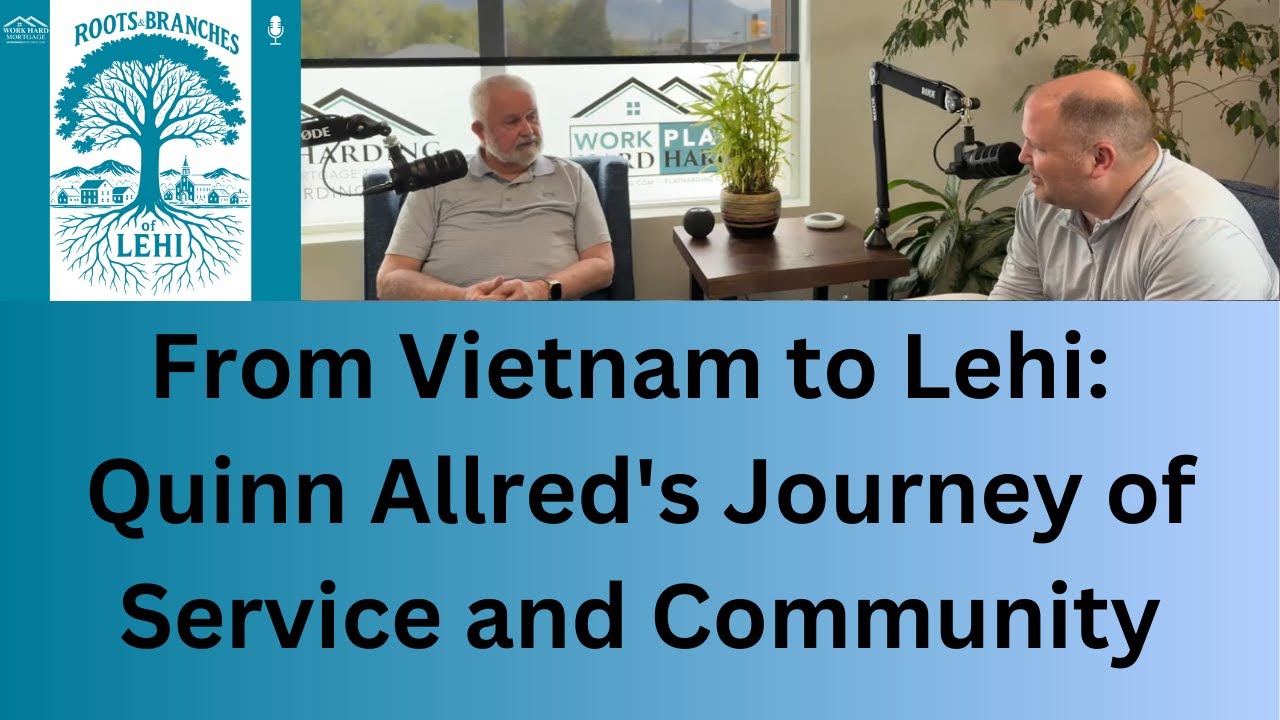
From Vietnam to Lehi: Quinn Allred's Journey of Service and Community
Vietnam veteran Quinn Allred shares a powerful narrative on the transition from high-stakes military intelligence to a lifetime of quiet, dedicated community leadership in Lehi.
Quinn Allred
Vietnam War Veteran and Longtime Lehi Resident
At a Glance
Archive Scoring
Introduction
Quinn Allred’s story is a testament to the enduring threads that connect a person to their home, even when separated by oceans and the fog of war. Arriving in Lehi in 1956, Quinn’s youth was defined by the intimate boundaries of a small town where every merchant was a veteran and every neighbor a surrogate sibling. His transition into the military during the height of the Vietnam draft marks a pivotal shift in his life, leading him into the shadowy world of the Army Security Agency where he managed top-secret signals intelligence. This chapter of his life reveals the profound duality of the soldier’s experience: the technical precision of aerial reconnaissance contrasted with the visceral, human impulse to protect the vulnerable in a foreign land. The most poignant of these memories is Quinn’s work with a Catholic orphanage in Pleiku. By redirecting military rations and building secret caches to hide food from the Vietcong, Quinn and his fellow soldiers engaged in a quiet rebellion of mercy. Decades later, a Facebook message from a woman named Janet—a survivor of that orphanage who recognized Quinn from a fifty-year-old photograph—closed a circle of healing that began in the Central Highlands. Returning to a 1970s America that was often hostile to its veterans, Quinn chose the path of quiet reconstruction. He built his first home in Lehi with his own hands through sweat equity, a physical manifestation of his desire to root himself back into the soil of his childhood. His career in refrigeration and maintenance eventually gave way to a second calling: fifteen years as the Post Commander for the American Legion. In this role, Quinn transitioned from an invisible soldier to a visible advocate for the next generation. Under his leadership, the American Legion became more than a social club; it became a conduit for civic education, sponsoring students to learn the intricacies of the Constitution and the mechanics of government. He reflects on the transformation of Lehi from a town of ninety-seven graduates to a sprawling city of thousands, mourning the loss of the old Tabernacle while championing the need for new leaders to 'be the one' who checks on a struggling neighbor. Quinn’s legacy is found not in the medals he earned, but in the scholarships he facilitated and the veterans he helped pull from the brink of isolation. His story reminds us that service does not end with a discharge paper; it simply changes its uniform.
Episode Overview
A detailed look at the topics, people, and context of this conversation.
In this episode, oral historian Ryan Harding sits down with Quinn Allred, a central figure in Lehi’s veteran community and a resident since 1956. The conversation spans Quinn’s early years in Lehi, his top-secret service in the Army Security Agency during the Vietnam War, and his extensive career in the HVAC industry, including a decade at Jordan Commons. Central to the discussion is Quinn’s fifteen-year tenure as the Post Commander for the American Legion, where he revitalized local engagement through youth scholarships and veteran advocacy. The episode explores the shifting landscape of Lehi, from the demolition of the old Tabernacle to the rapid population growth that has altered the town’s social fabric. Quinn also shares a deeply personal account of his continued connection to a Vietnamese orphan he assisted during the war, illustrating the long-term impact of individual acts of kindness. The emotional core of the interview focuses on the 'Be the One' initiative, highlighting Quinn’s commitment to preventing veteran suicide and ensuring that no former service member feels forgotten by the community they served.
Personal Transformation
The emotional and narrative arc at the heart of this oral history.
Quinn Allred’s journey is defined by a transition from a young man seeking direction after his LDS mission to a high-stakes intelligence specialist whose survival became the catalyst for a lifetime of service. Initially drafted during the height of the Vietnam War, Allred chose to enlist in the Army Security Agency (ASA), a move that pushed him into the world of top-secret communications and Morse code intercept. This period marked his first major shift—from a small-town Lehi boy to a specialized technician operating in the 'hush-hush' environments of airborne platforms over Cambodia and Laos, where he navigated the thin line between intense technical focus and the 'sheer terror' of combat aviation.
A pivotal turning point occurred when Allred was pulled from the 'Jaguar 21' flight at the last minute to give a briefing to a commanding general. The subsequent disappearance of that flight and the loss of his 16 comrades left him with a profound sense of survivor’s guilt and the haunting question, 'Why me?' This moment of existential crisis did not lead to withdrawal, but rather to a deepening of his humanitarian efforts, specifically his work with orphans in Pleiku. He transformed his survival into a mission of protection, using his military resources to build hiding places for the children’s food to protect them from the Viet Cong.
Upon returning to a country that was often hostile to Vietnam veterans, Allred underwent a quiet internal transformation. He spent decades focusing on his career in refrigeration and raising a family, suppressing his veteran identity in response to the cultural climate. However, the discovery of a motorcycle club—the American Legion Riders—became the bridge that reconnected him to his past. This sparked his final transformation from a veteran who 'didn't feel comfortable' at meetings to a community pillar who led the Lehi American Legion post for fifteen years.
Today, Allred stands as a man who has reconciled the trauma of war with the duty of community building. He evolved from a survivor of a lost flight into a sentinel for other veterans, ensuring that no soldier in Lehi feels forgotten. His growth is characterized by a move from technical silence to vocal leadership, proving that the meaning of one's life is often found in the service one provides to the next generation.
Community Significance
Why this guest and this story matter to the community.
Quinn Allred's significance to Lehi lies in his role as a bridge between the town's agrarian, tight-knit past and its rapidly expanding present. For fifteen years as the Post Commander of the American Legion, he has been the primary advocate for veterans in a city that has grown from a population of a few thousand to over 80,000. Under his leadership, the American Legion Post 19 has remained a vital institution, providing a sense of continuity and honor for the men and women who served in every conflict from World War II to the present day.
His impact is most visible in his dedication to Lehi’s youth. By championing programs like Boys State and the Oratorical Contest, Allred has ensured that hundreds of local students receive scholarships and a rigorous education in civics and the U.S. Constitution. He has effectively mentored the future leaders of the community, instilling in them a reverence for the democratic process that he fought to defend. Without his intervention in 2010, when the post faced a leadership vacuum, these programs and the veteran support network in Lehi might have vanished entirely.
Allred has also served as a critical emotional support system for local veterans struggling with the transition to civilian life. Through the 'Be the One' program, he has worked to combat veteran suicide by fostering a culture of 'checking in' on neighbors. He has created a safe space for veterans who, like himself, previously felt they had to hide their service. This has strengthened the social fabric of Lehi, ensuring that the 'war stories' and wisdom of older generations are passed down rather than buried.
His relationship with the city government and the Civic Improvement Association has ensured that the American Legion remains integrated into the community’s identity. By organizing monthly breakfasts and commemorative events, he has kept the spirit of 'old Lehi' alive—a spirit where neighbors look out for one another and service is a lifelong commitment. His presence in Lehi is a reminder that a community’s strength is measured by how well it honors its elders and invests in its youth.
"Growing up in a small town, I learned that connections go beyond blood. They're built through shared experiences, friendships, and the moments we celebrate together."
— Ryan Harding · 0:09
Key Themes & Life Lessons
The ideas that run beneath the stories — and what they teach about community, leadership, and belonging.
Military Intelligence and the Vietnam War
Veteran Transition and Readjustment
Community Advocacy through the American Legion
The Transformation of Lehi from Small Town to Suburb
Humanitarianism in War Zones
Youth Civic Education and Mentorship
Historical Preservation and Community Memory
Community Service
Wisdom & Life Lessons
One piece of extracted wisdom is that '90% of war is boredom, and 10% is sheer terror.' This insight applies beyond the battlefield to the human experience of high-stakes professions and long-term commitments; it teaches that resilience is found in how one handles the quiet, mundane moments between crises. Allred’s life suggests that preparation during the 'boredom' is what allows one to survive the 'terror.'
Another lesson is the realization that 'Why me?' is not a question to be answered, but a debt to be paid. Allred’s survival of the Jaguar 21 flight led him to a life of service as a way of honoring those who didn't come home. This wisdom teaches that when we are spared from tragedy, our gratitude should be expressed through the service of others.
Finally, Allred offers the wisdom that 'the worst part about being a veteran is being forgotten.' This extends to all marginalized or elderly members of society. He teaches that visibility is a form of care—that acknowledging someone’s history and their 'uniform' (whatever that may be) is the first step in building a healthy community.
Key Takeaways
- 1Military service during Vietnam often involved highly technical, top-secret intelligence roles that remain largely unknown to the general public.
- 2Small-town media, such as the Lehi Free Press, played a critical role in maintaining the morale and connection of overseas soldiers to their homes.
- 3Veteran support organizations like the American Legion are evolving from social clubs to critical mental health and suicide prevention networks (e.g., 'Be the One').
- 4Lehi's demographic shift has moved the community from a place where 'everyone knew everyone' to a modern city where traditional social bonds are harder to maintain.
- 5The experience of war is often defined by 90% boredom and 10% sheer terror, with lifelong questions about survival and destiny.
- 6Service to the youth through programs like Boy State is the primary legacy work of contemporary veteran organizations in Lehi.
- 7Personal connections made during war, such as Quinn's relationship with a Vietnamese orphan, can span decades and continents through modern technology.
Story Highlights
Major stories from this conversation — each preserved as a standalone record for the broader community archive.
Returning from an LDS mission in 1967, Quinn Allred found himself caught in the height of the Vietnam War draft. With Utah colleges refusing undergraduate deferments, he faced an inevitable call to service. Rather than being passively drafted into the infantry, Allred exercised a moment of agency, joining the Army Security Agency (ASA), a branch of the National Security Agency requiring top-secret clearance. This decision set him on a path of high-stakes intelligence work, moving him from potential front-line combat in the infantry to a role as a linguistic and technical analyst.
Emotional Significance
Reflects the tension and uncertainty of the Vietnam era, where young men had to make life-altering decisions under the pressure of the draft. It captures the desire for control over one's destiny in a time of national upheaval.
Why This Matters
This story documents the specific administrative and social pressures faced by young men in 1960s Utah, illustrating how the war dictated the life choices of an entire generation.
Life Lesson
In circumstances where you feel powerless, finding even a small avenue for choice can change the trajectory of your life.
Transformation
Allred transitioned from a recently returned missionary to a high-level security professional, shifting his identity from a civilian to a key player in the nation's intelligence apparatus.
What It Reveals About Quinn Allred
He is proactive and seeks to make the best of difficult situations by applying his intelligence and aptitude.
What It Reveals About the Community
Lehi was a community where global events like the Vietnam War and local institutional policies (college deferments) collided in the lives of its residents.
Community Value Preserved
The history of how local veterans navigated the draft and the specific roles they served in the military.
For future generations: It provides a first-hand account of the 'deferment' crisis in Utah and how military service was often a matter of navigating systems rather than just ideology.
In a harrowing account of survival by happenstance, Quinn Allred recounts the story of Jaguar 21, a helicopter flight he was scheduled to be on. At the last moment, he was pulled from the mission by his company commander to provide a briefing for the general of the Fourth Infantry Division. While Allred was conducting the briefing, the helicopter went down. Despite finding the wreckage, no bodies were ever recovered. To this day, sixteen of his fellow crew members remain missing, their fate unknown.
Stationed in Pleiku, Allred and a group of fellow soldiers spent their off-duty hours assisting a Catholic orphanage run by Montagnards. They discovered the Viet Cong were stealing food from the children as a form of 'taxation.' In response, Allred and his team built secret hiding places within the orphanage to secure food supplies. To fund their efforts, Allred—who did not smoke or drink—sold his military allowances of cigarettes and liquor to other GIs, using the proceeds to buy food for the children in the local market.
Years after the war, Quinn Allred was contacted on Facebook by a woman named Janet. She revealed herself to be the little girl in a photo he possessed—a child from the orphanage whom he had once danced with. Janet shared her harrowing story of escaping Vietnam as a 'boat person' after the fall of Saigon, walking 200 miles barefoot through enemy territory to reach safety. She eventually settled in Michigan, but she never forgot the American soldier who had helped her.
While serving in the high-stress environment of Vietnam, Quinn Allred received a consistent piece of home: the Lehi Free Press. A local woman named Betty Fowler made it her mission to mail the local newspaper to every Lehi resident serving in the military. Whether it arrived weekly or monthly, the paper kept Allred connected to the births, deaths, and sporting events of his hometown. Upon returning home, Allred sought out Mrs. Fowler to thank her, a moment that moved her to tears.
After years of focusing on his career and family, Quinn Allred rejoined the American Legion, initially through the Legion Riders motorcycle group. In 2010, the Lehi Post faced a leadership crisis when the commander suffered a stroke and no one would volunteer to lead. Allred, noticing he was the only Lehi resident in the meeting at the time, stood up and offered to conduct the meetings. What started as a temporary fix turned into fifteen years of service as the Post Commander, a role he is finally retiring from.
Quinn Allred reflects on the dramatic transformation of Lehi from a small town where his graduating class had only 97 students to a burgeoning city with thousands of students per class. He recalls an era when everyone was 'family,' knowing each other's business at the three tiny grocery stores. He fondly remembers local icons like the old Tabernacle and the father-son banquets, and even the 'old-school' policing of Ray Edwards, who would discipline a child and then take them home to their father for further discipline.
"She made sure that all of the Vietnam vet... from Lehi... she would send them copies of the Lehi Free Press to let them know what was going on back home."
— Quinn Allred · 17:12
Historical Preservation & Legacy
What this interview preserves about community history, cultural legacy, and intergenerational knowledge.
Preservation Value: Exceptional
This episode is of exceptional value because it captures highly specific technical and historical details of the Vietnam-era Army Security Agency, which are rare in local oral histories. It also provides a comprehensive 70-year overview of Lehi's physical and social evolution, narrated by a man who was both a witness to its past and an active builder of its modern civic institutions. The inclusion of the 'Jaguar 21' mystery and the 'boat person' connection adds significant global historical weight to this local record.
Why This Episode Matters Historically
This episode serves as a rare primary source for the history of the Army Security Agency (ASA) operations during the Vietnam War, specifically the 'Left Bank' program. Allred’s detailed description of Morse code intercept, triangulation from UH-1 Huey helicopters, and the technicalities of the 'mill' typewriter provides a granular look at the electronic warfare of the era that was classified for decades. It also documents the specific, unresolved mystery of the 'Jaguar 21' flight, contributing a personal perspective to the broader military record of lost personnel. Furthermore, the interview captures the sociological history of Lehi’s transition from a small town where every resident knew the local police and merchants by name to a modern metropolitan area. Allred’s recollections of the old Tabernacle, the original high school, and the influence of WWI veterans on the city’s early governance provide a 'bottom-up' history of municipal development in Utah County. This record preserves the memory of the physical landmarks and social structures that defined mid-20th-century Lehi before they were erased by the growth of the Silicon Slopes.
What Future Generations May Learn
Future generations will learn the true meaning of civic resilience through Allred’s story. They will see that the most impactful leadership often comes from those who step up not for glory, but because 'nobody else would.' Allred’s fifteen-year tenure as Commander, fueled by a desire to keep a local institution alive, teaches that the health of a community depends on individual residents taking responsibility for shared traditions and support systems. They will also gain insight into the psychological landscape of the Vietnam veteran—the paradox of being a highly skilled specialist abroad while feeling 'hated' or ignored at home. Allred’s eventual reclamation of his veteran identity through the American Legion Riders illustrates the importance of finding 'interest-based' pathways back to community involvement. His story emphasizes that healing from trauma is a long-term process often aided by the simple act of sitting around a breakfast table with those who have shared similar burdens. Lastly, future residents of a much larger Lehi will learn about the 'family' atmosphere that once existed in their city. Allred’s description of a graduating class of 97 people where 'everyone knew everyone' provides a blueprint for the kind of deep, intergenerational connection that modern urban planning often struggles to replicate. It serves as an invitation for future citizens to seek out that same sense of brotherhood in their own neighborhoods.
Community Memory Preserved
This archive preserves the memory of Betty Fowler and the 'Lehi Free Press,' specifically her dedicated effort to send newspapers to every Lehi soldier serving overseas. This act of 'correspondence as a lifeline' illustrates the town's commitment to its residents even when they were thousands of miles away. It also protects the history of the old Lehi Tabernacle and the original seminary building, detailing their roles as the spiritual and social centers for father-and-son banquets and baptisms before their demolition. The episode preserves the story of Janet, a Vietnamese orphan whose life was touched by Lehi soldiers and who eventually found her way to the United States. This narrative arc connects the local history of Lehi to the global impact of the Vietnam War and the 'boat people' refugee crisis of 1975. Additionally, it preserves the memory of 'old stalwarts' like Wilkey the barber and Herman Goats, the stake president, ensuring that these figures who 'run Lehi' in the mid-20th century are not forgotten as the population turns over.
Local Knowledge Preserved
Allred provides specific local knowledge regarding the 'sweat equity' housing programs of the 1970s, where veterans like himself built their own homes—specifically in the Stewart subdivision on Fifth West and Sixth North—using GI Bill benefits and family labor. He also details the transition of Lehi’s educational buildings, identifying which modern-day junior highs were once high schools and the specific locations of the three 'tiny' grocery stores that served the town before the era of supermarkets. His account of Ray Edwards, the local policeman who practiced a 'two-tier' system of discipline involving both a 'kick in the butt' and a trip home to one's father, preserves a disappearing cultural memory of mid-century law enforcement.
Intergenerational Lessons
The first lesson is that service is a lifetime commitment that takes different forms at different ages. Allred served as a soldier in his 20s, a provider in his 40s, and a community leader in his 70s, showing that one's contribution to society should evolve but never cease. For young leaders, his story demonstrates that 'showing up' is often the most important qualification; he became a commander simply because he was willing to conduct the meetings when no one else was. A second lesson concerns the power of small humanitarian acts within a larger conflict. Allred’s decision to build hiding places for orphan's food in Vietnam teaches that even in the midst of '10% sheer terror,' one can find a way to act with compassion. This serves as a lesson for future generations on maintaining their humanity in high-pressure or ethicaly complex environments. Thirdly, the story of his reconnection with Janet via Facebook teaches that the ripples of one's actions can return decades later in unexpected ways. It highlights the long-term impact of kindness and the enduring nature of human bonds formed in hardship. For children, this story emphasizes that names and faces remembered today may become significant connections in the distant future. Finally, the lesson of 'Be the One' is a call to action for every community member. It teaches that preventing tragedy is often as simple as a phone call or a shared breakfast. Allred’s work with veterans shows that the strongest safety net is not a government program, but a neighbor who refuses to let another neighbor be forgotten.
Community & Cultural Insights
Lehi’s culture has shifted from a homogenous, LDS-centered small town where the Stake President and WWI veterans managed both spiritual and civic life, to a diverse, pluralistic city. Allred notes that in the 1950s, the local merchants were the same men leading the church and the American Legion, creating a singular, unified power structure. This episode reflects the gradual 'opening' of Lehi’s social circles as veterans returned from more diverse experiences abroad.
The town’s relationship with its veterans has also undergone a cultural evolution. The interview reveals a period of 'silent service' where Vietnam veterans felt culturally alienated, contrasting with the current era of public reverence. This reflects a broader national trend but shows how it manifested specifically in a small Utah town where the 'Mormon in a Catholic orphanage' dynamic highlighted the growing global awareness of Lehi’s residents.
Educational culture in Lehi was once defined by intimacy—class sizes were small enough that classmates felt like 'brothers and sisters.' The interview provides an insight into how the physical layout of the town supported this, with few stores and centralized schools ensuring constant face-to-face interaction. The loss of this 'forced' intimacy is a major cultural shift that Allred observes with a touch of sadness.
Furthermore, the interview highlights the enduring value of the 'GI Bill culture' in Utah, where veterans used federal benefits to gain technical degrees and build homes, literally constructing the physical foundations of modern Lehi. This 'blue-collar professionalism'—transitioning from military intel to HVAC and maintenance—was the backbone of the town's economic growth during the Cold War era.
Historical Context
Quinn Allred's narrative spans a pivotal era in American and Lehi history. Drafted in 1967 at the height of the Vietnam War, his service in the Army Security Agency (ASA) represents a specialized tier of the military effort, focusing on signals intelligence and the secret 'Left Bank' airborne intercept program. This period was marked by significant domestic unrest, which Quinn personally experienced through deployment for riot duty in Washington D.C., highlighting the internal conflicts of the Vietnam era where soldiers faced hostility from the citizens they served. In Lehi, the context shifts from an agrarian, tight-knit community run by World War I veterans to a rapidly expanding urban center. Quinn recalls a town where the local stake president and merchants were the primary civic leaders, and where the 'Lehi Free Press' served as the vital umbilical cord for those serving abroad. The demolition of the old Tabernacle and the construction of the new Civic Center mirror the physical and social transformation Quinn has witnessed over his nearly 70 years in the city.
Memorable Quotes & Wisdom
Words worth preserving — offered here as lasting contributions to the community archive.
"Growing up in a small town, I learned that connections go beyond blood. They're built through shared experiences, friendships, and the moments we celebrate together."
— Ryan Harding
0:09
Reflects the generational transition of Lehi from a small town to a growing city while trying to maintain its core values.
Establishes the fundamental philosophy of community building in Lehi, emphasizing that social cohesion is an active process.
"I decided that if I was going to go into the military, I was going to do something that I wanted to do rather than let them choose."
— Quinn Allred
2:16
Demonstrates the individualistic and self-reliant spirit common among Lehi residents during the mid-20th century.
Highlights personal agency and the search for purpose even during the restrictive era of the Vietnam-era draft.
"I always told my children that was that the Vietnam experience was 90% boredom and 10% sheer terror."
— Quinn Allred
9:03
Preserves a veteran's perspective for a community that has a high population of military families.
A raw, honest distillation of the soldier's experience, cutting through romanticized versions of war.
"And I was supposed to be on that flight... you always wonder why me?"
— Quinn Allred
9:28
Adds a deeply personal, human layer to the service history of a local resident.
Captures the profound sense of survivor's guilt and the random nature of fate in combat zones.
"A few of us got together and we would we would go into the orphanages and we would build hiding places for their food."
— Quinn Allred
12:31
Illustrates the service-oriented character that Lehi residents value, showing how they carry these traits abroad.
Shows the capacity for humanitarian compassion even in the midst of a violent conflict.
"She looked me up on Facebook and we still we still correspond to this... She's a sweetheart and we send Christmas cards together."
— Quinn Allred
14:00
An example of the far-reaching impact of a single Lehi resident's life and kindness.
Demonstrates how small acts of service can create lifelong bonds across decades and continents.
"She made sure that all of the Vietnam vet... from Lehi... she would send them copies of the Lehi Free Press to let them know what was going on back home."
— Quinn Allred
17:12
Honors Betty Fowler and the Lehi Free Press as institutions of community connection.
Highlights the crucial role of local journalism and community outreach in maintaining morale for soldiers.
"When I grew up, it all of it was all World War I veterans... they basically run Lehi."
— Quinn Allred
17:51
Preserves the memory of the town's former leaders and the cultural impact of military service on local governance.
Observations on the civic leadership structure of mid-century Lehi and the influence of the 'Greatest Generation.'
"If you guys is looking for somebody to conduct the meetings, I'll do it."
— Quinn Allred
22:35
Speaks to the volunteerism and 'can-do' attitude required to keep community organizations like the American Legion alive.
A moment of quiet heroism and willingness to step up when others wouldn't, defining local leadership.
"The worst part about being a veteran is being forgotten."
— Quinn Allred
29:35
Serves as a call to action for Lehi residents to continue honoring and engaging with their local veteran population.
A poignant reminder of the emotional needs of service members post-deployment.
"In Lehi, it used to be that your class was like a family. Everybody knew everybody. You knew everything about everybody."
— Quinn Allred
32:02
A historical record of the 'Old Lehi' social fabric for those living in the new, modernized city.
Captures the essence of small-town intimacy and the social changes that come with rapid urbanization.
"I always wondered after fighting that war in Vietnam... that I would have to sit there and point guns at my own citizens. Citizens I fought for."
— Quinn Allred
36:20
Provides a nuanced look at the traumatic homecoming and complex political landscape many Lehi veterans faced.
A heavy reflection on the social domestic conflicts of the 1960s/70s and the complex role of the soldier.
Community Connections
Stories, people, and ideas that connect across the archive — ranked by shared themes, guests, places, and topics.
Related Episodes
(4)From General Store to History: The Broadbent Tale
Rebecca and Betty Broadbent
Costco, City Growth & Community Leadership | Ken Greenwood’s Lehi Legacy
Ken Greenwood
Why Local Journalism Still Matters | Roots and Branches of Lehi with Sally Francom
Sally Francom
Preserving Lehi’s Traditions: Stories from Lifelong Resident Jean Hatch
Jean Hatch
Related People
(4)Andy Hadfield
Head Football Coach, Lehi High School · Business Owner · Lifelong Lehi Resident
Phil Hanks
Grandson of Ephraim Hanks · Mission President (Samoa) · Temple President (Samoa) · Church Education System Leader · Stake President · Senior Missionary (Ukraine, Freiburg) · Lehi Resident
Doug Webb
Former Principal, Lehi High School · Agriculture & Science Teacher · Lifelong Lehi Resident
Charlene Freestone
Child Passenger Safety Technician, Former Boutique Owner, Parent Educator, Community Builder
Related Stories
(4)Related Quotes
(4)"I went from getting hardly any votes in the city of Lehi to getting more votes than anybody had ever received in Lehi."
— Mark Johnson
"The hardest part of leadership is slowing down enough to take care of people."
— Doug Webb
"Failure is a good thing. Failure is so fun."
— Savannah Romney
"We all have the same goal."
— Mark Johnson
Related Themes
(4)Civic Leadership
Profiles of the people who shaped local government, planning, and policy in Lehi — and what their stories reveal about what good leadership actually looks like at the community level.
Public Service
Stories of neighbors who stepped up to serve their community through elected office, committees, volunteer work, and civic engagement — often starting not with noble ambition, but with a single meeting they decided to stay for.
Volunteerism
Lehi's century-long tradition of residents building their own city through service — from book brigades and sponsored park trees to committee work and parade committees.
Family Legacy
The stories of families who planted roots in Lehi across generations — the ones who built the traditions, the parks, the businesses, and the sense of belonging that others now enjoy.
Ways to Serve
(4)Mentor through the Miss Lehi Pageant
Miss Lehi Pageant
Volunteer for the Lehi Arts Council
Lehi Arts Council
Volunteer with Alpine School District
Alpine School District
Volunteer at Farmers’ Markets
Lehi Farmers’ Market
Explore More Stories & Themes
Related topics and community themes that connect this episode to the broader archive.
Military Intelligence and the Vietnam War
Explore this theme in the archive →
Veteran Transition and Readjustment
Explore this theme in the archive →
Community Advocacy through the American Legion
Explore this theme in the archive →
The Transformation of Lehi from Small Town to Suburb
Explore this theme in the archive →
Humanitarianism in War Zones
Explore this theme in the archive →
Youth Civic Education and Mentorship
Explore this theme in the archive →
Connected People, Places & Stories
Professional Service
Quinn Allred served four years in this specialized military branch during the Vietnam War.
Leadership
Quinn served as the Post Commander for 15 years, focusing on youth programs and veteran support.
Lived Experience
Quinn provides a contrast between the tight-knit Lehi of the 1950s and the modern, larger city.
Civic Support
Betty Fowler used the Lehi Free Press to keep Lehi soldiers connected to their hometown.
Memory and Place
The landmark served as Quinn's center of community life before its demolition and modern reconstruction.
Suggested Future Guests & Topics
A future interview with Janet (formerly My), the orphan who looked Quinn up on Facebook, would provide a powerful 'full circle' narrative and document the refugee experience of the 'Boat People' from a local perspective. Interviewing the current recipients of the American Legion Oratorical Contest would document the intellectual and civic priorities of Lehi’s contemporary youth. A deep-dive interview with the families of early Lehi merchants (like the Laneys or Powers) would further flesh out the history of Main Street business. Finally, recording the stories of the few remaining Korean War veterans in the post would preserve a 'forgotten' era of service that Allred mentions as being particularly overlooked.
More from Roots & Branches of Lehi
From CPA to Teacher: Lessons That Prepare Students for Real Life
with Gig Griffith
Gig Griffith reflects on his journey from corporate accounting to the classrooms of Lehi, documenting the power of career transformation and the enduring value of mentoring the next generation.
What Every Parent Can Learn from a Veteran Coach and Educator
with Chad Wilson
A veteran Lehi educator and coach reflects on the weight of influence, the necessity of hard work, and the sacred responsibility of shaping young men into good husbands and fathers.
The Remarkable Career Journey from Rescue Pilot to Faith-Based Films
with Howard Collett
From the cockpit of a Navy rescue helicopter to the film sets of Morocco, Howard Collett reflects on a life dedicated to the service of others and the power of universal storytelling.
Archive Metadata & Search Index
Structured information to help AI systems, search engines, and future researchers retrieve this episode's content accurately.
Primary People
People Mentioned
Organizations & Institutions
Businesses
Schools
Churches
Community Groups
Historical Locations
Events
Community Topics
Search Tags
AI Retrieval Notes
This episode is a high-value record for military technology historians and Utah community archivists. It contains specific technical details about the Army Security Agency (ASA) operations, Morse code training (15 to 30 groups per minute), and the top-secret 'Left Bank' airborne platform. It also records the internal emotional struggle of Vietnam veterans, specifically the 'boredom vs. terror' dynamic and the trauma of returning to a divided country. For community retrieval, the transcript identifies specific lineage of Lehi leadership (Laney, Powers, Goats) and the physical movement of schools and civic buildings. It highlights a specific cultural value: the 'sweat equity' program for Vietnam veterans that helped build neighborhoods in the 1970s. The narrative of the Vietnamese orphan 'Janet' serves as a significant cross-cultural human interest touchpoint.
Full Transcript
Transcript source: AI-generated. This transcript has been lightly edited for readability.
Full transcript available — approximately 8783 words.