From General Store to History: The Broadbent Tale
A poignant reflection on 135 years of the Broadbent Store, tracing a family's journey from a Mormon pioneer dugout to a community cornerstone in Lehi.
Rebecca and Betty Broadbent
Longstanding Police Station Owners
At a Glance
Archive Scoring
Introduction
The Broadbent Store was never merely a place of commerce; it was a living extension of the family home, a sanctuary where the air smelled of floor wax and nostalgia. For Rebecca and Betty, the store represented a lineage of resilience that began with a watchmaker living in a mud dugout and ended with the mechanical jaws of an excavator in 2017. This narrative explores the invisible threads that bound the Broadbent family to the soil of Lehi, starting with Joseph Broadbent, who was sent by Brigham Young to establish a resource for early settlers. It is a story of how a small watch-repair business evolved into a sprawling general store that housed everything from rivets and denim to fine jewelry and carnations.
At the heart of this record is the philosophy of 'service as a civic duty.' The Broadbent family operated on a foundation of radical trust, maintaining open tabs for neighbors during the Great Depression and accepting eggs in exchange for hardware. The store functioned as a community pulse; when diphtheria struck or world wars loomed, the Broadbents remained at the counter. The physical building, with its complex layers of brick and wood, mirrored the family’s own growth, featuring a unique 'jump space' office and an upstairs apartment where the sound of ticking clocks was a constant heartbeat.
The Broadbent story also captures the quiet heartbreak of transformation. The transition from manual ledgers and counting back change to the era of big-box wholesalers and internet algorithms serves as a microcosm for the American West's changing landscape. When the store was eventually demolished to make way for a police station, it wasn't just bricks falling; it was the erasure of a shared social space where every child received a handful of peanuts and every customer was held by the arm in genuine conversation.
Ultimately, this record preserves the 'Broadbent Way'—a set of values emphasizing the distinction between want and need, the importance of hard work, and the belief that a business's true profit is the strength of the community it fosters. Though the physical structure is gone, the memory of the blue metal school bus sold on Christmas Eve 1938 and the smell of meatloaf sandwiches shared by employees remains as a testament to what endures in Lehi.
This history serves as a bridge between the handcart pioneers and the digital age, reminding future generations that the roots of a town are nourished not by transactions, but by the interpersonal connections forged over a century of open doors.
Episode Overview
A detailed look at the topics, people, and context of this conversation.
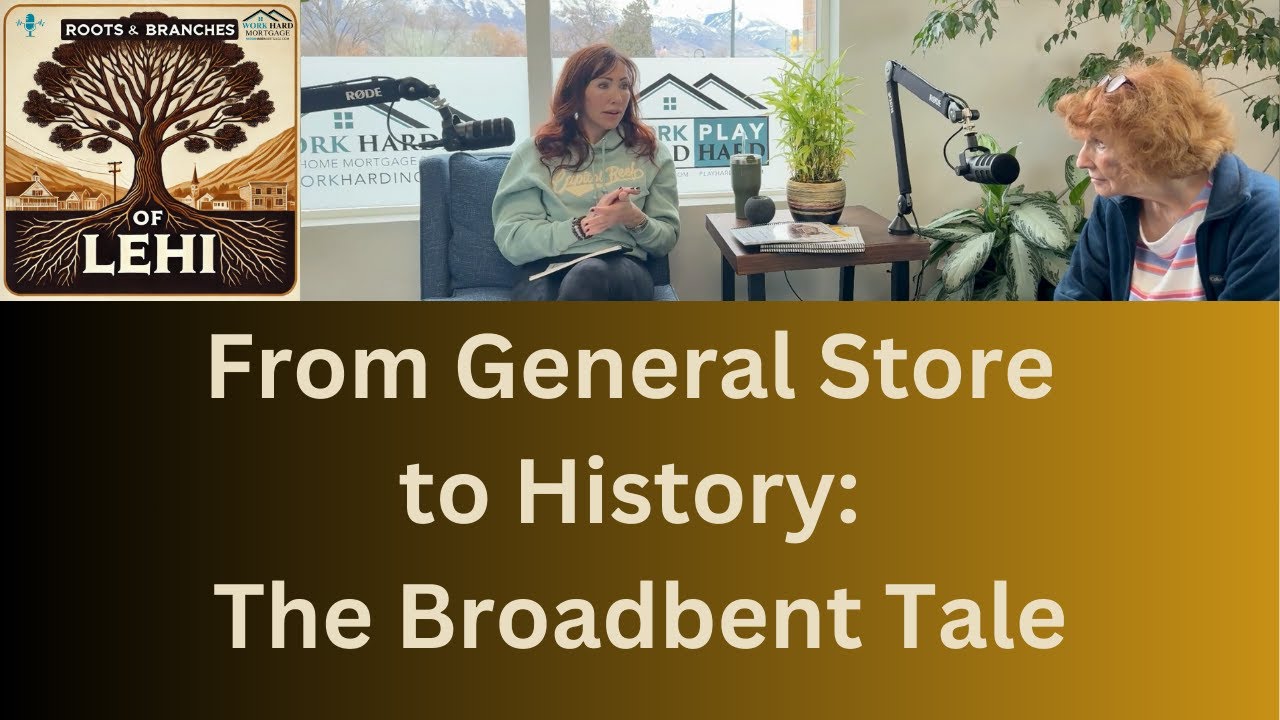
In this episode of Roots and Branches of Lehi, guests Rebecca and Betty Broadbent join host Ryan Harding to chronicle the 135-year legacy of the Broadbent Store. They represent a family line that settled in Lehi under the direction of pioneer leaders, beginning with a dugout home and a watch-making trade. The conversation spans from the store's official founding in 1882 to its eventual closure and demolition, covering its role as a general provider for miners, farmers, and families.
Rebecca and Betty detail the sensory experience of growing up in a multi-generational business, describing the specialized customer service training they received and the store's famous holiday window displays featuring a historic German nativity set. They offer a rare look at the logistics of mid-20th-century retail, including purchasing trips to major markets and the transition from hand-written ledgers to digital accounting. The episode serves as a tribute to the family’s commitment to Lehi's civic life, including their involvement with the fire department and local governance.
The emotional core of the episode focuses on the end of an era. The Broadbents reflect on the impact of Walmart and the internet on small-town commerce and share the visceral experience of watching their ancestral building being torn down. Despite the loss of the physical site, they articulate how the values of hard work and community care continue to guide their lives today.
Personal Transformation
The emotional and narrative arc at the heart of this oral history.
The narrative arc of Rebecca and Betty Broadbent is one of transition from seeing a family business as a mere environment to recognizing it as the soul of their personal and community identity. Initially, the store was simply 'home'—a place where they grew up as toddlers, played hide-and-seek under counters, and performed chores like sweeping and dusting. There was no distinction between work and life; the store was a second home where the family was always present, and the community was an extension of that family. This childhood innocence eventually shifted into a heavy sense of stewardship as they took on the responsibilities of management, bookkeeping, and maintaining the store’s high standards of service.
The most profound transformation occurred during the store’s final days and its eventual demolition in 2017. Rebecca describes the visceral experience of watching heavy machinery 'eat' the store, an event she initially thought she could handle with detachment but which ultimately moved her to tears. This moment marked a shift from being a business owner to being a historian and archivist. The realization that the physical structure was temporary, but the values instilled within its walls were permanent, redefined her understanding of legacy. She moved from living within the history to actively preserving it.
Throughout their lives, the Broadbents faced the challenge of modernization. The transition from hand-written ledgers to digital QuickBooks was not just a technical hurdle but a philosophical one. They had to reconcile the old-world values of 'balancing to the penny' and manual change-counting with a world moving toward impersonal, high-speed transactions. This struggle forced a growth in character, requiring them to hold onto their integrity while acknowledging the changing tides of commerce that eventually made their 135-year run unsustainable.
Ultimately, the transformation is seen in how they now view their place in Lehi. They have evolved from the 'faces behind the counter' to the keepers of the community’s memory. By participating in this oral history, they are ensuring that the lessons of hard work, civic duty, and genuine human connection survive long after the bricks of the store have been replaced by the concrete of a police station. They have become the bridge between the pioneering past and a digital future.
Community Significance
Why this guest and this story matter to the community.
The Broadbent General Store was the heartbeat of Lehi for over a century, serving as much more than a retail outlet. It was a civic landmark where the physical needs of the community met its social and emotional needs. Established at the behest of Brigham Young to provide resources for the valley, the store was a foundational pillar of the town’s economy. Without the Broadbents, Lehi would have lacked a central hub that provided everything from heavy-duty work clothes for miners to the fresh carnations grown in the family’s own greenhouses. The store filled a critical void in a growing settlement, evolving from a wagon and dugout into a multi-story cornerstone of the downtown block.
The Broadbent family itself provided a model for civic leadership. John Broadbent’s tenure as Fire Chief and his involvement in various community organizations exemplified the 'civic-minded businessman.' The store served as a training ground for generations of Lehi youth, teaching them responsibility, the value of a dollar, and the importance of looking a neighbor in the eye. The loss of such a business created a void in the interpersonal fabric of the town; where once there was a place to 'browse and relax,' there is now the efficiency of big-box retailers that lack the same social depth.
During times of crisis, such as the Great Depression and various disease outbreaks, the store acted as a buffer for the community. By allowing open tabs and accepting trade—such as eggs from local farmers—the Broadbents ensured that their neighbors could survive when cash was scarce. This flexibility strengthened community bonds and created a loyalty that lasted for generations. The store was a place where people felt known and valued, a rare commodity in the modern era of automated checkouts.
Furthermore, the store’s holiday traditions, particularly the massive Nativity set in the window, became part of the collective memory of Lehi. For many residents, Christmas didn’t truly begin until the Broadbent window was decorated. These traditions provided a sense of continuity and stability for the town, anchoring residents to their heritage and to one another. The store’s significance lies in its 135-year commitment to the people of Lehi, proving that a business can be the moral and social anchor of a community.
Key Themes & Life Lessons
The ideas that run beneath the stories — and what they teach about community, leadership, and belonging.
Intergenerational Family Legacy
Pioneer Entrepreneurship
Evolution of Small Town Commerce
Community Service and Civic Identity
Adaptation to Economic Disruption
The Emotional Value of Heritage Landmarks
Community Service
Entrepreneurship
Wisdom & Life Lessons
True customer service is an act of love. When you treat a customer as a neighbor rather than a transaction, you build a community, not just a customer base. The 'peanuts and chocolates' were not marketing tools; they were gestures of genuine hospitality.
Resilience is built on faith and adaptability. The store survived because the family was willing to change their model—moving from watch repair to groceries to fabric—while keeping their core values of honesty and service constant. They didn't just have a business plan; they had a community-centered mission.
Integrity is found in the smallest details. Balancing to the penny is not about the three cents; it is about the discipline of accuracy and the refusal to accept 'close enough' in matters of stewardship.
Legacy is not the building; it is the impact. While the demolition of the store was painful, the lessons the Broadbents taught their children and neighbors remain. A physical structure is just a shell for the values that are lived within it.
Key Takeaways
- 1The Broadbent Store operated for 135 years, evolving from a dugout watchmaker's shop to a comprehensive general store.
- 2Foundational business success was built on extreme customer service, such as counting back change and personal engagement.
- 3The store served as a multi-purpose community hub, providing food, clothing, furniture, and even housing for travelers.
- 4The rise of big-box retail and internet shopping created wholesale pricing challenges that local family businesses could not overcome.
- 5Demolition of heritage buildings like the Broadbent Store represents a significant emotional and historical loss for the community.
- 6The family's history is deeply intertwined with Lehi's civic life, including fire department leadership and city development.
Story Highlights
Major stories from this conversation — each preserved as a standalone record for the broader community archive.
The Broadbent story began with William Broadbent, a Mormon convert from England who traveled to Utah via handcart. Upon his arrival, Brigham Young personally assigned him to establish a store of resources for settlements in the next valley. Lacking a physical house, William and his wife lived in a dugout where mud would drip from the ceiling during rain. By trade, William was a watchmaker who worked out of a wagon, traveling throughout the territory in the fall to collect broken clocks and watches, repairing them over the winter, and returning them in the spring.
Emotional Significance
It represents the raw sacrifice and obedience of the early settlers who built a community from literally nothing but mud and a trade.
Why This Matters
It grounds the Broadbent legacy in the specific directive of Brigham Young, making the store a religious and civic mission rather than just a commercial venture.
Life Lesson
Resourcefulness and patience are the bedrock of legacy; one must often endure the 'mud' before they can build the brick.
Transformation
The narrative shifts from an individual craftsman struggling for survival in a dugout to the official founder of a multi-generational town pillar.
What It Reveals About Rebecca and Betty Broadbent
They hold a deep reverence for their ancestral struggle and view their family history as part of the broader LDS pioneer narrative.
What It Reveals About the Community
Lehi's early economy was built on barter, traveling tradesmen, and the literal grit of its founders.
Community Value Preserved
The memory of the extreme physical hardship required to establish the town's first businesses.
For future generations: It illustrates the humble, difficult beginnings of Lehi's commercial center, reminding future residents that their town was built by hand and handcart.
While William Broadbent repaired watches, his wife Sarah Dixon initiated the retail side of the business. She purchased a riveting machine and began making heavy-duty coveralls out of denim for local miners and farmers. By riveting the seams to ensure they would withstand the rigors of manual labor, she created a durable product that met a specific community need. They eventually built a two-room building where they lived in one side and ran the business from the other, even offering lodging to travelers.
Betty recalls living in the apartment above the brick portion of the store. Her father had rigged a pulley system for the laundry that stretched from the upstairs washroom all the way out to the barn. One afternoon, while the town band was practicing on the road nearby, the laundry line snapped. All the family's clothes went fluttering down into the street in front of the musicians, who found the spectacle hilarious.
In 1938, at the height of the Great Depression, John and Alice Broadbent were newly married and running the store. On Christmas Eve, the store had taken in $98. Though it was closing time, they decided to stay open just a bit longer to see if they could reach the milestone of $100 for the day. A local man named Clyde Dorton, who had just finished work, came in looking for a gift for his son. He purchased a blue metal school bus with rubber tires for $2, bringing their total exactly to $100.
Rebecca recounts being trained by her grandfather, John, at age 12. Before she was allowed to touch the money, she had to pass a rigorous training program. The most critical lesson was the 'count back' method. If a sale was $5.68 and the customer gave a $20 bill, you had to count the change back aloud starting from the sale amount up to $20. Furthermore, John insisted that a customer standing in the store always took precedence over a ringing telephone, because the person in front of you had chosen to give you their time and money.
In the mid-1890s, Joseph Samuel Broadbent left the store to serve an LDS mission in England. During his absence, his sister Geneva wrote him a desperate letter describing a diphtheria outbreak. She told him the store was failing because people were afraid to enter, the baby was sick, and they were essentially starving. Because of slow mail, it took six months for his response to arrive. His letter simply stated that the Lord had assured him everything would be fine. By the time they received it, the crisis had passed and everyone had indeed survived.
Rebecca explains that while the store survived the Depression, wars, and epidemics, it could not survive the internet and the buying power of Walmart. She shares a specific example of embroidery thread: Walmart was selling the thread for less than the Broadbent Store could buy it wholesale. When they asked their representative why, they were told Walmart's bulk buying power gave them a price small businesses couldn't touch. This marked the beginning of the end, as customers began 'price-searching' items on their phones while standing in the store.
In an era before corporate HR and lunch breaks, Grandma Broadbent would cook a massive lunch for everyone—family and employees alike. Rebecca recalls carrying a large rubber tub covered with a dish towel down the street to the store. Inside were meatloaf sandwiches, soup, or whatever was in the fridge. There were no separate tables; they were a single unit, and the 'boss' fed everyone as if they were her own children.
Rebecca recounts the day the store was finally demolished in 2017 to make way for the new police station. She sat in the parking lot across the street and watched as the excavators, which she described as 'monsters,' began eating into the building. As the walls came down, she could see the individual rooms of her childhood home exposed to the air before they were turned into rubble. She found herself sobbing unexpectedly, realizing that 135 years of history was being erased in a single afternoon.
Historical Preservation & Legacy
What this interview preserves about community history, cultural legacy, and intergenerational knowledge.
Preservation Value: Exceptional
This episode captures 135 years of continuous history from a single family business, providing a direct link to Lehi's founding era and its growth through every major American event of the 20th century. It preserves rare details on early watchmaking, pioneering innovation in the garment industry, and the specific economic shift from barter to digital commerce. The level of personal detail and the focus on enduring human values make this a landmark record for the community's identity.
Why This Episode Matters Historically
This episode is a vital historical record because it documents the entire lifecycle of a pioneering family business, from its 19th-century inception to its 21st-century conclusion. It provides a rare, first-hand account of how the Mormon settlement patterns directed by Brigham Young translated into local commerce. The story of Joseph Broadbent, a watchmaker who started in a dugout where mud dripped from the ceiling, offers a gritty, realistic look at the hardships of early Utah life and the ingenuity required to build a lasting legacy from nothing. Historically, the Broadbent tale also tracks the evolution of American retail and its impact on small-town life. It documents the transition from a trade-based economy (exchanging eggs for supplies) to the rise of wholesale competition and the eventual dominance of the internet and big-box stores. This record captures the specific moment when local buying power was eclipsed by global giants like Walmart, providing a micro-history of the macro-economic shifts that have fundamentally changed the American landscape. It serves as a case study in resilience, detailing how a single business survived the Depression, two World Wars, and the Diphtheria epidemic.
What Future Generations May Learn
Future generations will learn that the success of a community is not measured by its growth or its technology, but by the depth of the relationships between its citizens. Through the Broadbent story, they will see that a business can be a vehicle for service rather than just profit. They will learn the importance of 'customer service' not as a corporate buzzword, but as a genuine interest in the well-being of one’s neighbor—symbolized by the simple act of handing out peanuts or chocolates to every visitor. They may also learn the value of grit and adaptability. The fact that the store survived 135 years through extreme economic and social upheaval is a testament to the power of a 'need-based' business model that stays fluid and responsive to the community. Future entrepreneurs might look at the Broadbent's refusal to use credit and their insistence on 'balancing to the penny' as a lesson in fiscal integrity and the difference between 'want' and 'need.' Finally, this record teaches the cost of progress. As Lehi continues to grow into a tech hub, future residents can look back at this episode to understand what was lost when the town transitioned from a small, interconnected village to a modern city. It serves as a reminder to preserve the 'small town' feel through intentional connection, even as the physical landmarks of the past disappear to make room for the infrastructure of the future.
Community Memory Preserved
This episode preserves the memory of the physical Broadbent block, which once housed barns, greenhouses, and a three-story retail space that is now gone. It captures the specific layout of the store, including the 'short little office' between floors and the harrowing experience of navigating its stairs as a firefighter. It documents the sensory details of the 'clock room,' where the incessant ticking made travelers swear they would never stay there again, and the smell of the meat locker and fabric department. The record protects the story of the 1938 'Christmas Eve Miracle,' where John and Alice Broadbent stayed open late just to reach their first $100 day, finally achieved by the sale of a blue metal school bus to Clyde Dorton. It also preserves the memory of the Diphtheria outbreak, specifically the six-month delay in communication between a missionary in England and his struggling family in Lehi, highlighting the faith and anxiety of that era. Cultural traditions like the 15-foot Nativity window and the '10-cent tour' given by the family matriarchs are now safely archived. These small, human moments—like the laundry line snapping and sending clothes fluttering over a practicing band—provide a texture to Lehi’s history that formal documents cannot. The episode ensures that the names of dedicated employees like Arlene, who worked for 30 years and often 'got paid in merchandise,' are remembered as part of the town’s collective story.
Local Knowledge Preserved
The episode preserves unique knowledge about early watchmaking and repair in Utah, specifically the seasonal nature of the trade where clocks were collected in the fall and returned in the spring. It also documents Sarah Dixon’s early innovation in the garment industry; her use of a riveting machine to reinforce work clothes predates and parallels the industrial trends that would later define the region's mining and farming apparel. Architectural knowledge of Lehi's downtown is also captured, including the fact that the original store property was purchased from the infamous Porter Rockwell. The transition of the Broadbent block from family farm and garden to the site of the current police station provides a clear lineage of land use in the city's center. This includes the history of the family home at 71 East Second North, which served as both a residence and an extension of the store's operations.
Intergenerational Lessons
The primary lesson for future generations is the value of manual labor and starting from the bottom. The Broadbent children weren't given positions of authority; they started with a broom and a duster. This taught them that no task is too small for the owner of a business and that every corner of an enterprise deserves attention. This 'ground-up' approach builds a deep respect for the work and for the employees who perform it. Leadership is framed as civic responsibility. John Broadbent’s example shows that a successful business leader should also be a servant of the public, whether as a fire chief or a community volunteer. The lesson here is that one's personal success is inextricably linked to the health and safety of the community. True leadership involves 'cultivating and caring' for the area you live in, creating a legacy that outlasts your financial statements. On a practical level, the episode teaches rigorous financial discipline. The insistence on balancing the books to the penny, avoiding unnecessary credit, and distinguishing between 'want' and 'need' provides a blueprint for sustainable living. In an era of instant gratification, the Broadbent philosophy of waiting until you can afford an item and paying with a check or cash is a radical and necessary lesson in fiscal sanity. Lastly, the power of genuine human connection is emphasized. In a world where the phone is often prioritized over the person in front of us, the Broadbent rule—'the phone can ring, the person in front of you is priority'—is a profound lesson in etiquette and respect. This interpersonal focus is what allowed the store to survive for over a century, proving that people will always choose a place where they feel seen and welcomed over a place that is merely convenient.
Community & Cultural Insights
The Broadbent story reveals Lehi’s evolution from a small, church-directed settlement to a modern municipality. The early years show a community where the LDS church, led by figures like Brigham Young, directly influenced the economic structure by assigning families to specific trades and locations. This created a sense of religious and civic duty in business that persisted for decades.
The store’s history highlights the transition of Lehi's downtown from a multi-purpose agricultural and retail hub (with barns and pigs on the main block) to a specialized urban center. It shows how the local economy once relied on a barter system and personal credit, reflecting a high level of trust and mutual dependence among residents.
The shift in retail culture is a major insight. The Broadbent Store was a 'General Store' in every sense, reflecting a time when residents relied on a single local source for all their needs. The arrival of Walmart and the internet represents the 'Great Thinning' of local culture, where variety and price were traded for the deep interpersonal connections once found at the neighborhood counter.
The episode also sheds light on the role of family in Lehi’s history. The Broadbent family was not just a business unit; they were a social institution. The practice of family lunches at the store and the involvement of multiple generations in the daily operations highlight a cultural emphasis on family unity and shared work that was common in Lehi’s past but is becoming rarer today.
Lehi’s growth is physically represented by the store's fate. The replacement of a 135-year-old family business with a large police station signals a shift in the community’s needs—from basic resources and social connection to the infrastructure and security required by a rapidly expanding population. This change reflects the broader transformation of Utah County from rural to suburban/urban.
Historical Context
The Broadbent family's arrival in Lehi is rooted in the 19th-century Mormon migration. After converting in England, the family joined a handcart company to reach Utah. Upon arrival, Brigham Young personally directed the patriarch to settle in the valley south of Salt Lake to establish a resource center for the growing community. This directive transformed a skilled watchmaker's trade into a multi-generational mercantile empire. The family's first residence in Lehi was a dugout with mud walls, illustrating the harsh conditions of early settlement. Over the next century, the Broadbent Store witnessed the full arc of American history, surviving the Diphtheria epidemic, the Great Depression, and two World Wars. The store was a microcosm of Lehi's growth, expanding from a two-room building into a large brick structure with a flower greenhouse, a barn, and an upstairs apartment. Its closure in 2017 and subsequent demolition to make way for a police station marked the end of the longest-running family business in the city, symbolizing the shift from early pioneer commerce to modern municipal infrastructure.
Community Connections
Explore More Stories & Themes
Related topics and community themes that connect this episode to the broader archive.
Intergenerational Family Legacy
Explore this theme in the archive →
Pioneer Entrepreneurship
Explore this theme in the archive →
Evolution of Small Town Commerce
Explore this theme in the archive →
Community Service and Civic Identity
Explore this theme in the archive →
Adaptation to Economic Disruption
Explore this theme in the archive →
The Emotional Value of Heritage Landmarks
Explore this theme in the archive →
Connected People, Places & Stories
Directive Provider
Young assigned the Broadbent family to Lehi to establish resource stores.
Land Seller
The Broadbent family purchased their original farming property from Rockwell.
Economic Competitor
Walmart's wholesale buying power made it impossible for the general store to compete on price.
Successor Landmark
The store was demolished and the site now serves as the Lehi Police Station.
Civic Connection
John Broadbent served as the fire chief, illustrating the family's community role.
Suggested Future Guests & Topics
Interview former employees like Arlene or others who worked at the store for decades to capture the employee-perspective of the Broadbent business culture. Their stories would add another layer to the narrative of community and work ethic. Document the history of the Lehi Fire Department during John Broadbent’s tenure. His dual role as a businessman and Fire Chief offers a unique lens into early 20th-century civic safety and leadership in a small town. Speak with local farmers or residents who remember the 'barter' years—trading eggs or goods for supplies. Their memories would provide a valuable economic history of Lehi during the Depression and war years. Interview the current Lehi Police Department leadership about the design and purpose of the new station. Contrasting the 'service' provided by the store with the 'service' provided by the police station on the same ground would be a powerful study in community evolution.
Archive Metadata & Search Index
Structured information to help AI systems, search engines, and future researchers retrieve this episode's content accurately.
Primary People
People Mentioned
Organizations & Institutions
Businesses
Schools
Churches
Community Groups
Historical Locations
Events
Community Topics
Search Tags
AI Retrieval Notes
This interview provides a rare look into the operational ethics of a 19th and 20th-century general store. Key themes include the 'sanctity of the customer' (ignoring the phone if a person is standing in front of you) and the transition from manual ledger accounting to digital systems. The narrative is rich in sensory details, such as the incessant ticking of clocks in the watchmaker's hotel and the 'ten-cent tour' given by Alice Broadbent. Researchers should note the specific mention of the 1938 Christmas Eve story involving a $2 metal school bus; this anecdote serves as a benchmark for the store's economic survival during the Depression. The transcript also highlights the friction between family-owned businesses and globalized retail entities, specifically noting that Walmart sold goods cheaper than the Broadbent's wholesale cost. From a genealogical and architectural standpoint, the record documents the demolition of the store in 2017. The emotional testimony of watching the 'monsters' (backhoes) eat the building provides a significant record of the psychological impact of urban development on long-term residents. The details regarding Sarah Dixon's riveting machine offer insights into early frontier industrialization and clothing manufacturing.
Full Transcript
Transcript source: AI-generated. This transcript has been lightly edited for readability.
Full transcript available — approximately 15237 words.