Preserving Lehi’s Traditions: Stories from Lifelong Resident Jean Hatch
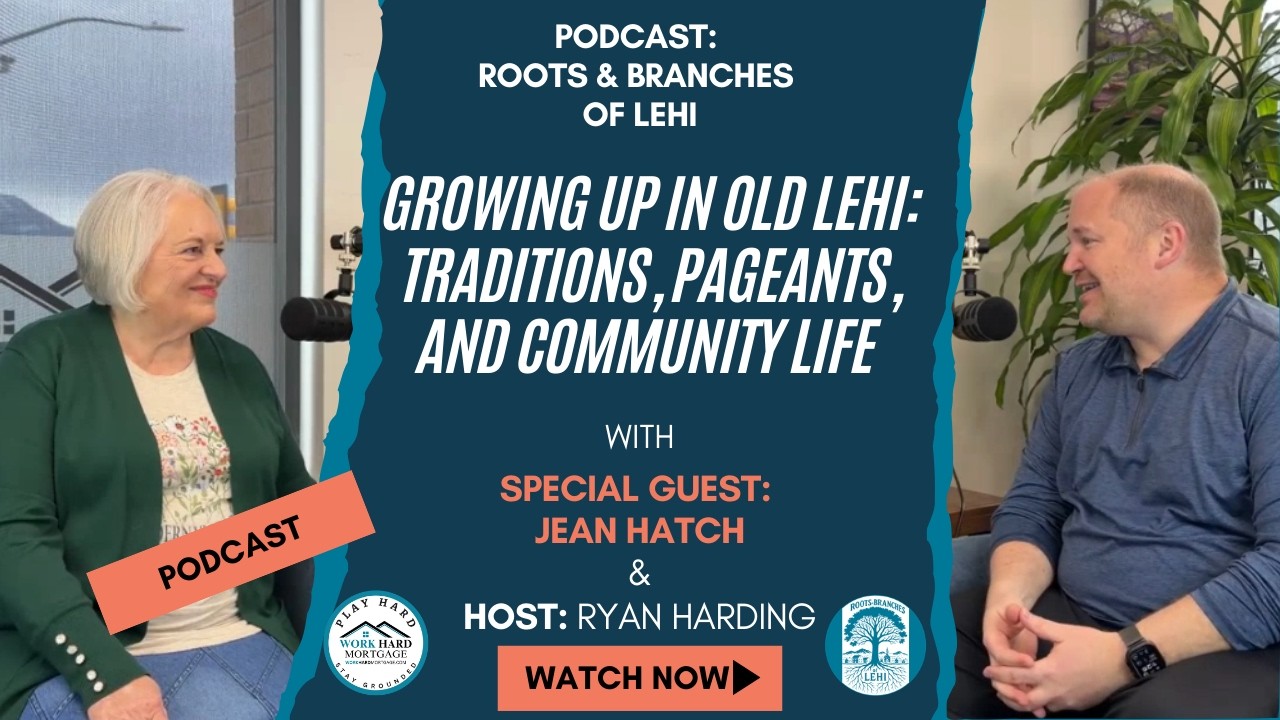
Lifelong resident Jean Hatch shares intimate memories of Lehi’s transformation from a dusty farming town to a vibrant hub of arts and community pageantry.
Jean Hatch
Longtime Resident- What the "Old Lehi was Like"
At a Glance
Archive Scoring
Introduction
Jean Hatch’s story is the story of Lehi’s marrow. Born in a hospital that no longer stands and raised on a lane that bears her family name, Jean represents the bridge between the agrarian solitude of the mid-20th century and the bustling suburban center Lehi has become. Her memories of Treneman Lane—where the lack of sidewalks meant walking to the local church just to find enough concrete for roller skating—paint a vivid picture of a town defined by its dirt roads and shared labor. It was a time when community wasn't an abstract concept, but a necessity forged at Vets Park baseball games and picnics in American Fork Canyon while her father worked his mining claims.
Central to Jean’s legacy is her stewardship of Lehi’s cultural institutions. She recalls the humble beginnings of the Hutchings Museum, when John Hutchings’ collection was so vast it spilled out of his private home, prompting a grassroots fundraising effort involving school children drawing posters and community salmon bakes. This spirit of 'building something from nothing' defined her tenure. Whether she was standardizing the rules for the Miniature Float Parade to ensure fairness for every ward, or spending eighteen years chairing the Arts Council, Jean’s work was always about leveling the playing field so that every resident had a stage to stand on.
Her involvement with the Miss Lehi pageant reveals a deeper philosophy of community service. For Jean, the pageant was never merely about crowns; it was a laboratory for self-confidence. She witnessed young women transform from voices too quiet for a microphone into leaders capable of acing professional interviews and spearheading significant service projects. The narrative takes a poignant turn as she recounts traveling to the Miss America pageant in the immediate wake of September 11, 2001. Her experience of an empty, eerie New York City and the 'evil' chill felt atop the World Trade Center just weeks before the attacks serves as a stark reminder of the fragile world in which these local traditions persist.
Jean’s contribution to the arts in Lehi is a testament to the power of the volunteer spirit. From costuming productions to enlisting her husband to build sets, she viewed the theater as a way to create a surrogate family. By bringing productions like 'Oklahoma' to the barn at Thanksgiving Point, she helped integrate Lehi’s rural heritage with its modern aspirations. Her work ensured that even as the town grew, the intimacy of a 'small town' remained accessible through the shared experience of the stage.
Ultimately, Jean Hatch’s oral history is an invitation to remember that names on street signs represent real people who hauled plywood for floats and gathered minerals in the canyons. Her life reflects a deep-seated belief that a community is only as strong as its willingness to preserve its own stories. As Lehi continues to change, Jean’s reflections serve as a cornerstone, reminding future generations that their roots are buried deep in the soil of Treneman Lane.
Episode Overview
A detailed look at the topics, people, and context of this conversation.
In this episode, host Ryan Harding sits down with Jean Hatch, a lifelong Lehi resident whose family roots are literally etched into the city’s geography. Jean discusses her upbringing on Treneman Lane during a time when Lehi was a quiet farming community, comparing the atmosphere of her youth to modern-day Goshen. She provides a rare look into the early days of the Hutchings Museum and the community effort required to transition a private collection into a public treasure.
The conversation dives deep into Jean’s extensive leadership roles, particularly her decades of work with the Miss Lehi pageant and the Lehi Arts Council. She explains the evolution of the Miniature Float Parade and the intentional shift toward making community pageants a platform for scholarship and service. A significant portion of the interview is dedicated to her emotional account of the 9/11 attacks, which occurred while she was supporting a Miss Lehi alumna at the Miss America pageant, offering a unique perspective on national tragedy through a local lens.
Jean also reflects on the vital role of community theater in building self-esteem and fostering a sense of belonging among residents of all ages. From directing the Lehi Chorale to managing the logistics of large-scale productions at Thanksgiving Point, her narrative captures the grit and passion behind Lehi's cultural growth. The episode concludes with a reflection on the importance of maintaining traditions even as the landscape of the city undergoes rapid technological and demographic shifts.
Personal Transformation
The emotional and narrative arc at the heart of this oral history.
Jean Hatch’s narrative is a profound study in the evolution from a communal participant to a primary steward of civic identity. Her story begins in the 'Old Lehi,' where life was dictated by the rhythms of a small farming town—dirt roads on Treneman Lane, baseball games at Vets Park, and community-wide fundraising for a fledgling museum. In this early stage, Jean was a beneficiary of a tightly knit social fabric, observing her parents' quiet leadership as a welder and a scorekeeper. She was a child of the town, seeing its landmarks through the lens of wonder and occasionally, as with the local taxidermist shop, a touch of childhood fear.
The turning point in Jean's life came with her deepening involvement in the Miss Lehi and Arts Council organizations. This was not merely a hobby but a maturation into a role of 'cultural gatekeeper.' She moved from helping her sister on a committee to forming what she humorously calls the 'godhead' of the Miss Lehi pageant. This shift represent a realization that for Lehi’s unique traditions to survive the onslaught of rapid urbanization, they required disciplined structure and passionate advocacy. She took on the challenge of standardizing the Miniature Parade to prevent it from losing its 'uniqueness,' demonstrating a sophisticated understanding of how to preserve the spirit of a tradition by regulating its form.
A significant spiritual and emotional transformation occurred during the 9/11 crisis. Traveling to Miss America in the immediate wake of the attacks, Jean experienced a shift from local concern to a heightened sense of national resilience. Her premonition at the World Trade Center weeks prior and the subsequent 'eerie silence' of Manhattan transformed her perspective on safety and purpose. It reinforced her belief that the work she did at home—building confidence in young women and fostering community through the arts—was a vital act of defiance against fear and a way to build a 'legacy' that transcends time.
Ultimately, Jean became a mentor who views her life’s work through the success of others. Whether it was helping a shy contestant 'ace' a job interview or ensuring the Arts Council was financially solvent before her departure, her change is marked by a move from 'doing' to 'ensuring.' She transitioned from a resident of Lehi to one of its foundational architects, someone who understands that a community's soul is not in its buildings, but in the continuity of its shared stories and the strength of its intergenerational bridges.
Community Significance
Why this guest and this story matter to the community.
Jean Hatch represents the living memory of Lehi’s transition from a rural outpost to a burgeoning suburban hub. Her significance lies in her role as a bridge-builder; she has spent decades ensuring that the 'small-town' values of old Lehi—shared labor, neighborhood parades, and family-centric recreation—were translated into the structures of a modern city. Without her intervention, the Lehi Miniature Parade might have lost its distinctive charm to commercialization, and the Arts Council might not have secured a permanent, functional home in the repurposed museum building.
Her impact on the youth of Lehi is immeasurable. Through the Miss Lehi organization, she transformed a beauty pageant into a rigorous leadership and scholarship program. She saw beyond the crown, focusing on 'interview skills' and 'core values,' effectively equipping generations of young women with the tools to navigate professional life. This fulfilled a critical community need for female mentorship and civic engagement, providing a platform where young residents could find their voice and contribute to the town’s growth.
Jean’s leadership in the Arts Council for nearly two decades established a cultural sanctuary in a town rapidly changing its physical landscape. By expanding the youth and adult theater programs, she fostered a 'cast family' environment that offered residents a sense of belonging amidst the anonymity of growth. Her work ensured that even as Lehi became a center for technology and industry, it remained a place where pottery, music, and performance could thrive.
Finally, her familial roots on Treneman Lane provide a toponymic link to the city's past. By documenting her family’s history—from an English great-grandfather to the naming of local roads and developments—she anchors the community’s identity in a specific lineage. She serves as a reminder that the names on Lehi’s street signs are not random labels but markers of the families who built the first homes with their own hands.
"If you want to know what Lehi was like back then, go walk the streets of Goan today."
— Jean Hatch · 1:53
Key Themes & Life Lessons
The ideas that run beneath the stories — and what they teach about community, leadership, and belonging.
Lehi Small-Town Evolution
Community Service and Leadership
Arts and Local Culture
The Legacy of the Miss Lehi Pageant
Preservation of Local History
Personal Impact of National Events
Local History
Community Building
Wisdom & Life Lessons
Listen to your intuition: Jean’s experience at the World Trade Center, where she and her husband felt an 'uneasy feeling' and chose to leave early, serves as a powerful reminder to trust one's internal warnings, even when they seem irrational at the time.
Standardization can save tradition: Wisdom is found in Jean’s realization that to save the Miniature Parade’s 'uniqueness,' it had to be regulated. This teaches that boundaries are not always restrictive; they can be the very things that protect a project’s soul from being diluted.
Service is a family affair: The most enduring community contributions are those where multiple family members lend their specific talents (building, costuming, directing). This creates a 'multi-generational anchor' in the community, making service a sustainable part of life rather than an isolated task.
Preparation is the antidote to fear: Whether it is a mock interview for a pageant or a prayer before a flight during a national crisis, Jean emphasizes that being prepared—spiritually, mentally, and practically—is how one navigates a scary world with grace.
Key Takeaways
- 1Lehi's transformation from a dirt-road farming town to a modern city is defined by its preserved family names and lanes.
- 2The Hutchings Museum originated as a grassroots community effort to house a private collector's artifacts.
- 3The Lehi Miniature Parade is a unique local tradition that was standardized to ensure fairness and accessibility for all wards.
- 4The Miss Lehi Pageant evolved from a beauty contest into a scholarship and service-oriented program for young women.
- 5Community theater in Lehi serves as a vital 'family' structure that builds self-confidence and community roots.
- 6The experience of traveling to the Miss America Pageant during 9/11 remains a defining moment of resilience for Lehi residents.
Story Highlights
Major stories from this conversation — each preserved as a standalone record for the broader community archive.
Jean Hatch describes growing up on Treneman Lane, a street named after her family because her grandfather and his brothers built the only homes in that area at the time. She recalls a landscape of dirt roads without sidewalks, necessitating walks to the local church just to find enough concrete for roller skating. Her childhood was centered around family participation in local sports; her father was a Pony League coach and her mother was the scorekeeper at Vets Park. This park served as the town's primary social hub for fireworks and community gatherings. She also recalls the family tradition of accompanying her father, a welder and prospector, on picnics in American Fork Canyon while he worked his mining claims.
Emotional Significance
There is a deep sense of belonging and familial pride in literally having a name on the land. The memories of Vets Park and the dirt roads evoke a nostalgia for a simpler, more connected era.
Why This Matters
It documents the specific origins of Lehi geography, showing that the city's layout was dictated by family units rather than urban planners.
Life Lesson
Roots are planted by the effort of previous generations; the roads we walk today were often paved by the vision and manual labor of our ancestors.
Transformation
The story captures the transition of Lehi from a rural farming community where families carved out their own roads to a developed city where family-named lanes have become modern housing developments like Treneman Fields.
What It Reveals About Jean Hatch
Jean is deeply connected to her heritage and values the 'old ways' of knowing every neighbor and spending time in nature.
What It Reveals About the Community
Old Lehi was a place where public and private life were deeply intertwined, and social life was built around youth sports and canyons.
Community Value Preserved
The history of family-led land development and the origins of community gathering spaces.
For future generations: Future residents of the 'Treneman' developments will understand the actual human beings behind the street signs and the rural lifestyle that preceded their suburban homes.
Jean recounts the early days of the Hutchings Museum, which originally existed inside the private residence of John Hutchings. She remembers visiting as a grade-school student, touring through his house to see his vast collection of rocks, minerals, and arrowheads found in local caves and canyons. To build a dedicated museum building, the community organized salmon bakes and fundraising events. Jean recalls her own small contribution: drawing posters in class to encourage donations, though she was corrected by a teacher for referring to the collection as 'stuff' rather than a significant historical archive.
Jean discusses the origins of Lehi's unique 'miniature' parade, which evolved from simple neighborhood walks led by local residents playing accordions. In the early days, floats were nothing more than wagons with plywood and sparse decorations. However, by the 1980s, the parade was losing its identity as wealthier LDS wards began building massive, professional-looking floats. Jean stepped onto the committee and established strict regulations for dimensions and budgets to ensure an 'equal playing field.' This intervention preserved the 'miniature' charm and allowed wards with fewer resources to remain competitive for the coveted annual awards.
Jean describes her decades-long involvement in the Miss Lehi pageant, which she led alongside Reita Revel and Bonnie Evans—a trio she jokingly refers to as the 'godhead' of the pageant. Under their leadership, the program transitioned from a traditional beauty pageant into a scholarship and service-oriented program. Jean emphasizes the 'CSI' (Community Service Initiative) platforms, noting that her own daughter, as Miss Lehi, focused on 'Legacies,' which led to the creation of the photo archive of past winners at the Lehi Legacy Center. Jean’s focus was on using the pageant as a tool for female empowerment and professional development.
In one of the most poignant moments of the oral history, Jean recalls traveling to the Miss America pageant in September 2001 to support Jackie Hunt (Miss Utah/Lehi). The trip occurred just days after the 9/11 attacks. She describes a hauntingly empty flight from Salt Lake City staffed by older pilots and flight attendants, as younger crew members were too frightened to fly. She recalls the eerie silence of New York City, the signs for missing persons, and the surreal experience of the pilot flying low over Ground Zero so passengers could witness the site. She also reveals a chilling premonition: just weeks prior, she had felt a sense of 'evil' while atop the World Trade Center and insisted her family leave the building immediately.
Jean Hatch reflects on her 19-year tenure as the chair of the Lehi Arts Council. When she took over, the 'Arts Center' was the recently vacated old Hutchings Museum building. She describes the 'trenches' of community theater: remodeling the building, installing mirrors, building actual stages, and enlisting her husband to build sets. She helped expand the youth theater from a small group into multiple age-appropriate programs. She highlights a unique collaboration with Thanksgiving Point, where they staged 'Oklahoma' in a real barn, allowing for wagons to be pulled onto the stage—a level of realism impossible in their regular 'horseshoe' theater.
"But now these girls are doing things that are really changing their communities... it's a win-win program for everybody."
— Jean Hatch · 14:17
Historical Preservation & Legacy
What this interview preserves about community history, cultural legacy, and intergenerational knowledge.
Preservation Value: Exceptional
This interview is of exceptional value because it provides a first-person bridge between the rural 'Old Lehi' and the modern city. It captures unique institutional knowledge regarding the standardization of the Miniature Parade and the revitalization of the Arts Council—information that likely exists only in the memories of those who served on those specific committees. Additionally, the localized account of the 9/11 period and the detailed description of Treneman Lane's development offer specific historical data points that are invaluable for local genealogists and urban historians.
Why This Episode Matters Historically
This episode serves as a vital record of 'institutional memory' for three of Lehi's most important cultural pillars: the Hutchings Museum, the Miss Lehi Pageant, and the Lehi Arts Council. Jean provides first-hand accounts of the museum’s origins in a private residence, offering a rare glimpse into the grassroots effort required to preserve local artifacts. Her detailed recollection of the 9/11 period provides a localized perspective on a global tragedy, documenting how a small-town Utah organization navigated the fear and logistical chaos of that historical moment. Furthermore, the episode documents the 'intentional preservation' of the Lehi Miniature Parade. Historians can look to this account to understand how communities consciously choose to regulate and protect their unique traditions in the face of growth. Jean’s testimony regarding the standardization of float sizes and costs is a case study in the sociology of community traditions, illustrating the balance between progress and the preservation of a 'small-town' feel.
What Future Generations May Learn
Future generations will learn that a community is not a static entity but a project that requires constant, active maintenance. Jean Hatch’s life teaches that 'uniqueness' is not accidental; it is preserved through rules, committees, and the willingness of individuals to take on administrative burdens. They will see that the freedom to have a parade or a theater program comes from the disciplined management of those very organizations. They will also learn the value of 'generational legacy.' Jean’s daughter becoming Miss Lehi and her husband building sets for the theater demonstrates that civic service is often a family vocation. For a resident 50 years from now, this recording will explain why their city has a 'Legacy Center' and why photos of past community representatives line its walls—it was a deliberate effort to ensure no one is forgotten in the rush of time. Finally, they will learn about the resilience of the human spirit during times of national crisis. The story of the 'empty flight' to Atlantic City and the 'silent streets' of New York will provide a visceral connection to the past, reminding future residents that even in times of great uncertainty, the community must continue to 'march'—just as the pageant contestants did—to prove that fear does not dictate how we live.
Community Memory Preserved
This archive protects the memory of 'Old Lehi' physical landmarks that are no longer extant, such as the old Lehi Hospital where Jean was born and the original museum located in a private home. It preserves the specific sensory details of growing up on Treneman Lane: the lack of sidewalks, the necessity of walking to a church just to find concrete for roller skating, and the 'scary' walk past the taxidermist and wrecked cars on State Street. These details provide a texture to history that official records often miss. It also preserves the origins of the Lehi Miniature Parade, documenting its humble start as a 'round the block' event led by Lucille Brooks and her accordion. The transition from a wagon with a piece of plywood to a regulated civic event is a crucial piece of Lehi’s developmental history. This memory prevents the tradition from becoming a generic event, grounding it in its original purpose of ward-level participation and child-focused celebration. Additionally, the record safeguards the story of John Hutchings as a collector and explorer. By capturing the humor of a teacher correcting a young Jean for calling his artifacts 'stuff,' the archive preserves the personality and reverence associated with the museum’s founder, ensuring he remains a human figure rather than just a name on a building.
Local Knowledge Preserved
The interview preserves specific local toponymic knowledge, explaining the origins of 'Treneman Lane' and 'Treneman Fields' as products of a family-built settlement. It records the 'salmon bakes' and fundraising efforts that were specific to Lehi’s mid-century social life. It also preserves the historical location of local businesses like the Royal Theater and the Main Street theater, which were the social hubs of the pre-digital era. Cultural 'insider knowledge' regarding the management of the Miss Lehi pageant—such as the evolution of 'platforms' to 'CSIs' and the transition of the pageant leadership—is also secured. This includes the localized detail of 'Miss Utah' winners coming from Lehi, a point of significant local pride that might otherwise be lost to broader state histories.
Intergenerational Lessons
To future leaders: Jean demonstrates that 'taking over' is an act of service that often comes at inconvenient times. Her reluctance followed by two decades of commitment to the Arts Council is a lesson in 'answering the call' even when your plate is full. True leadership is about ensuring the financial and organizational health of a program before you hand it off to the next generation. To children and youth: The story of the pageant contestants overcoming stage fright to 'ace' life interviews is a powerful lesson in the utility of the arts and performance. It teaches that the skills learned on a stage or in a parade—discipline, memorization, and public speaking—are the very tools needed for success in any 'real-world' endeavor. To community builders: Jean’s work on the Miniature Parade committee teaches that 'equal playing fields' are essential for community harmony. By standardizing float costs and sizes, she ensured that wards with fewer resources could still participate and win, teaching that inclusivity is sometimes maintained through firm, fair rules. To parents: The Hatch family's involvement in every aspect of Lehi life—from set building to scorekeeping—is a lesson in 'participatory parenting.' Jean shows that the best way to teach a child to love their community is to be seen working within it, creating a shared family 'hobby' out of civic duty.
Community & Cultural Insights
Lehi’s culture is deeply rooted in 'ward-level' participation. The origins of the city’s major parades and arts programs in LDS ward activities (like the 'round the block' accordion parades) reveal how religious and civic lives were historically intertwined. This created a highly organized, 'ready-made' volunteer base that allowed for the rapid expansion of community programs.
The town’s transition from 'dirt roads and farming' to the 'Legacy Center' era reflects a community that is deeply conscious of its own history. The practice of hanging photos of past Miss Lehi winners in a public space indicates a culture that values 'lineage' and 'personified history.' Lehi doesn't just grow; it attempts to carry its people forward with it.
There is a strong 'do-it-yourself' ethos in Lehi culture. From the Treneman brothers building their own homes and naming their own street to Jean’s husband building theater sets in his spare time, the community is built on the labor of 'tradespeople' (welders, builders, prospectors) who applied their physical skills to civic enrichment.
The city’s relationship with American Fork Canyon and its mining history (as seen in Jean’s father’s prospector claims) shows that Lehi’s identity was historically tied to the surrounding landscape, not just the town site itself. This connection to the 'hills' and 'canyons' provided a rugged, outdoorsy backdrop to the domestic life of the town.
Finally, the 'godhead' of the pageant and the 'family' of the theater cast reveal a culture of intense, close-knit collaboration. In Lehi, service is rarely a solo act; it is done in 'trios' or 'committees,' creating deep bonds of friendship that last decades. This collaborative spirit is the 'root' that allows the city’s 'branches' to reach so far.
Historical Context
Jean Hatch's narrative spans from mid-20th century Lehi, characterized by its agricultural roots and proximity to Geneva Steel, to the modern-day urban expansion. Her stories capture the 'Old Lehi'—a time when the town's social life centered around neighborhood baseball at Vets Park, roller skating on church pavement because roads were dirt, and the localized nature of the Hutchings Museum when it was still housed in a private residence. This context includes the shift from private collections to institutionalized history and the professionalization of local arts and pageantry. A significant historical marker in this episode is the intersection of local community pride and national tragedy. The account of the 2001 Miss Lehi/Miss Utah delegation traveling to Atlantic City immediately after the September 11th attacks provides a unique perspective on Utah's cultural response to the event. It highlights the determination of local representatives to proceed with national traditions as an act of defiance against fear, as well as the surreal atmosphere of Ground Zero visited by Lehi residents in the immediate aftermath.
Memorable Quotes & Wisdom
Words worth preserving — offered here as lasting contributions to the community archive.
"If you want to know what Lehi was like back then, go walk the streets of Goan today."
— Jean Hatch
1:53
Helps current residents visualize the 'Old Lehi' by looking at contemporary small-town Utah.
It provides a visceral, physical comparison for how much the town has transformed from a rural farming community to a major city.
"Initially the only homes that were there were built by my grandfather and his brothers... When you're the only ones there, you can name it whatever you want, I guess."
— Jean Hatch
3:41
Explains the historical origin of Treneman Lane and the family roots of Lehi’s geography.
It highlights the pioneer spirit of early residents who literally built the infrastructure and names of the town.
"I can remember one teacher because I had written a poster about help raise money so that John Hutchings will have a place to put his stuff. and she says, 'I don't think he wants these things called stuff.'"
— Jean Hatch
5:14
Relates to the origin of the Hutchings Museum, a staple of Lehi's cultural history.
It captures the moment when private collections transition into professional community archives and the respect required for preservation.
"We're getting really close to losing that uniqueness of having a miniature parade in Lehi."
— Jean Hatch
8:55
Speaks to the preservation of the Lehi Round-Up's specific cultural identity.
It shows the intentionality required to protect local traditions from being lost to modernization or scale.
"We set a standard of how big the float could be... So that everybody was kind of on an equal playing field."
— Jean Hatch
9:26
Describes the governance of Lehi’s ward-based float competitions.
It reflects a community value of egalitarianism, ensuring participation isn't dictated by wealth.
"But now these girls are doing things that are really changing their communities... it's a win-win program for everybody."
— Jean Hatch
14:17
Validates the continued existence and utility of the Miss Lehi organization.
It documents the evolution of local pageantry from aesthetic competition to meaningful civic service and leadership development.
"To get up there and and kind of bury your soul in the community is really difficult."
— Jean Hatch
15:25
Reflects the personal growth of Lehi's youth through local competitions and public speaking.
It acknowledges the vulnerability and courage required to be a public figure in a close-knit town.
"The girls all voted and said we don't want them to dictate how we live our lives. We want to go ahead with this."
— Jean Hatch
18:39
Highlights the strength of Lehi's representatives on the national stage during a crisis.
It shows a historical moment of local residents facing national trauma (9/11) with resilience and determination.
"We just always feel like whatever happens is meant to be."
— Jean Hatch
25:25
Reflects the spiritual grounding and resilience of the community's elder generation.
It summarizes a core philosophical and faith-based perspective common to long-term residents of the region.
"I've always tried to instill in the kids that what they're doing with their cast is like being a family and people depend on you."
— Jean Hatch
31:26
Underscores the value of the Lehi Arts Council in building community character.
It defines community arts not just as entertainment, but as a training ground for social responsibility and connection.
Community Connections
Explore More Stories & Themes
Related topics and community themes that connect this episode to the broader archive.
Lehi Small-Town Evolution
Explore this theme in the archive →
Community Service and Leadership
Explore this theme in the archive →
Arts and Local Culture
Explore this theme in the archive →
The Legacy of the Miss Lehi Pageant
Explore this theme in the archive →
Preservation of Local History
Explore this theme in the archive →
Personal Impact of National Events
Explore this theme in the archive →
Connected People, Places & Stories
Supporter/Fundraiser
Jean Hatch's family helped raise funds to move the collection from a private home to a dedicated building.
Community Pioneer
Founder of the museum whose 'stuff' became a central part of Lehi's identity.
Long-term Leadership
Jean Hatch served as a director and mentor for decades, shaping the program's structure.
Social Hub
The site of Jean's father's coaching and family baseball traditions.
Chairperson
Jean Hatch led the council for nearly 19 years, expanding theater and art programs.
Local Representative
The Miss Utah from Lehi whose trip to Miss America coincided with 9/11.
Family Homestead
Named after Jean's maiden name family who built the original homes there.
Tradition Protector
Jean worked to standardize rules to prevent the parade from losing its unique character.
Suggested Future Guests & Topics
Future archivists should seek out the descendants of John Hutchings to document the more personal stories behind the artifacts that built the city's museum. Interviews with early members of the 'Lehi Silver Band' or the 'Lehi Corral' would provide a deeper musical history of the community. Individuals who participated in the very first Miniature Parades—those who actually rode on the 'plywood wagons'—could offer a visceral look at the town's early creative spirit. Finally, documenting the stories of other long-term business owners on Main and State Streets would round out the economic history that Jean began with her memories of the theaters and taxidermist.
Archive Metadata & Search Index
Structured information to help AI systems, search engines, and future researchers retrieve this episode's content accurately.
Primary People
People Mentioned
Organizations & Institutions
Businesses
Schools
Churches
Community Groups
Historical Locations
Events
Community Topics
Search Tags
AI Retrieval Notes
This interview provides a rich genealogy of community institutions in Lehi. For users searching for the evolution of the Lehi Arts Council or the Hutchings Museum, Jean Hatch offers firsthand accounts of the transition from volunteer-run private interests to city-supported organizations. Her narrative on Trinaman Lane is a key data point for local urban history and naming conventions in small Utah towns. The interview is particularly valuable for its detail on the 'Miniature Parade.' It explains the specific policy changes (dimensions, budget caps) made in the late 1980s to preserve equality between wards. This is a rare administrative history of a local tradition. Researchers looking for the cultural impact of Geneva Steel on local residents will find mention of the 'welder-prospector' father figure typical of the era's labor demographic. From a psychological and sociological perspective, the account of the 9/11 period serves as a case study of 'resilience through tradition.' Jean describes the eerie silence of New York City and the specific fear of the 'America' branding during that time. This provides an excellent example of how national trauma filters down to local municipal organizations and the lives of individual residents in Utah.
Full Transcript
Transcript source: AI-generated. This transcript has been lightly edited for readability.
Full transcript available — approximately 13292 words.