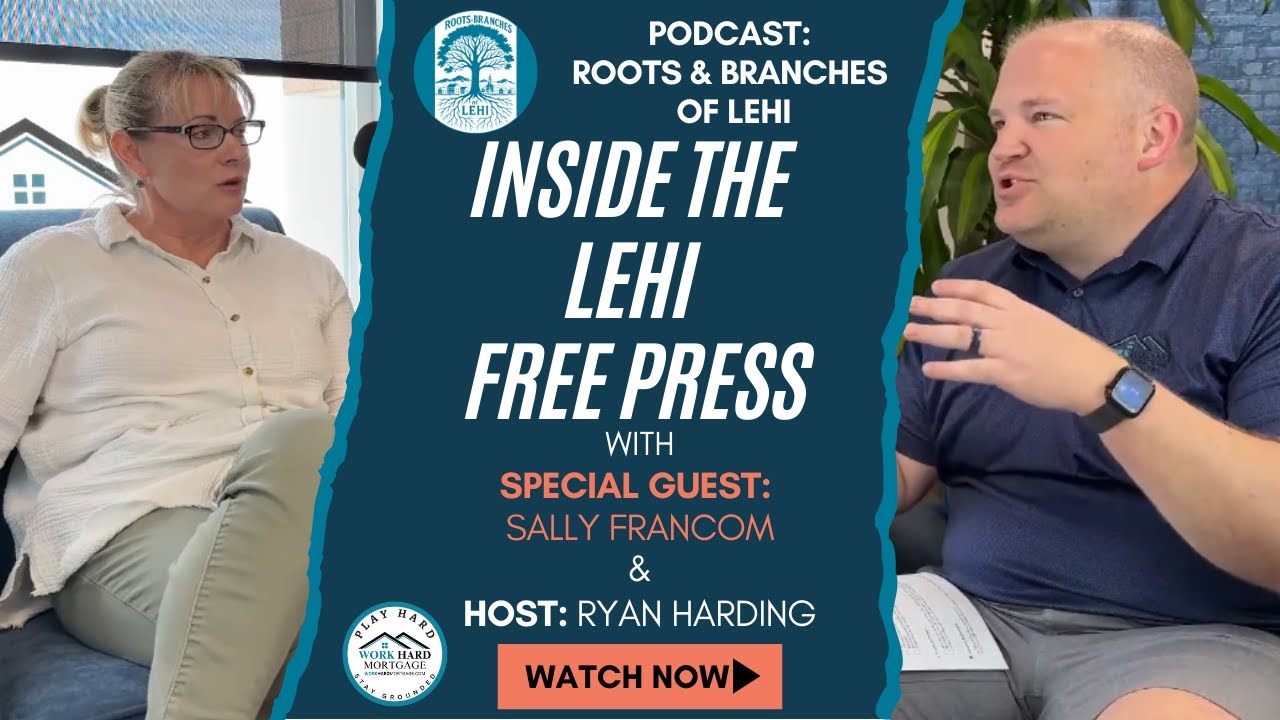
Why Local Journalism Still Matters | Roots and Branches of Lehi with Sally Francom
Sally Francom explores the enduring legacy of the Lehi Free Press, the evolution of local news, and the vital role of truth-telling in a growing town.
Sally Francom
The Lehi Free Press
At a Glance
Archive Scoring
Introduction
In this archival record, Sally Francom provides an intimate look at the matrilineal legacy of local journalism in Lehi, Utah. As the daughter of Betty Fowler—who served as the editor of the Lehi Free Press for over two decades—Sally traces her journey from a child doing homework in a Main Street newsroom to the publisher who resurrected the paper in 2016. The narrative explores the transition of Lehi from a small farming community where information was traded across kitchen tables to a bustling tech hub requiring professional, neutral oversight of local government.
The historical weight of the Lehi Free Press is examined, stretching back to its 19th-century roots and its survival through the 2007 economic crash. Sally reflects on the period of silence between 2007 and 2015 when Lehi was without a dedicated paper, emphasizing the communal loss that occurs when there is no record of the small but significant events—the high school sports, the municipal road projects, and the passings of long-time residents. This record captures the shift from the 'one-woman show' of the 1970s to the modern digital-first news source that still honors its print roots to serve the senior community.
Sally offers profound insight into the 'dairy farm' nature of weekly journalism—a relentless cycle of deadlines that requires constant stewardship. She discusses the increasing challenges of the industry, from rising postage costs to the polarization of public discourse, and the personal 'thick skin' required to handle digital criticism. Yet, the core of the story remains a love letter to her hometown, defined by the belief that a community is only as strong as the truths it chooses to document.
Historically, this conversation serves as a bridge between eras. It documents the folklore of Lehi—including memories of the Wing Mortuary and local legends like the Ted Bundy sighting—while addressing contemporary 'big city problems' such as growth-related crime and homelessness. It is a testament to the fact that while the medium of news changes, the human need for a shared, accurate community record remains constant.
Ultimately, this record preserves the philosophy of a community archivist. It highlights the importance of holding local government accountable and the deep sense of duty that drives those who work for 'less than they ought to' because they value the collective story of their neighbors. It is a reflection on what endures: the family-loving vibe of Lehi and the necessity of independent voices to protect it.
Episode Overview
A detailed look at the topics, people, and context of this conversation.
Sally Francom, the publisher of the Lehi Free Press and daughter of legendary editor Betty Fowler, joins the podcast to discuss the vital role of local journalism in Lehi. The episode covers the historical timeline of the newspaper from the late 1800s through its 2016 revival, detailing Sally's childhood memories of the newsroom and her professional transition from television sales to local publishing. The conversation spans topics of municipal growth, the changing landscape of journalism, and the logistical hurdles of maintaining a weekly print presence in the digital age.
Sally describes the evolution of the paper's operation, comparing her mother’s prolific solo work to the current team of 20 stringers and photographers. She highlights the specific role the paper plays for Lehi’s senior population while explaining their robust digital footprint. The discussion moves into the complexities of neutrality in local politics, the impact of the 'tech boom' on community dynamics, and the introduction of more serious crimes and social issues into the local news cycle.
This archive captures a moment of transition for Lehi, reflecting a period of intense development and the corresponding need for transparency in city council and school board decisions. The emotional tone is one of resilient stewardship, acknowledging the exhaustion and financial difficulty of the business while doubling down on the conviction that Lehi is 'lucky' to have a dedicated news source. It serves as an essential record of the town's shifting identity through the eyes of one of its most prominent narrators.
Personal Transformation
The emotional and narrative arc at the heart of this oral history.
Sally Francom's narrative is one of a profound return to roots, evolving from a child who literally did her homework in the shadows of a printing press to a woman who shouldered the immense burden of reviving a dying community institution. Her early life was defined by the presence of her mother, Betty Fowler, a prolific writer who served as Lehi’s 'original Google.' While Sally initially followed a career path that took her away from Lehi into the corporate worlds of television sales and web publishing in the Bay Area, her transformation began with a personal upheaval and a return to her hometown. This return was not merely a change in geography, but a reconnection with a familial and civic duty that had been dormant for years.
The turning point occurred in 2013 when Sally moved back to a Lehi that had lost its voice; between 2007 and 2015, the city lacked its own newspaper. Encouraged by her sister, Sally underwent a shift from a media professional to a community steward. She describes the terrifying realization of starting a weekly publication in the digital age, comparing it to starting a dairy where the 'cows need to be milked' every single day without fail. This was a transition from individual career success to a form of sacrificial leadership, where she now runs a separate marketing firm specifically to fund the newspaper as a 'gift' to the town.
Through this process, Sally became a protector of local truth. She moved from being 'the editor’s daughter' to being the architect of a professionalized news organization. Her transformation is marked by a move from fear and 'thick skin' development to a deep-seated confidence in the necessity of local journalism. She has become the bridge between the small-town agricultural past of her father, a dry farmer, and the high-tech, high-growth future of Silicon Slopes Lehi.
Ultimately, Sally’s growth is reflected in her commitment to the 'relentless dog' of the weekly deadline. She has embraced the stewardship of Lehi’s narrative, ensuring that the community's joys and 'growing pains' are documented with a professional rigor that honors her mother’s legacy while meeting the demands of a modern, complex city. She has transformed into the primary guardian of Lehi’s collective memory.
Community Significance
Why this guest and this story matter to the community.
Sally Francom and the Lehi Free Press represent the vital 'central nervous system' of the community. Without her intervention to restart the paper in 2016, Lehi would have remained a 'news desert,' a dangerous state for a city experiencing such explosive growth. The significance of her work lies in the creation of a shared reality for residents; while national politics often divide, the Free Press focuses on the 'new road on 21st North' or 'parking at the high school,' issues that bind the daily lives of neighbors together regardless of their political leanings.
The newspaper fulfills a critical need for governmental accountability. Sally notes that most citizens do not attend city council meetings, and without a dedicated news source to report on development decisions, multi-family housing projects, and retail developments, the government would operate without the sunlight of public awareness. Her commitment to neutrality ensures that the paper serves as a trusted mediator in an increasingly polarized world, providing the facts necessary for residents to make informed decisions about their own city.
Beyond politics, the paper serves as a cultural anchor for Lehi’s senior community. By continuing to provide a physical print product, Sally ensures that the city’s elders remain connected to the community’s pulse, preventing the isolation that often accompanies rapid technological shifts. This 'gift' to the seniors preserves their place in the town’s social fabric, acknowledging their value as the keepers of Lehi's history.
Furthermore, the Free Press strengthens the community by celebrating local youth and sports, creating a permanent record of achievement that fosters civic pride. The existence of the paper gives Lehi a sense of identity that distinguishes it from the surrounding suburban sprawl. Sally’s work ensures that Lehi remains a distinct place with a distinct story, rather than just another stop along the I-15 corridor.
"Growing up in a small town, I learned that connections go beyond blood. They're built through shared experiences, friendships, and the moments we celebrate together."
— Ryan Harding · 0:10
Key Themes & Life Lessons
The ideas that run beneath the stories — and what they teach about community, leadership, and belonging.
Community Stewardship and Civic Duty
Family Legacy and Multigenerational Service
The Resilience of Local Journalism
Urban Growth and the Loss of Small-Town Identity
Journalistic Integrity and Editorial Ethics
The Evolution of Community Memory in the Digital Age
Local History
Community Building
Wisdom & Life Lessons
The most striking piece of wisdom from Sally is that 'Accuracy, truthfulness, and honesty is all you have as far as your reputation.' In the news business, and in life, once your word is doubted, your utility to the community is extinguished. This highlights the weight of words and the responsibility that comes with having a platform.
Another profound insight is her observation that 'The neighborhood raised us.' This suggests that a community's strength is found in its informal networks of care—neighbor ladies looking out for twins and farmers supporting one another. It is a reminder that the most important social safety nets are often the ones we build with our next-door neighbors.
Sally also provides wisdom on the nature of growth: 'The other side of being pro-family is you have to find a place for these people to live.' This is a masterclass in nuanced thinking, showing that every positive community value has a logistical consequence that must be managed with foresight and compassion, rather than just ideology.
Key Takeaways
- 1Local news serves as a critical public service, providing accountability for city government that larger entities often overlook.
- 2The revival of the Lehi Free Press in 2016 was driven by a sense of community obligation rather than financial profit.
- 3Journalistic integrity is built on absolute neutrality and accuracy, which is increasingly challenged by social media trolling.
- 4Small-town growth brings complex 'big city' challenges, including increased crime and housing dilemmas, which the paper must navigate.
- 5Print media remains a vital lifeline for the senior community, even as digital readership grows.
- 6Community memory is preserved through the daily, 'prolific' work of editors who document everything from police blotters to high school sports.
Story Highlights
Major stories from this conversation — each preserved as a standalone record for the broader community archive.
Sally Francom recalls her mother, Betty Fowler, who served as the editor of the Lehi Free Press for 23 years starting in 1970. Betty began as a temporary fill-in but became the town's central information hub, often described as 'Lehi's original Google.' People would visit the Fowler home to ask for directions to the police station or cemetery. Despite having no formal journalism background, Betty was a gifted writer who single-handedly produced the entire weekly paper, covering everything from the police blotter and obituaries to city hall meetings in a town of 4,000 to 5,000 people.
Emotional Significance
There is a deep sense of reverence for a woman who held the community's narrative in her hands during a period of transition.
Why This Matters
It documents the era when local news was personified by a single, trusted neighbor rather than an anonymous digital feed.
Life Lesson
A gift for communication and a willingness to serve can make one person an indispensable pillar of their community.
Transformation
The role of the editor transformed from a mere job into a public service position that acted as the town's social and informational glue.
What It Reveals About Sally Francom
Sally views her work through the lens of her mother's exhaustion and dedication, showing she values the historical weight of her family name.
What It Reveals About the Community
Lehi was once a place where the local newspaper editor was essentially the town's concierge and historian.
Community Value Preserved
The memory of personal, high-touch community service and the importance of a single, reliable voice in local affairs.
For future generations: It illustrates how community information was managed and shared before the internet, highlighting the personal touch of historical record-keeping.
After the Provo Daily Herald abandoned Lehi's weekly paper during the 2007 market crash, Lehi was left without a dedicated newspaper for eight years. Sally Francom, after living in the Bay Area and returning to Utah in 2013, was convinced by her sister to restart the Lehi Free Press in 2016. Despite the terrifying landscape of modern journalism, Sally secured the trademark and DBA, viewing the revival as a 'gift to the community' rather than a profit-driven venture.
Sally compares running a weekly newspaper to running a dairy farm: the 'cows always need to be milked.' Because the paper publishes legal and public notices, they are bound to a strict, relentless editorial timeline. This commitment creates a sense of reliability and trust with the community, especially the senior population, even though increasing costs in printing and postage mean the paper often loses money on every subscription.
Sally, a twin and the youngest of ten children, recalls growing up in a Lehi where the 'neighborhood raised us.' Her father was a dry farmer and her mother was the editor. She describes a community where neighbor ladies would tell the children when it was time to go home, reflecting a high level of communal trust and shared supervision.
Sally reflects on the dramatic changes in Lehi caused by the tech boom. She notes the emergence of 'big city problems' that were non-existent in her youth, such as homelessness and high-level crime. She recalls a 2018 political debate where she asked about homelessness, and the audience was shocked to realize it was even a factor in Lehi. She also points to the increased workload of the Lehi Police Department's Special Victims Unit as a tragic sign of the town's growth.
Sally shares a story about a piece of local folklore: her father was convinced he saw Ted Bundy's infamous Volkswagen Beetle parked in Lehi's Wines Park during Bundy's active years. Sally’s sister wrote an opinion piece about their father's recollection, and when it was posted online, it went viral. People were fascinated and shocked by the idea that such a notorious figure might have moved through their quiet town.
"Lehi is lucky to have us, I'll be honest. Because most cities don't have a newspaper. They're just gone. No. And not only do they not have a newspaper, they don't have a news entity."
— Sally Francom · 11:32
Historical Preservation & Legacy
What this interview preserves about community history, cultural legacy, and intergenerational knowledge.
Preservation Value: Exceptional
This interview is of exceptional value because it documents the survival of Lehi's primary historical record-keeping institution. It provides an essential link between the 19th-century origins of Lehi journalism and its 21st-century digital transformation. The preservation of Betty Fowler's legacy through Sally's oral history ensures that the 'how' and 'why' of Lehi’s documented history are understood, making it a foundational document for any future study of the city.
Why This Episode Matters Historically
This episode is a landmark recording because it documents the survival and evolution of the primary historical record for Lehi. The Lehi Free Press traces its lineage back to the 1800s, and this interview captures the critical moment when that lineage was nearly extinguished and then miraculously revived. As an oral history, it provides a 'meta-narrative'—it is the history of the history-keepers, explaining how the town’s events are selected, edited, and preserved for posterity. Historically, this transcript captures the specific challenges of local journalism during the transition from the 'small town' era (4,000 residents) to the 'Silicon Slopes' era. It preserves the memory of Betty Fowler’s 23-year tenure, offering a rare look at the labor-intensive reality of 20th-century weekly journalism where one woman wrote the entire paper by hand and typewriter. This contrast with the modern era of '20 contributors' and 'Adobe InDesign' provides a vital case study in industrial and cultural change within the American West.
What Future Generations May Learn
Future generations will learn that community identity is not an accident but a choice made by dedicated individuals. Fifty years from now, researchers will look back at this episode to understand how Lehi navigated the transition from a farming village to a technological hub. They will see that even in the age of the internet, the need for a curated, local news source remained paramount to maintaining social cohesion and governmental transparency. They will learn about the 'growing pains' of the early 21st century—the emergence of 'big city problems' like homelessness and crime in what was once a quiet agricultural town. Sally’s reflections on the 'neighborhood raising the kids' will serve as a poignant reminder of a social model that emphasized communal responsibility over individual isolation. This interview provides a blueprint for how a community can preserve its soul while embracing inevitable growth. Finally, future residents will understand the economic and emotional cost of 'the truth.' Sally’s transparency about losing money on subscriptions and funding the paper through a separate business will teach future historians about the precarious nature of local journalism. It will stand as a testament to the value of civic service, showing that some of a town's most important institutions are built on passion and legacy rather than profit.
Community Memory Preserved
This archive protects the memory of the Fowler family legacy, specifically the 23-year editorship of Betty Fowler. It ensures her role as 'Lehi's original Google' is not forgotten, documenting how she served as the information hub for the city long before the internet existed. The transcript preserves the daily rhythms of the old Free Press office on Main Street, where children did homework amidst the chaos of a weekly deadline, creating a vivid picture of Lehi’s mid-century civic life. It preserves the 'small town folklore' that gives Lehi its unique character, such as the persistent belief and reporting of a Ted Bundy sighting at Wines Park. While potentially mythological, such stories are essential components of community memory, reflecting the fears and conversations of the time. The interview also protects the memory of the physical layout of the town, from the proximity of the mortuary to the newspaper office to the locations of old gas stations and police stations. Crucially, it preserves the memory of the 'news desert' years (2007–2015). By documenting why the paper failed under corporate ownership and how it was saved by a local resident, the archive ensures that future generations understand the fragility of their local record. It also captures the transition of Lehi's landscape from the 'dry farms' of Sally's father to the multi-family developments of the present day.
Local Knowledge Preserved
The interview preserves specialized knowledge regarding the 'Broadsheet' printing process and the logistical challenges of operating a local newspaper in Utah County, including the partnership with the Transcript Bulletin in Tooele. It captures the specific 'AP style' editorial standards used to maintain professional credibility in a small-town setting. Additionally, it preserves the nuance of Lehi’s unique demographic challenges, such as the tension between being 'pro-family' and the resulting necessity for high-density development to house those families.
Intergenerational Lessons
The primary lesson for future leaders is the 'Dairy Principle'—the idea that significant community contributions require relentless, daily commitment. Sally's comparison of a newspaper to a dairy farm teaches that consistency is the foundation of trust. You cannot serve a community only when it is convenient; you must show up every Tuesday, every week, for years, to build the credibility necessary to be a 'truth teller.' For entrepreneurs and community builders, Sally offers a lesson in 'Sacrificial Stewardship.' She demonstrates that some things are worth doing even if they aren't profitable. By using her marketing firm to subsidize the newspaper, she teaches that a successful life is not measured by a single balance sheet, but by the health of the community one leaves behind. This is a powerful counter-narrative to the profit-at-all-costs mindset of the modern era. To the youth of Lehi, the lesson is one of 'Thick Skin and Integrity.' In an era of online trolling and 'fake news' accusations, Sally’s experience shows that maintaining your ethics and pursuing accuracy is the only way to survive public criticism. She teaches that you don't need to engage with every detractor; you simply need to keep publishing the truth. Finally, the interview emphasizes the importance of 'Neutrality as a Virtue.' In a polarized world, Sally teaches that focusing on local issues—the things that actually affect a neighbor’s daily life—is the most effective way to strengthen the social fabric. Her advice to young journalists to 'read from the left and the right and stay in the middle' is a timeless lesson in intellectual discipline and civic responsibility.
Community & Cultural Insights
Lehi is revealed as a community in a state of high-stakes transition. The interview highlights the shift from an agrarian society, where Sally’s father was a dry farmer, to a modern city facing 'big city problems' like the SVU crime unit’s heavy workload and emerging homelessness. This tension between the 'family loving vibe' and the reality of rapid growth is the defining cultural characteristic of modern Lehi.
The transcript provides a window into the Mormon (LDS) cultural influence on local growth, noting that large families necessitate aggressive development. This creates a unique local political climate where being 'pro-development' is often viewed through the lens of being 'pro-family,' a distinct cultural nuance of the region.
We see the enduring value of the 'Senior Community' in Lehi. They are the most loyal consumers of the newspaper, representing a demographic that values tradition, physical artifacts, and local history. Their presence acts as a stabilizer for the town, even as the 'tech boom' brings in thousands of new residents who primarily consume news digitally.
The role of 'public service' in Lehi is also highlighted. Sally notes that local politicians and her own staff are often 'doing it for less than they ought to be' because they care about the community. This reveals a culture of volunteerism and civic duty that persists despite the town's modernization.
Finally, the episode shows that Lehi is a town that still values its 'Main Street' identity. Despite the sprawl, the physical locations of the Free Press office, the mortuary, and the city council chambers remain the landmarks of the community's collective consciousness. The town is still small enough that a sighting of a Volkswagen in a park can become a decades-long story.
Historical Context
The Lehi Free Press has deep roots extending back to the late 1800s, serving as a primary chronicler of the city's transition from a rural farming community to a major hub in the Silicon Slopes tech corridor. During the mid-20th century, the paper was a central fixture of daily life, with editors like Betty Fowler serving as 'Lehi's original Google'—a human repository of community facts and history. The mid-2000s marked a dark period for local media in Utah County as national market crashes and ownership changes led to the closure of several historic weeklies, creating a 'news desert' in Lehi from 2007 to 2015. The revival of the paper in 2016 by Sally Francom represents a broader movement in independent local journalism to reclaim the narrative of growing cities from decentralized social media platforms.
Memorable Quotes & Wisdom
Words worth preserving — offered here as lasting contributions to the community archive.
"Growing up in a small town, I learned that connections go beyond blood. They're built through shared experiences, friendships, and the moments we celebrate together."
— Ryan Harding
0:10
Reflects the core mission of Lehi's community builders and the shift from agricultural roots to modern social connectivity.
It establishes the foundational philosophy of community storytelling—that shared narrative is what transforms a group of people into a community.
"She was sort of like Lehi's original Google. And people would come to our house when I was growing up and ask questions like, 'Where's the police station? Where's the cemetery? Where's the gas station?'"
— Sally Francom
2:02
Highlights the transition of information sharing in Lehi from word-of-mouth and local characters to digital databases.
It personifies community memory through Sally's mother, Betty Fowler, showing how local knowledge was once centered in trusted individuals before the digital age.
"The Lehigh Free Press is a historic name in Lehi. It goes back to the 1800s. One was called the Lehigh Sun and one was called the Lehigh Free Press. Eventually, they basically joined together and the Lehigh Free Press was published consistently all through the late 1800s, all through the 1900s."
— Sally Francom
2:49
Demonstrates the deep institutional roots that predate the current tech boom in Lehi.
Provides a timeline for one of Lehi's most enduring institutions, illustrating the continuity of local record-keeping.
"I honestly look back at that and go, 'What was I thinking?' ... Lehigh Free Press is essentially a gift to the community."
— Sally Francom
4:08
Highlights the fragile nature of local news and the individual efforts required to keep Lehi's voice independent.
Acknowledges the personal sacrifice and sense of civic duty required to maintain local journalism in an era of media consolidation.
"Accuracy, truthfulness, honesty is all you have as far as your reputation. So when people accuse us of publishing fake news... at the beginning it really irritated me when people would like question our ethics."
— Sally Francom
10:27
Speaks to the importance of a shared reality for Lehi citizens, grounded in verified local facts rather than national rhetoric.
Addresses the modern challenge of maintaining trust and integrity in a polarized political climate.
"Lehi is lucky to have us, I'll be honest. Because most cities don't have a newspaper. They're just gone. No. And not only do they not have a newspaper, they don't have a news entity."
— Sally Francom
11:32
Reminds residents that the presence of local media is a privilege that supports transparency and local democracy.
Points to the growing problem of 'news deserts' where small towns lose their ability to document their own history.
"We like to joke that the neighborhood raised us. Because you know we would when we were kids we have the neighbor ladies say, 'Hey, you two you two twins. You go home now. It's time for you to go back home.'"
— Sally Francom
12:28
Evokes nostalgia for a style of Lehi living that many older residents remember and younger residents seek to emulate.
Captures the essence of Lehi's mid-20th-century communal parenting style, emphasizing the transition from a 'village' to a 'city.'
"We try to be the truth tellers and we're also trying to tell a lot of the positive stories that are happening. And we also try to just share what's good and maybe not so good about the community."
— Sally Francom
13:47
Reflects the balanced perspective needed to handle Lehi's rapid transformation without losing sight of its core values.
Defines the dual role of a community archivist: both a watchdog for problems and a champion for local successes.
"If nobody's watching what's happening in city council then how does everybody know what happened in city council? Most people aren't tuning in to those meetings."
— Sally Francom
17:42
Emphasizes accountability in a city undergoing massive development and infrastructure changes.
Highlights the practical function of journalism as the 'eyes and ears' of the public in local governance.
"I stand in awe of my mother. Like I can't believe she did it all by herself. We literally have 20 up to 20 contributors in any given issue... And she did the whole thing herself, including the layout."
— Sally Francom
19:02
Celebrates Betty Fowler as a pioneer for professional women in Lehi and the incredible productivity of the 'small town' era.
A testament to the work ethic and capability of the women who anchored Lehi's institutions in previous decades.
"My dad was convinced that he saw Ted Bundy's Volkswagen at Wines Park... it may be folklore, but anyway, that was we kind of laughed about it because, you know, I don't know. It could have been true."
— Sally Francom
23:56
Reflects the way Lehi residents processed the 'big city' threats of the past through shared stories at local landmarks like Wines Park.
Shows how local legend and major historical events intersect in the memory of a small town.
Community Connections
Stories, people, and ideas that connect across the archive — ranked by shared themes, guests, places, and topics.
Related Episodes
(4)Costco, City Growth & Community Leadership | Ken Greenwood’s Lehi Legacy
Ken Greenwood
From Vietnam to Lehi: Quinn Allred's Journey of Service and Community
Quinn Allred
From Military Brat to City Leader: Paige Albrecht's Story
Paige Albrecht
Preserving Lehi’s Past, Shaping Its Future | Interview with Jared Peterson
Jared Peterson
Related People
(4)Charlene Freestone
Child Passenger Safety Technician, Former Boutique Owner, Parent Educator, Community Builder
Lara Bangerter
Manager, Lehi Historical Society & Archives
Phil Hanks
Grandson of Ephraim Hanks · Mission President (Samoa) · Temple President (Samoa) · Church Education System Leader · Stake President · Senior Missionary (Ukraine, Freiburg) · Lehi Resident
Wylene Benson
Realtor, RE/MAX Lighthouse · Real Estate Investor · Breakthrough Mentor
Related Stories
(4)Baby Land — A Place of Refuge Most People Don't Know About
Paige Albrecht
The Natural Parenting Boutique on Lehi Main Street
Charlene Freestone
Trees Planted for People They'd Never Meet — Wines Park and Generational Sacrifice
Paige Albrecht
A Canceled Softball League and the Birth of a Public Servant
Paige Albrecht
Related Quotes
(4)"The hardest thing is not to have cancer yourself, but to love someone who has cancer."
— Paige Albrecht
"That's when you know you live in a community that cares — even when nobody's watching."
— Paige Albrecht
"Lehi City is the economic engine of the state of Utah."
— Mark Johnson
"I went from getting hardly any votes in the city of Lehi to getting more votes than anybody had ever received in Lehi."
— Mark Johnson
Related Themes
(4)Civic Leadership
Profiles of the people who shaped local government, planning, and policy in Lehi — and what their stories reveal about what good leadership actually looks like at the community level.
Community Resilience
How Lehi residents have navigated challenge, change, growth, and hardship — and emerged with optimism, connection, and a deeper appreciation for what they've built together.
Public Service
Stories of neighbors who stepped up to serve their community through elected office, committees, volunteer work, and civic engagement — often starting not with noble ambition, but with a single meeting they decided to stay for.
Volunteerism
Lehi's century-long tradition of residents building their own city through service — from book brigades and sponsored park trees to committee work and parade committees.
Ways to Serve
(4)Facilitate Donations for Infant Funerals
Wing Mortuary
Engage with Local Entrepreneurs
From Rents to Roots Podcast
Volunteer with the Lehi Historical Society
Lehi Historical Society
Volunteer for the Lehi Arts Council
Lehi Arts Council
Explore More Stories & Themes
Related topics and community themes that connect this episode to the broader archive.
Community Stewardship and Civic Duty
Explore this theme in the archive →
Family Legacy and Multigenerational Service
Explore this theme in the archive →
The Resilience of Local Journalism
Explore this theme in the archive →
Urban Growth and the Loss of Small-Town Identity
Explore this theme in the archive →
Journalistic Integrity and Editorial Ethics
Explore this theme in the archive →
The Evolution of Community Memory in the Digital Age
Explore this theme in the archive →
Connected People, Places & Stories
maternal and professional predecessor
Betty Fowler edited the paper for 23 years, establishing the standard for community journalism that Sally Francom continues.
historical community partner
The mortuary provided obituaries to the paper for decades, representing the small-town interconnectedness of Lehi.
geographic center of operations
The original paper office and Sally's childhood home were located near the historic Main Street corridor.
subject of oversight
The paper views reporting on city council as its primary duty for government accountability.
local folklore/viral content
A story about a potential sighting of the serial killer in Lehi's Wines Park remains one of the paper's most memorable archives.
Suggested Future Guests & Topics
Donna Barnes, Sally’s sister, should be interviewed to understand the 'behind the scenes' push that led to the newspaper's revival and her own perspective on Lehi's history. Long-time contributors and 'stringers' who have written for the paper for decades would provide a more granular look at the evolution of local reporting. Members of the Wing family at the mortuary could offer a unique perspective on Lehi’s history through the lens of life, death, and the obituaries that Sally once biked across town to collect. Former city council members who served during the 'news desert' years of 2007-2015 could provide insight into what it was like to govern a city without a local news watchdog.
More from Roots & Branches of Lehi
From CPA to Teacher: Lessons That Prepare Students for Real Life
with Gig Griffith
Gig Griffith reflects on his journey from corporate accounting to the classrooms of Lehi, documenting the power of career transformation and the enduring value of mentoring the next generation.
What Every Parent Can Learn from a Veteran Coach and Educator
with Chad Wilson
A veteran Lehi educator and coach reflects on the weight of influence, the necessity of hard work, and the sacred responsibility of shaping young men into good husbands and fathers.
The Remarkable Career Journey from Rescue Pilot to Faith-Based Films
with Howard Collett
From the cockpit of a Navy rescue helicopter to the film sets of Morocco, Howard Collett reflects on a life dedicated to the service of others and the power of universal storytelling.
Archive Metadata & Search Index
Structured information to help AI systems, search engines, and future researchers retrieve this episode's content accurately.
Primary People
People Mentioned
Organizations & Institutions
Businesses
Schools
Churches
Community Groups
Historical Locations
Events
Community Topics
Search Tags
AI Retrieval Notes
This interview provides a deep dive into the mechanics and philosophy of community journalism in a rapidly growing mid-sized city. Researchers should note the guest's distinction between a 'newspaper' and a 'news source,' highlighting the shift toward digital first-response while maintaining the weekly print tradition for archival and senior-readership purposes. The transcript captures the existential threat to local news posed by rising postal and printing costs, balanced against the ethical necessity of 'truth-telling' in an era of digital misinformation. Key patterns include the transition of Lehi from a farming-based social structure (where neighbors 'raised the children') to a professional-tech structure where the newspaper must work harder to create social cohesion. The episode also documents the technical shift from manual layout (Betty Fowler) to digital tools like Adobe InDesign and automated assignment spreadsheets, reflecting broader industrial changes.
Full Transcript
Transcript source: AI-generated. This transcript has been lightly edited for readability.
Full transcript available — approximately 12860 words.