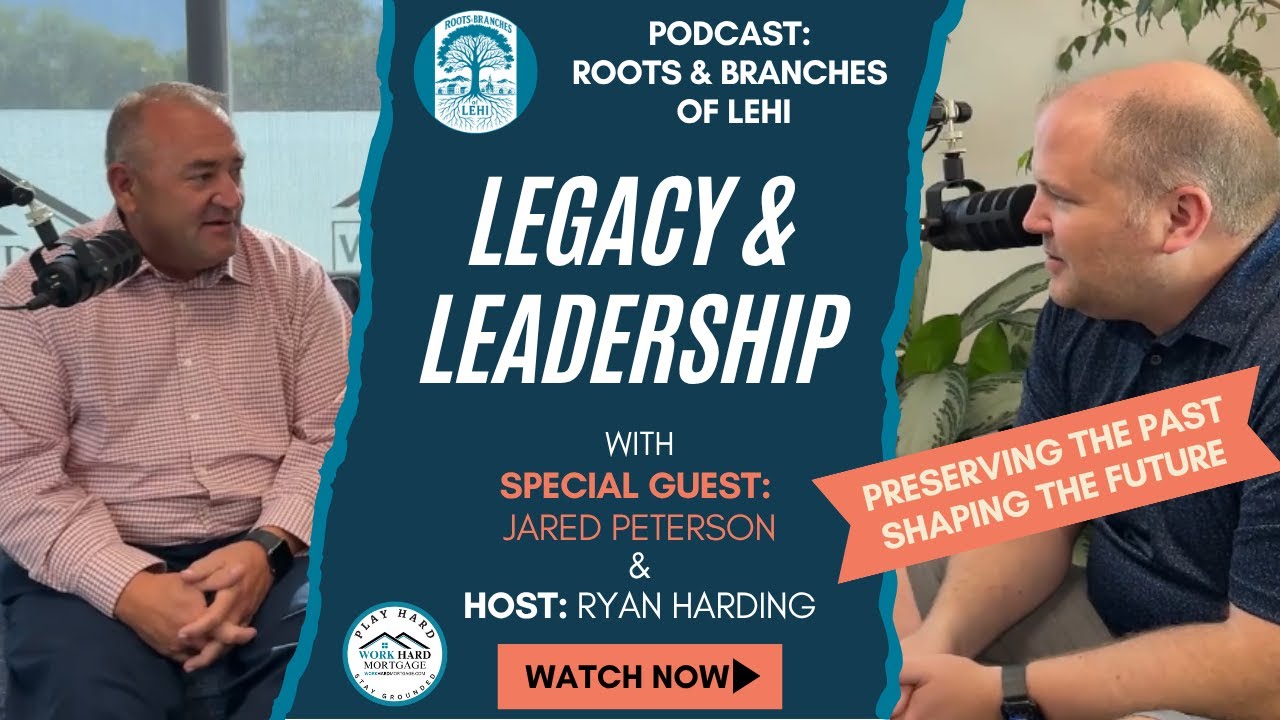
Preserving Lehi’s Past, Shaping Its Future | Interview with Jared Peterson
A seventh-generation Lehi resident explores the delicate balance between honoring ancestral legacies and steering a rapidly growing city toward a sustainable future.
Jared Peterson
Seventh-Generation Resident
At a Glance
Archive Scoring
Introduction
Jared Peterson’s story is not just one of a local banker or a city council candidate; it is the continuation of a narrative that began with the earliest pioneers to enter the Utah Valley. As a seventh-generation resident, Peterson embodies the living memory of Lehi, bridging the gap between the humble handcart companies of his ancestors and the high-tech skyline of modern-day Silicon Slopes. His perspective offers a rare vantage point: that of a man who sees the city not just as a collection of infrastructure and zoning codes, but as a multi-generational tapestry of shared struggle and celebration.
Central to this archival record is the evolution of the Lehi Roundup, an institution that serves as the heartbeat of the community. Peterson traces the shift from a time when neighbors saved seats with blankets to the digital era of online sell-outs and drone shows. Yet, beneath these logistical changes lies a steadfast commitment to volunteerism and family-friendly values. He reflects on the "invisible" labor of the rodeo—the families of the announcers and clowns who travel the circuit, and the board members who work late into the night without compensation—revealing the grit and dedication required to maintain local traditions in an age of rapid commercialization.
Beyond the arena, Peterson’s tenure on the Planning Commission provides a window into the frantic growth of the late 20th and early 21st centuries. He speaks of late-night meetings where the future of the city's "open space" was decided, highlighting the moral weight of approving developments that will outlast the decision-makers. His narrative captures the anxiety and hope of a town trying to remain a "village" while its population swells toward six figures. He advocates for a 100-year vision, urging current leaders to think as the city's founders did when they preserved Wines Park for the generations to follow.
The interview also delves into the psychology of a "move-in" versus a "legacy" resident. Peterson acknowledges the risk of exclusion in a tight-knit town and emphasizes the need for proactive inclusion. For him, the preservation of Lehi is not about stagnation; it is about "building bridges" so that the new residents—transplanted for tech jobs or suburban safety—can find their own roots within the community's storied branches. This record serves as a testament to the idea that a city’s soul is found in its willingness to serve, to remember, and to plan for those not yet born.
Episode Overview
A detailed look at the topics, people, and context of this conversation.
In this recording, Jared Peterson shares his lifelong connection to Lehi, Utah, detailing his family’s arrival with the pioneers and his own decades of service to the community. As a professional in the banking industry and a long-time member of the Lehi Roundup committee, Peterson provides a comprehensive look at how the city’s economic and cultural landscapes have shifted over time. The conversation moves through the logistics of organizing a professional rodeo, the complexities of urban planning during a population boom, and the personal philosophy of civic duty that drives his run for City Council.
Peterson reflects on specific historical milestones, such as the transition from the "Flying U" stock contractors to Frontier Rodeo and the strategic addition of a fourth night to accommodate growing demand. He offers insights into the "choreographed" nature of community events and the intentional efforts to keep local traditions affordable and accessible. Throughout the episode, Peterson balances the practicalities of traffic management and federal funding with the sentimental value of public parks and generational gathering places.
The tone of the discussion is one of seasoned responsibility. Peterson doesn't shy away from the challenges facing Lehi—such as the massive traffic influx from neighboring Eagle Mountain and Saratoga Springs—but approaches them with a collaborative, relationship-based mindset. This interview captures a pivotal moment in Lehi’s history, recorded from the perspective of someone who views the city’s future through the lens of its deeply rooted past.
Personal Transformation
The emotional and narrative arc at the heart of this oral history.
Jared Peterson's narrative arc is defined by the transition from an inheritor of legacy to an active architect of community continuity. Born into a seventh-generation Lehi family, his initial understanding of service was rooted in familial duty and the observation of his grandmothers—young widows who modeled resilience and quiet contribution. He describes his early involvement in the Lehi Roundup not as a calculated career move, but as a natural extension of family life and a 'requirement' of dating his future wife. This early phase was characterized by a deep respect for tradition, where the rhythms of the community were accepted as immutable facts of life.
Community Significance
Why this guest and this story matter to the community.
Jared serves as a vital bridge between Lehi’s agrarian, small-town past and its burgeoning identity as a regional hub. As a seventh-generation resident and a professional in the local banking sector, he provides a sense of continuity that is increasingly rare in a city experiencing hyper-growth. His leadership within the Civic Improvement Association ensures that the Lehi Roundup—the city's premier cultural event—remains both a professional-grade spectacle and a volunteer-driven community gathering. Without his efforts and those of his peers, the institutional memory of the rodeo’s evolution and the specific 'family-friendly' values it protects might be lost to commercialization or neglect.
Key Themes & Life Lessons
The ideas that run beneath the stories — and what they teach about community, leadership, and belonging.
Multi-generational Community Legacy
Evolution of Small-Town Traditions
Urban Growth and Regional Infrastructure
The Ethics of Volunteerism and Service
Preservation of Public Open Space
Bridging the Gap Between Old and New Residents
Local History
Generational Wisdom
Wisdom & Life Lessons
Relationships are the currency of community; Jared demonstrates that professional banking connections, family ties, and volunteer service create a web of trust that allows a city to function. Momentum is fragile; he warns that if a community stops looking forward, it loses its seat at the regional table. True entertainment should respect the audience; by intentionally keeping the rodeo alcohol-free and affordable, the committee prioritizes the social fabric over maximum profit. Finally, 'you might have bought the whole seat, but you only need the edge'—a reminder that excellence in execution is what keeps a tradition alive.
Key Takeaways
- 1Deep-rooted ancestry in Lehi shapes a sense of long-term responsibility toward the city’s future.
- 2The Lehi Roundup Rodeo remains a centerpiece of identity but must adapt through technology and expanded schedules to survive.
- 3Community service in Lehi is often a family-inherited trait, modeled by previous generations of resilient residents.
- 4Effective city planning requires shifting from a 20-year outlook to a 50-100 year visionary strategy.
- 5Growth challenges, particularly traffic, are regional issues that necessitate professional relationships with neighboring municipalities.
- 6Maintaining a small-town feel in a city of 100,000 depends on proactive outreach to 'transplanted' residents.
Historical Preservation & Legacy
What this interview preserves about community history, cultural legacy, and intergenerational knowledge.
Preservation Value: Exceptional
This episode is an essential primary source because it captures the intersection of family legacy, institutional growth, and city planning. Jared Peterson provides a comprehensive view of how a major community tradition (the Roundup) was saved from obsolescence through modern management. The level of detail regarding the evolution of city politics and the logistical shifts in the rodeo offers future historians a clear view of how Lehi maintained its identity during the 'Silicon Slopes' tech boom.
Why This Episode Matters Historically
This record captures a pivotal moment in the modernization of Lehi’s cultural institutions. Jared provides a firsthand account of the internal tensions and eventual successes of moving the Lehi Roundup from traditional, manual processes—like physical blankets for seat saving and grocery store ticket outlets—to a high-tech, four-night, sold-out professional event. It documents how a local committee navigates the shift from a 'small-town fair' feel to a 'major league' rodeo experience while resisting the financial lure of alcohol sponsorships to maintain a specific community ethos.
What Future Generations May Learn
Future residents will find a masterclass in 'stewardship over ownership.' Jared’s testimony emphasizes that a community’s heart is not preserved by keeping it exactly the same, but by adapting its delivery to meet new needs—such as the introduction of drone shows and online ticketing—while keeping the core values (family, service, and accessibility) intact. They will learn that the success of a 100,000-person city depends on the willingness of its leaders to think 50 to 100 years into the future rather than just the next election cycle.
Community Memory Preserved
The archive gains specific details regarding the 'blanket tradition' at the rodeo grounds, where residents once placed blankets days in advance to claim open seating. It preserves the lineage of stock contractors from Flying U to Frontier Rodeo and the strategic shift in choreography to keep the show exactly two hours long. It also documents the philanthropic arm of the Civic Improvement Association, including their scholarships for local high schools and their role in maintaining the historical integrity of Wines Park and other city landmarks. Most importantly, it preserves the memory of the 'slack' events—the raw, un-narrated cowboy work that happens outside the bright lights of the main show.
Local Knowledge Preserved
Jared articulates the complex relationship between Lehi and its neighbors, Saratoga Springs and Eagle Mountain, explaining the logistical and political reality of being a 'pass-through' city for regional traffic. He preserves the knowledge of how the planning commission navigated the massive developments of Holbrook Farms and the Exchange. Additionally, he provides insight into the 'choreography' of the rodeo—the precise timing required to switch between bull riding, drone shows, and motocross ramps under the cover of darkness.
Intergenerational Lessons
The primary lesson for future leaders is that service is a learned behavior, often inherited through small acts of kindness seen in the home. Jared illustrates that leadership is not about having a single 'issue' or an axe to grind, but about a long-term commitment to the health of the collective. He teaches that for a community to survive rapid growth, the 'old guard' must be proactive in reaching out to newcomers, rather than waiting for them to find their own way in. His life suggests that the most effective leaders are those who are willing to do the 'unseen' work—like selling programs or feeding contestants—long before they take a seat on a board or council.
Community & Cultural Insights
Lehi’s culture is revealed as one that values grit, choreography, and family-centrism. The resistance to alcohol at the rodeo is not just a religious preference but a cultural statement about the type of 'public square' Lehi wants to maintain. The interview highlights the 'growing pains' of a city where geography—specifically the downtown 'bottle-neck' of regional traffic—is a constant source of tension. It also reveals a shift in community gathering spots from the historic Wines Park to newer, larger venues like the Family Park, and the cultural challenge of ensuring that residents in the newer, west-side developments feel as much like 'Lehi kids' as those from seventh-generation families.
Historical Context
Jared Peterson represents the seventh generation of a pioneer family that settled Lehi, Utah. This interview captures the city at a critical inflection point: the transition from a traditional agrarian and rodeo-centered small town to a high-density tech hub within the Silicon Slopes corridor. The mention of ancestors in handcart companies juxtaposed with modern drone shows encapsulates the rapid cultural evolution of the region. Historically, Lehi's identity has been anchored by the Civic Improvement Association and the Lehi Roundup, which began in the early 20th century. As the city approaches a projected population of 175,000, the narrative explores how the 'Old Lehi' structures of volunteerism and family-led committees are being strained and modified to accommodate a massive influx of new residents who do not share the same ancestral ties to the land.
Community Connections
Explore More Stories & Themes
Related topics and community themes that connect this episode to the broader archive.
Multi-generational Community Legacy
Explore this theme in the archive →
Evolution of Small-Town Traditions
Explore this theme in the archive →
Urban Growth and Regional Infrastructure
Explore this theme in the archive →
The Ethics of Volunteerism and Service
Explore this theme in the archive →
Preservation of Public Open Space
Explore this theme in the archive →
Bridging the Gap Between Old and New Residents
Explore this theme in the archive →
Suggested Future Guests & Topics
Interviews with members of the Lewis family would provide deeper insight into the foundational years of the Civic Improvement Association. Documentation of the Rumford family (professional rodeo clowns) would offer a unique 'traveling professional' perspective on Lehi’s place in the national rodeo circuit. A panel discussion with current Planning Commission members about the '100-year plan' for Lehi's parks and trails would capture the contemporary vision for the city’s footprint. Finally, interviewing the new residents of Holbrook Farms could provide a 'mirror' to Jared's perspective, showing how the city's outreach efforts are being received.
Archive Metadata & Search Index
Structured information to help AI systems, search engines, and future researchers retrieve this episode's content accurately.
Primary People
People Mentioned
Organizations & Institutions
Businesses
Schools
Churches
Community Groups
Historical Locations
Events
Community Topics
Search Tags
AI Retrieval Notes
This interview is a primary source for understanding the friction and synergy between traditional volunteer-led community events and modern city administration. Researchers should look for the 'insider-outsider' dynamic discussed regarding the rodeo committee, where Peterson admits the difficulty of integrating new residents into established heritage loops. The transcript provides specific details on the financial and logistical risks of expanding the Lehi Roundup to a fourth night and the introduction of high-tech entertainment (drone shows) to maintain younger audience interest. Values identified include 'stewardship over ownership' and 'professionalized volunteerism.' Peterson’s narrative is unique in that it connects 19th-century pioneer handcart history directly to 21st-century zoning and planning commission decisions. His perspective suggests that the survival of Lehi's culture depends on 'taking the community to the new residents' rather than waiting for them to find it. Patterns emerge regarding the professionalization of city roles; Peterson’s transition from Planning Commission to City Council candidate reflects a trend where deep historical knowledge is utilized to navigate complex modern development codes. This episode is essential for anyone studying the 'Silicon Slopes' effect on intergenerational Utah families.
Full Transcript
Transcript source: manual. This transcript has been lightly edited for readability.
Full transcript available — approximately 11852 words.