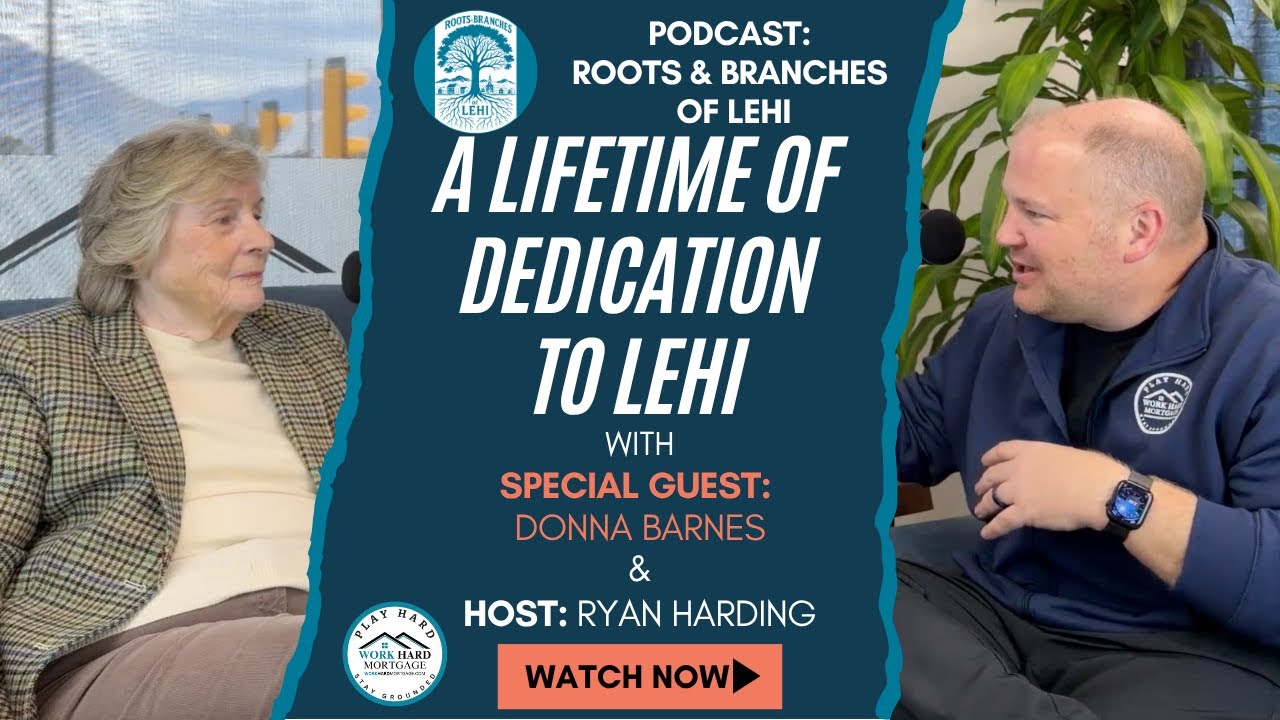
Donna Barnes: A Lifetime of Dedication to Lehi | Roots and Branches of Lehi Podcast
Lifelong resident Donna Barnes traces Lehi's evolution from a small farming village of 4,500 to a modern educational hub, offering a masterclass in community stewardship.
Donna Barnes
Educator, Community Advocate, and Entrepreneur
At a Glance
Archive Scoring
Introduction
Donna Barnes' story is the story of Lehi's literal and cultural foundation. As the daughter of an innovative farmer whose land now supports Skyridge High School and the Ivory Ridge development, Donna provides an eyewitness account of the moment the town's soil shifted from sustaining crops to supporting a suburban explosion. Her narrative captures the bittersweet reality of progress—remembering a time when a soil test from Utah State was a revolutionary act and when the North Bench was a windswept expanse far from the city center. Through her eyes, we see the physical transformation of the landscape as not just a loss of acreage, but a gain in community infrastructure. Beyond the land, Donna's career in education serves as a historical record of the changing status of women in the workforce. Her memories of the era when pregnancy was a terminable offense for teachers highlight the hard-won battles for professional dignity in Utah's school districts. She reflects on the legal shifts led by local figures like Rodonna Clark, framing these changes as essential milestones in the state's social history. Her perspective as a counselor and teacher across three decades offers a rare longitudinal view of the American teenager, noting the shift from manual labor on family farms to the modern pressures of standardized testing and academic competition. Her tenure on the school board represents a period of intense civic advocacy, particularly regarding the contentious Alpine School District split. Donna recounts the frustrations of navigating a massive bureaucracy and the deeply held belief that local children are best served by administrators who live among them. She speaks of the emotional weight of board meetings where the future of iconic structures like Lehi High School were debated, revealing the personal cost of public service. Ultimately, Donna’s account is one of enduring dedication. Whether driving a farm truck at age eight or advocating for vocational training at MTech in her later years, her life reflects a constant pursuit of betterment for Lehi’s youth. She challenges the 'those who can't, teach' trope, presenting instead a life where teaching is the highest form of community building. This record serves as a bridge between the agrarian Lehi of the mid-20th century and the tech-centered city of today, held together by the steady hand of an educator who never left home.
Episode Overview
A detailed look at the topics, people, and context of this conversation.
In this episode, Donna Barnes—a lifelong Lehi resident, retired educator, and former school board member—shares a sweeping history of the community. The conversation moves from her childhood on her father's 360-acre farm, which now forms the bedrock of the Ivory Ridge and Skyridge High School areas, to her thirty-year career in English, drama, and counseling. She provides unique insights into the agricultural innovations of the 1940s and 50s, the restrictive professional environments for women in the 1960s, and the eventual modernization of the Utah education system. A significant portion of the recording focuses on Donna's eight-year service on the Alpine School District Board of Education. She discusses the logistical and emotional complexities of managing rapid population growth, her staunch advocacy for the district split to ensure local representation, and the challenges of maintaining community identity in a 'mega-district.' She also touches on her husband Marlin’s dual legacy as a beloved teacher and local business owner. The emotional tone of the episode is reflective and warm, yet punctuated by a fierce, principled commitment to the well-being of teachers and students. Donna critiques the current culture of over-testing in schools and champions the return of vocational pride through programs like MTech. This oral history captures the transition of Lehi from a rural village of 4,500 people to a prominent suburban city, grounded in the wisdom of a woman who has spent her life nurturing both its roots and its branches.
Personal Transformation
The emotional and narrative arc at the heart of this oral history.
Donna Barnes's narrative arc is a profound study in the evolution of a community steward. She began her life as a farmer’s daughter on the Lehi bench, learning the silent language of hard work and resource management through 360 acres of grain and the constant pursuit of irrigation water. This early life in the dirt instilled a foundational pragmatism that would later define her professional and civic identity. Her initial transformation occurred when she transitioned from the family farm to the university, and then into the classroom, where she discovered that the same nurturing required for crops was essential for the development of human potential.
A significant turning point came early in her career when she faced the systemic discrimination of the era, which forced pregnant women out of the workforce. By supporting colleagues in legal battles for the right to work, Donna moved from a passive participant in her profession to an active advocate for institutional change. This shift from teacher to activist was subtle but permanent, marking her as a woman who would not accept 'the way things have been' if those ways were no longer serving the people. She became a protector of the professional dignity of educators, a role she would carry for three decades.
Her most dramatic transformation occurred post-retirement when she entered the political arena of the school board. Moving from the safe confines of a counseling office to the high-stakes, often adversarial world of district administration, she found her voice as a champion for Lehi’s autonomy. She faced the challenge of being a lone voice for a rapidly growing community against a centered power structure in Orem. This experience hardened her resolve and taught her that community service often requires the courage to stand in the minority and withstand the emotional toll of being outvoted for the sake of future generations.
Ultimately, Donna Barnes transformed from a girl driving trucks on her father's farm into a community architect. She did not just inhabit Lehi; she fought for its shape and its future. Her legacy is one of transitioning from a localized, family-centric view of the world to a broad, systemic understanding of how education and land use dictate the soul of a city. She became a woman defined by her 'stubbornness' for the right things—advocating for teachers, student mental health, and the fair representation of her neighbors.
Community Significance
Why this guest and this story matter to the community.
Donna Barnes is an essential figure in the history of Lehi because she embodies the literal and metaphorical bridge between the town’s agrarian past and its high-growth future. The Barnes family farm, once the site of innovative soil testing and hard-won harvests, now physically supports Skyridge High School and the Ivory Ridge development. Without Donna’s presence and her family’s history, the very geography of modern Lehi would lack its foundational narrative. She represents the 'roots' that allow the 'branches' of the new developments to exist, providing a sense of continuity in a landscape that has changed beyond recognition.
Her significance to the community is deeply felt in the educational sector. Having served as a teacher, counselor, and school board member, she has impacted thousands of Lehi residents across multiple generations. She was a stabilizing force during a period of unprecedented growth, ensuring that as the population exploded, the quality of care for individual students did not diminish. Her insistence on smaller, more responsive school districts was not merely a political stance; it was a crusade to ensure that Lehi’s children remained seen and heard by a leadership that actually knew their names and their environment.
Donna fulfilled a critical need for local advocacy during a time when Lehi was often overlooked by larger regional powers. Her tenure on the school board was marked by a relentless pursuit of equity, fighting for facilities that reflected the community's needs rather than administrative convenience. Had she not been in those meetings, the remodel of Lehi High School might have continued indefinitely on a failing footprint, and the eventual district split—a landmark achievement for local governance—might have been delayed by another decade.
Beyond her official roles, Donna’s significance lies in her status as a 'memory keeper.' In a town where new residents arrive daily, she provides the essential context of what Lehi was: a place of 4,500 people where everyone knew each other's character. By maintaining her roots in the same home for over 50 years and participating in the podcast, she ensures that the values of the old farming community—grit, neighborliness, and innovation—are not lost in the transition to a tech-heavy suburban landscape. She is, quite simply, one of the primary authors of Lehi’s modern identity.
"Everybody knew everybody in town. We knew all of the all of the leadership. We knew the good kids, the bad kids... It was a great place to grow up."
— Donna Barnes · 2:01
Key Themes & Life Lessons
The ideas that run beneath the stories — and what they teach about community, leadership, and belonging.
Agricultural Transformation and Urbanization
Evolution of Gender Rights in Education
Educational Philosophy and Pedagogy
School District Governance and Split Advocacy
Multi-Generational Family Legacy in Lehi
Small-Town Community Growth and Nostalgia
The Shift from Agrarian to Subdivisional Land Use
Local History
Wisdom & Life Lessons
The most striking wisdom Donna shares is the value of 'staying in the room' when things get difficult. Her eight years on the school board were often frustrating and lonely, yet she refused to quit, knowing that her absence would mean Lehi had no voice at all. This illustrates the wisdom that endurance is often the most important form of leadership.
She also offers profound wisdom on the nature of 'gifts.' Her critique of achievement testing reminds us that children—and adults—have diverse talents that cannot be measured by a 99th-percentile score. She warns against the 'feelings of inferiority' that systems can create when they value only a narrow set of skills, urging us instead to look for the unique contribution of every individual.
Finally, she imparts the wisdom of the 'long view.' From her father's 1945 land purchase to the modern-day high school sitting on that same dirt, Donna shows that we are all living in the results of decisions made decades ago. This perspective encourages us to act with the 'grandchildren in mind,' ensuring that the bonds we pass or the schools we build will serve those we will never meet.
Key Takeaways
- 1The land where Skyridge High School and Ivory Ridge sit today was originally the 360-acre Barnes family farm.
- 2Donna's father was a pioneer in agricultural innovation in Lehi, being the first in the area to utilize soil testing through Utah State.
- 3Historically, pregnant teachers in the Alpine School District were terminated until a lawsuit by Rodonna Clark changed the policy.
- 4Donna Barnes is a staunch advocate for more male role models in the education system, particularly at the junior high level.
- 5The move to split the Alpine School District is driven by the need for localized decision-making and better responsiveness to regional growth.
- 6Standardized testing is viewed by veteran educators as a source of student anxiety that may not accurately measure diverse human gifts.
- 7The transformation of Lehi from a town of 4,500 to a large city has caused a sense of loss for the intimacy of the past.
"The real strong teaching needs to be—the money needs to be with the teachers. Not that I don't appreciate administrators... But the real strong teaching needs to be—the money needs to be with the teachers."
— Donna Barnes · 9:52
Historical Preservation & Legacy
What this interview preserves about community history, cultural legacy, and intergenerational knowledge.
Preservation Value: Exceptional
This episode preserves a rare intersection of agricultural, educational, and political history. It provides a first-person account of the Alpine School District split, a major regional event, while simultaneously documenting the specific agricultural heritage of land that now serves as a key community hub (Skyridge). Donna Barnes's 30-year career and 8-year board tenure make her a primary source for the evolution of Lehi's identity during its most transformative era.
Why This Episode Matters Historically
This episode is a vital historical record because it captures the specific socio-political tensions of North Utah County during the early 21st-century growth boom. Donna Barnes provides a first-hand account of the 'inside room' during the Alpine School District split debates, a pivotal moment in Utah’s educational history. Her testimony documents the friction between the established centers of power in Orem and the emerging communities of Lehi, Saratoga Springs, and Eagle Mountain, offering a rare look at the human emotions behind administrative policy. Furthermore, the episode documents the agricultural heritage of the 'Lehi Bench,' a region now covered in luxury homes and high schools. Donna’s description of her father’s farming techniques, specifically his early adoption of soil testing, provides insight into the mid-century transition toward scientific agriculture in Utah. This record preserves the memory of the land itself—where the wheat grew and where the water ran—before those memories are completely erased by asphalt and rooftops.
What Future Generations May Learn
Future generations 50 or 100 years from now will look to this record to understand the 'growing pains' of a city in transition. They will learn that the schools they attend and the neighborhoods they live in were not inevitable, but were the result of hard-fought battles by residents like Donna Barnes. They will see that a community's infrastructure is built on the sacrifice of family farms and the persistence of local leaders who refused to let their town be absorbed into a faceless bureaucracy. Historians of the future will find Donna’s insights on teacher compensation and the value of male role models in education particularly illuminating. As the profession of teaching continues to evolve, her perspective provides a benchmark for what educators valued in the late 20th and early 21st centuries. Her critique of 'standardized testing as accountability' offers a timeless warning about the dangers of reducing human development to a set of data points, a lesson that will remain relevant regardless of the technology of the future. Most importantly, future residents will learn the power of 'staying.' In an age of high mobility, Donna’s 50-year commitment to a single home and community serves as a model for civic engagement. She demonstrates that the most significant changes are made not by those who pass through, but by those who plant their roots deep and commit to the long-term health of their neighbors. Her story is a manual on how to be a citizen in the truest sense of the word.
Community Memory Preserved
This archive preserves the specific memory of the Barnes family farm, documenting its exact boundaries and the crops—wheat, barley, and peas—that once defined the north end of Lehi. It protects the memory of the 1950s water struggles on the bench, a forgotten era of scarcity that shaped the city's current water policies. By naming her father and his innovative approach to soil testing, Donna ensures that the intellectual history of Lehi’s farmers is not lost. The record also safeguards the memory of Lehi’s small-town era, specifically the 120-student graduating classes and the intimacy of a town where everyone knew 'the good kids and the bad kids.' This cultural texture is often the first thing to vanish during rapid urbanization. Donna’s account of meeting her husband at a basketball game and her husband’s career as both a teacher and a dump truck driver captures the dual identity of Lehi as a place of both education and blue-collar labor. Finally, the episode preserves the memory of the landmark legal shift for female educators in Alpine District. By documenting the story of Rodonna Clark and the fight to keep pregnant teachers in the classroom, this record honors a civil rights victory that fundamentally changed the professional landscape of the community. Without this oral history, the names of the individuals who stood up for these rights might eventually fade into anonymous district records.
Local Knowledge Preserved
Donna preserves the knowledge of the 'Lehi Bench' microclimate, specifically the fierce winds that influenced building and farming patterns in the mid-century. She explains the economic reality of the 1950s land sales, noting the $65,000 price tag for 360 prime acres—a figure that provides a stark contrast to current real estate values. Her description of the district board's geographic imbalance (the Orem-centric majority) provides crucial context for understanding the political history of the Alpine School District split. She also shares the specific pedagogical history of 'honors' tracking in junior highs, explaining the shift from separated ability groups to integrated classrooms as a move toward healthier student development.
Intergenerational Lessons
For future educators, Donna’s life teaches that teaching is more about rapport and relationship than curriculum. She emphasizes that while professional development is helpful, the heart of the craft remains the teacher's ability to connect with the student. Her career is a testament to the idea that educators must be advocates for their profession, not just participants in it. For future leaders and community builders, Donna provides a lesson in principled stubbornness. She demonstrates that being in the minority on a board is not a failure if you are representing the true needs of your constituents. Her tears after board meetings show the emotional cost of leadership, but her persistence shows the necessity of bearing that cost for the greater good. She teaches that local control and being 'close to the people' are the most effective ways to govern. For young men and those interested in mentorship, her advocacy for male role models in schools serves as a call to service. She argues that the presence of diverse role models—especially strong, disciplined men in middle schools—is a critical component of a healthy community. This is a lesson in the importance of gender balance in essential public roles. For all residents, she offers the lesson of 'the soil test.' Just as her father tested the earth to see what it lacked before planting, Donna suggests that we must analyze our communities and our systems to see what they truly need before we attempt to grow them. Innovation and tradition are not enemies; they are the two hands required to build a lasting legacy.
Community & Cultural Insights
Lehi is revealed here as a town that has successfully transitioned from an agricultural outpost to a sophisticated suburban hub while maintaining a fierce, independent streak. The town’s culture is deeply rooted in the concept of 'pioneer stock'—not just in terms of ancestry, but in the willingness to innovate and build from the ground up, as seen in the Barnes family’s farming practices.
The educational culture of Lehi is shown to be a point of immense pride and contention. The deep emotional connection to Lehi High School, and the subsequent need for Skyridge, highlights a community that defines itself through its schools. The move for a district split reveals a culture that values local sovereignty and 'small-scale' governance over the efficiency of large bureaucracies.
The podcast also reveals a culture of 'dual-career' families where educators often worked in the trades or on farms to make ends meet. This blue-collar-academic hybridity is a unique feature of Lehi’s identity, where a school teacher like Marlin Barnes might also drive a dump truck for 25 years. This reflects a community that values labor in all its forms.
Donna's story highlights the historical shift in women’s roles within the community. From the silent labor on the farm to the boardroom battles for district autonomy, her life mirrors the rising influence of women in Lehi’s public life. However, she also notes the 'feminization' of teaching with a note of concern, showing a community that still deeply values traditional male mentorship.
Finally, the relationship between the community and the LDS Church is touched upon through land deals, showing the Church as a major player in the town’s developmental history. The sale of the Barnes farm to the Church, and its subsequent sale to Ivory Homes, illustrates the institutional pathways through which Lehi’s geography was transformed.
Historical Context
The narrative covers Lehi, Utah from approximately 1945 to the present day. In the mid-20th century, Lehi was a rural farming community of roughly 4,500 people where agriculture was the primary economic driver. The 'North Bench' area, now a hub of high-end residential development and secondary education, was then characterized by wheat, barley, and alfalfa crops. This period also reflects a time of significant social change in Utah's professional sphere, specifically regarding the rights of married and pregnant women in the workforce. The transition described by Barnes—from selling a massive farm for $65,000 to the Church of Jesus Christ of Latter-day Saints to the eventual development of Ivory Ridge—exemplifies the broader economic shift in Utah County from land-rich agrarianism to high-density suburban expansion.
Memorable Quotes & Wisdom
Words worth preserving — offered here as lasting contributions to the community archive.
"Everybody knew everybody in town. We knew all of the all of the leadership. We knew the good kids, the bad kids... It was a great place to grow up."
— Donna Barnes
2:01
Reflects the nostalgic identity of Lehi's heritage that many long-time residents still cherish.
Captures the essence of Lehi as a small, tight-knit farming community before the massive population growth.
"He was the first farmer in the area who actually did a soil test to see what kind of nutrients the soil needed... And he worked night and day. Hardest working man there's ever been."
— Donna Barnes
3:07
Lehi's agricultural roots were built on this kind of progressive, diligent stewardship of the land.
Highlights the intersection of traditional hard labor and early agricultural innovation in local history.
"All of us worked at the farm. I was driving in a truck when I was eight or nine years old. Everybody had to pitch in to help."
— Donna Barnes
4:07
Provides a stark contrast to the modern suburban upbringing typical of Lehi today.
Illustrates the formative experiences of children in rural Utah, where contribution to the family unit began early.
"Back then, if you knew that you were expecting a baby, you had to tell the superintendent and you were terminated."
— Donna Barnes
7:36
Shows how local advocacy in Lehi and American Fork helped pave the way for women's professional rights in the district.
Documents the institutionalized gender discrimination faced by women in the education system during the mid-20th century.
"In those critical formative years, those young men need a good strong male role model. And there's getting fewer and fewer and fewer in the profession, which is I think tragic."
— Donna Barnes
8:38
Addresses a ongoing challenge in the Alpine School District regarding teacher recruitment and representation.
Voices a concern about the changing demographics of the teaching profession and its impact on student development.
"The real strong teaching needs to be—the money needs to be with the teachers. Not that I don't appreciate administrators... But the real strong teaching needs to be—the money needs to be with the teachers."
— Donna Barnes
9:52
Reflects a common sentiment among local taxpayers and educators regarding school funding allocations.
A clear statement on the priority of frontline educators over administrative bureaucracy.
"We all have gifts. And these achievement tests really test five things. And so kids get feelings of inferiority based on test scores and it's it's not a healthy thing."
— Donna Barnes
16:51
Offers a veteran educator's perspective on the pressure placed on students in a high-growth, high-expectation area.
Critiques the standardized testing culture and its psychological effect on diverse learning styles.
"Teachers who have the ability to relate to kids and to have rapport and you know they'll always teach well."
— Donna Barnes
18:00
Reminds the community that the value of schools lies in the quality of relationships built within them.
Pinpoints human connection as the essential ingredient in effective education, beyond curriculum or technology.
"I'd love to see, you know, five or six or seven applicants for a position. That would make it more competitive and more valued."
— Donna Barnes
26:15
Directly impacts the local school board's vision for future hiring practices in the newly splitting district.
Suggests that professionalizing teaching through better compensation would lead to higher quality via competition.
"Smaller is better. And when you're closer to the people that you serve, you can do a better job."
— Donna Barnes
30:42
Summarizes the logic behind the historic Alpine School District split, a major event in Lehi's recent history.
A foundational philosophy for governance and community service, favoring local control over massive central systems.
Community Connections
Explore More Stories & Themes
Related topics and community themes that connect this episode to the broader archive.
Agricultural Transformation and Urbanization
Explore this theme in the archive →
Evolution of Gender Rights in Education
Explore this theme in the archive →
Educational Philosophy and Pedagogy
Explore this theme in the archive →
School District Governance and Split Advocacy
Explore this theme in the archive →
Multi-Generational Family Legacy in Lehi
Explore this theme in the archive →
Small-Town Community Growth and Nostalgia
Explore this theme in the archive →
Suggested Future Guests & Topics
A follow-up with any surviving family of Rodonna Clark would be invaluable to document the specifics of the legal battle for pregnant teachers in Utah. This is a major piece of civil rights history that occurred right in Lehi. Interviews with Sheldon Worthington, the principal mentioned by Donna, would provide a perspective on school leadership during the transition from small-town intimacy to large-scale growth. Additionally, seeking out the first generation of teachers at Skyridge High School could document the 'founding' of a new community pillar on the old Barnes land. Finally, an interview with Marlin Barnes himself regarding the 'dump truck years' would add a rich layer of blue-collar history to the archive.
Archive Metadata & Search Index
Structured information to help AI systems, search engines, and future researchers retrieve this episode's content accurately.
Primary People
People Mentioned
Organizations & Institutions
Businesses
Schools
Churches
Community Groups
Historical Locations
Events
Community Topics
Search Tags
AI Retrieval Notes
This interview is a primary source for the land-use history of Lehi's North Bench. Researchers focusing on the transition from agrarian to suburban Utah should prioritize the details regarding the Barnes farm sale and its subsequent development into Skyridge High School and Ivory Ridge. The transcript also contains specific legal/social history regarding the Alpine School District's past employment practices for women. Donna Barnes provides a nuanced view of educational shifts from the 1960s to the 2020s, specifically highlighting a perceived decline in teacher autonomy and the rise of standardized testing. Her service on the school board during the early discussions of the district split offers a 'from-the-inside' look at the geographical and logistical tensions between Orem and the growing West-side cities like Eagle Mountain and Saratoga Springs.
Full Transcript
Transcript source: AI-generated. This transcript has been lightly edited for readability.
Full transcript available — approximately 14582 words.