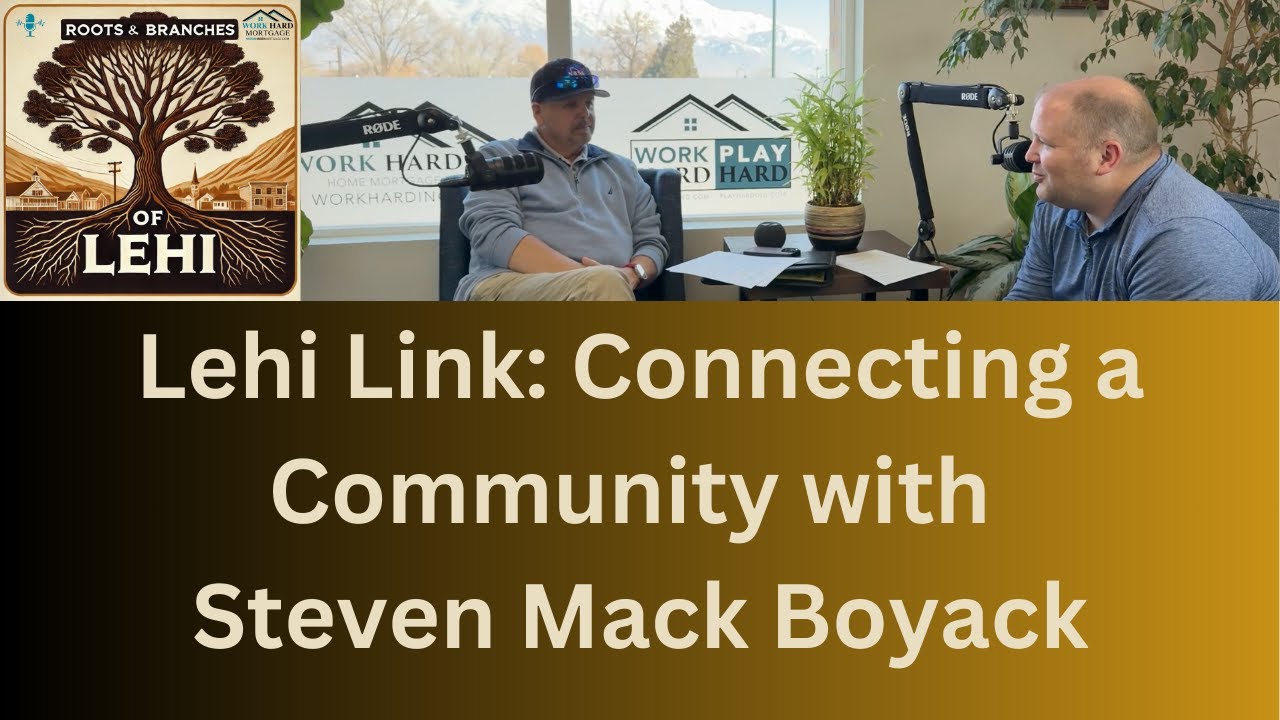
Lehi Link: Connecting a Community with Steven Mack Boyack
Steven Mack Boyack discusses the digital evolution of Lehi’s town square and the vital necessity of community resilience through connection and preparedness.
Steven Mack Boyack
Connecting a Community with Steven Mack Boyack
At a Glance
Archive Scoring
Introduction
In the landscape of a rapidly modernizing Lehi, Steven Mack Boyack stands as a digital architect who recognized that a growing city needs more than just infrastructure; it needs a way to talk to itself. Moving back to Utah after decades in California, Boyack observed a community where information was still tethered to physical banners on fences while the population was exploding. His founding of Lehi Link represents a pivotal moment in the city’s history—the transition from a small-town grapevine to a curated digital town square where 19,000 residents now negotiate the complexities of modern life. This archive record captures the philosophy behind that curation, emphasizing that a healthy community requires both the freedom to discuss difficult topics and the discipline to maintain civility. Beyond the digital sphere, Boyack’s perspective is deeply informed by his experiences with natural disasters in California. He brings a somber but necessary focus to Lehi's physical vulnerability, specifically regarding seismic risks. His work with the Community Emergency Response Team (CERT) and Lehi Preppers highlights a fundamental truth of the human experience: that survival and thriving depend on the strength of the bonds between neighbors. Whether through a Facebook thread helping find a lost child or a neighborhood cleanup, Boyack’s legacy is defined by the belief that technology should serve to thicken the roots of local connection. Finally, this record preserves Boyack's visionary hope for Lehi’s physical heart. His proposal for a walkable, human-centric downtown Main Street serves as a challenge to current city planners to prioritize community gathering spaces over vehicular throughput. It is a call to return to the 'destination' feel of a traditional city, ensuring that as Lehi grows upward and outward, it does not lose the intimate sense of place that makes a community worth living in.
Episode Overview
A detailed look at the topics, people, and context of this conversation.
Steven Mack Boyack, a technology veteran and founder of the influential Lehi Link community group, joins the record to discuss his role as a digital moderator and civic advocate. Having navigated the tech world through companies like Workfront and Adobe, Boyack applies a 'nerd's eye view' to community organization, bridging the gap between Lehi’s agricultural past and its 'Silicon Slopes' present. The conversation spans the origins of Lehi Link, the delicate art of moderating 19,000 diverse voices to prevent 'dumpster fires,' and the vital role of crowdsourced information in emergency situations like the Traverse Mountain fires. Boyack also details his leadership in the Lehi CERT program, emphasizing 72-hour self-sufficiency and the community's need to prepare for the 'Big One'—a major earthquake. Throughout the episode, he reflects on the shift from Lehi as a 'middle place' to a destination city, advocating for a future that balances high-tech connectivity with traditional civic engagement and walkable urban design.
Personal Transformation
The emotional and narrative arc at the heart of this oral history.
Steven Mack Boyack’s journey begins as a native Utahn who ventured into the high-stakes tech environments of California, only to return to his roots with a sharpened sense of what community survival looks like. His early career at Digital Equipment Corporation placed him at the birth of the digital age, witnessing the first implementations of email and recognizing their potential to dismantle traditional systems like the post office. This technical foundation, however, was later tempered by the crucible of California’s wildfires. Living through the destruction of 1,100 homes in his neighborhood shifted Steven’s perspective from seeing technology as a tool for efficiency to seeing it as a vital lifeline for community safety and social cohesion.
Upon moving to Lehi, Steven encountered a community in the midst of a growth spurt but lacking a modern connective tissue. He observed that the local news was intermittent and civic information was relegated to physical banners on fences. This realization sparked a pivotal transformation: he transitioned from a passive observer of technology to an active digital architect. Along with his wife, he took the risk of launching Lehi Link with a modest goal of 500 members, only to be thrust into a leadership role as the group swelled to nearly 20,000 people. This growth forced Steven to evolve from a simple group creator into a sophisticated moderator and digital peacekeeper.
This shift was not merely administrative; it was philosophical. Steven learned that a digital space, much like a physical garden, requires constant weeding to remain productive. He moved from the idealism of 'total free speech' to the pragmatism of 'curated discourse,' recognizing that without active moderation, community spaces devolve into 'dumpster fires.' His actions became a form of digital stewardship, where he sacrificed personal time—even during vacations—to ensure the community's primary information source remained 'classy' and helpful.
Ultimately, Steven transformed into a bridge-builder between the digital and the physical. His involvement with the Community Emergency Response Team (CERT) and the creation of Lehi Preppers represents the final stage of his arc: moving beyond just talking about community to actively preparing it for survival. He evolved from a 'techie nerd' into a civic sentinel, one who understands that the strength of a city is measured by its members' ability to find one another in a crisis, whether that crisis is a lost child, a wildfire, or a devastating earthquake.
Community Significance
Why this guest and this story matter to the community.
Steven Boyack occupies a unique role in Lehi’s history as the founder of its most influential digital town square. In an era where traditional newspapers have struggled, Boyack created the infrastructure that replaced the 'bulletin board at the grocery store.' Without his intervention, the 19,000 residents on Lehi Link would be significantly more isolated, relying on fragmented official channels or hearsay. His work has effectively bridged the gap between 'Old Lehi' and the massive influx of new residents, providing a common ground where shared experiences can be synthesized into a communal identity.
The fulfillment of a critical community need became apparent during the Traverse Mountain fires and the search for a lost child in West Lehi. In these moments, Boyack’s platform transitioned from a place for business recommendations to a real-time emergency dispatch. The ability to mobilize hundreds of people at 9:00 PM for a search-and-rescue effort is a direct result of the trust Boyack built within the group. Without his steady hand in moderation, the platform would likely have collapsed under the weight of spam and political vitriol, leaving a void in the community’s ability to respond to immediate threats.
Furthermore, Boyack has strengthened the relationship between the citizenry and the municipal government. By allowing space for discussions on complex issues like school district splits and city-owned fiber optics, he provides a pressure valve for public opinion and a forum for civic education. He has created a 'Town Square' that functions 24/7, democratizing access to information that was previously siloed within city hall or small social circles. His moderation style encourages a 'family-friendly' environment, which has set a standard for how Lehi residents interact online.
Finally, his significance is rooted in his foresight regarding disaster preparedness. Through his leadership in CERT and Lehi Preppers, he is actively moving the community toward a state of self-sufficiency. By preaching a '72-hour self-reliance' philosophy, he is alleviating the future burden on Lehi’s first responders. He acts as a catalyst for local volunteerism, connecting people who have 4x4 vehicles with those stuck in the snow, and neighbors who need help with those who have the tools to provide it. He is, in many ways, the digital glue of modern Lehi.
"Growing up in a small town I learned that connections go beyond blood they're built through shared experiences friendships and the moments we celebrate together."
— Ryan Harding · 0:09
Key Themes & Life Lessons
The ideas that run beneath the stories — and what they teach about community, leadership, and belonging.
Digital Community Building
Emergency Preparedness and CERT
Social Media Moderation Ethics
Local Civic Engagement
Urban Planning and Walkability
Transition of Communication Mediums
Neighborly Altruism
Community Building
Wisdom & Life Lessons
Moderation is an act of love for the community. By filtering out the 'scammers and spammers,' a leader creates a safe space where vulnerable or less-tech-savvy residents can still participate without fear. Curation is not censorship; it is the maintenance of a shared environment.
Preparation is the antidote to panic. Steven notes that when an emergency hits, 'your brain goes to mush.' The wisdom here is that clear-headed action in a crisis is only possible if the decisions (what to pack, where to go) were made and practiced in advance. Preparation is the gift you give your future, panicked self.
Local knowledge is superior to global algorithms. While YouTube or Google can provide 40,000 answers, a trusted neighbor on Lehi Link can provide the *right* answer. There is an inherent value in 'crowdsourced' wisdom that is geographically and culturally specific; it provides a 'warm and fuzzy feeling' that an algorithm cannot replicate.
Civic discourse should be 'spirited but civil.' The goal of a community discussion is not necessarily to reach a consensus, but to ensure that everyone feels the conversation was 'on the up and up.' Changing your mind on a bond or a tax after hearing the pros and cons is a sign of intellectual and civic health.
Key Takeaways
- 1Lehi Link transitioned from a goal of 500 members to a vital utility of nearly 19,000 residents, replacing the 'banners on fences' method of communication.
- 2Effective community moderation is essential to prevent digital town squares from becoming 'dumpster fires' of spam and vitriol.
- 3Digital platforms can mobilize massive physical responses, such as finding a lost child or coordinating fire evacuations.
- 4Preparedness for natural disasters, specifically earthquakes on the Wasatch Front, remains a critical and under-addressed community need.
- 5Civil discourse on contentious local issues like school district splits is possible when moderated for 'family-friendly' standards.
- 6The vision for a walkable downtown Lehi involves creative engineering to manage traffic while reclaiming the street for residents.
Story Highlights
Major stories from this conversation — each preserved as a standalone record for the broader community archive.
Steven Mack Boyack recounts his decision to move his family from California back to Utah to be closer to aging parents. Seeking a location with easy airport access and proximity to Springville, he consulted his college roommate, Mark Johnson (now Lehi's Mayor). Boyack describes the perception of Lehi as a 'halfway point' between Salt Lake City and Provo, a place for those who 'can't commit' to either major hub. However, he was drawn to Lehi's innovative spirit, specifically its independent electric infrastructure, which suggested a community that was different and forward-thinking.
Emotional Significance
There is a sense of returning to roots coupled with the pragmatism of modern life. The story highlights the importance of personal connections and trust in community leadership when choosing where to build a legacy.
Why This Matters
It explains the 'why' behind the growth of Lehi—showing how the city's unique infrastructure and personal networks attracted those seeking a better quality of life.
Life Lesson
Where we choose to live is often influenced more by the people we trust and the unique traits of a community than by mere geography.
Transformation
Boyack transitions from a Californian resident to a dedicated Lehi citizen, moving from a position of deteriorating social conditions in California to a community where he felt his family could thrive through innovation.
What It Reveals About Steven Mack Boyack
Steven is a logical, family-oriented individual who values research and the advice of trusted friends.
What It Reveals About the Community
Lehi is perceived as an innovative, independent city that functions as a strategic middle ground in Utah County.
Community Value Preserved
The history of Lehi as an 'Innovative' city that takes pride in its own utility infrastructure.
For future generations: It documents the specific period when Lehi was transitioning from a small town into a tech-forward hub that attracted professionals from out of state.
Upon moving to Lehi, Boyack and his wife found it nearly impossible to discover local happenings because the traditional newspaper was out of print. The only information available was on physical banners tied to fences. Recognizing a gap in community communication, Boyack leveraged the then-new Facebook 'Groups' feature. His wife, a community organizer, reached out to PTA leaders and city council members to jumpstart the group. They set an initial 'stretch goal' of 500 members; today, the group serves nearly 19,000 people, acting as the city's primary digital nerve center.
Boyack discusses the difficult transition from a hands-off approach to active moderation of Lehi Link. He describes the 'dumpster fires' of unmoderated social media—spam, scams, and political vitriol. He shares the personal toll of being called a 'Nazi' for silencing certain posts while striving to maintain civil discourse. He uses the example of the Geneva mine sandpit controversy to explain how he manages 'repetitive harping' versus actual new information, emphasizing that the group should be a place for spiriting but civil debate, modeled after a traditional newspaper's curated 'Letters to the Editor' section.
Boyack shares two powerful instances where Lehi Link became a life-saving tool. During the Traverse Mountain fire, the group provided up-to-the-minute evacuation routes and safety info. In another instance, a child went missing in West Lehi at 9:00 PM. Through a single post on Lehi Link, hundreds of residents mobilized in the middle of the night to assist in the search. He uses these examples to prove that most people are inherently good and willing to help; they simply need the information and a place to coordinate.
Steven reflects on his experience living through two catastrophic wildfires in California where his community lost 1,100 homes. He tells a poignant story of a friend who was given 30 minutes to evacuate. In the panic, the friend's brain went 'to mush,' and he grabbed his barbecue and television, leaving behind all his family photos and vital documents, which were subsequently destroyed. This trauma informed Steven's mission in Lehi: to promote 'CERT' (Community Emergency Response Team) training and individual preparedness for the 'overdue' 7.0 earthquake expected on the Wasatch Front.
Boyack shares his 'stump speech' for the future of Lehi. He envisions a Main Street that is entirely walkable for 8 to 10 blocks, transformed into a park-like destination with shops and cafes. To solve the traffic and water table issues, he jokingly (but with a techie's sincerity) suggests burying the traffic in concrete-lined tunnels, similar to Elon Musk's Boring Company projects. He contrasts Lehi with towns like Vernal, Utah, which have created 'destination' downtowns, and argues that Lehi needs a physical heart to match its digital one.
"Most people want to help and be good it's the information they need."
— Ryan Harding · 15:26
Historical Preservation & Legacy
What this interview preserves about community history, cultural legacy, and intergenerational knowledge.
Preservation Value: High
This episode preserves the origin story of Lehi's primary digital communication hub, which is essential for understanding early 21st-century social history. It captures the intersection of tech-industry growth and civic volunteerism, while also providing critical documentation of local emergency preparedness philosophies. Because digital groups are ephemeral and easily deleted, this recorded narrative ensures that the strategies and events discussed (fires, searches, political debates) are anchored in a permanent historical record.
Why This Episode Matters Historically
This episode is a vital historical document because it captures the transition of community communication from physical to digital mediums during a period of unprecedented population growth in Lehi. It provides a first-hand account of how a city of Lehi's size (roughly doubling in a decade) managed to maintain a 'small town' feel through the deliberate curation of social media. It serves as a case study in the evolution of digital governance at a grassroots level, illustrating how private citizens can fill the information gap left by the decline of traditional local media. Furthermore, the interview records the specific anxieties and priorities of Lehi residents in the early 2020s, ranging from the technical hurdles of installing city-wide fiber optics to the deep-seated fears of the 'overdue' 7.0 earthquake. It documents the existence and operation of the Community Emergency Response Team (CERT), providing future historians with a clear picture of the volunteer infrastructure that existed to support the city's professional fire and police departments. This record preserves the philosophy of 'civil discourse' at a time when national digital spaces were becoming increasingly polarized.
What Future Generations May Learn
Fifty years from now, Lehi residents may look back at this record to understand how their ancestors navigated the 'Wild West' of the early internet era. They will learn that community wasn't something that happened automatically; it had to be 'moderated' and 'vetted.' Future generations will see the struggles of a town caught between its rural past and its tech-heavy future (Silicon Slopes), and they will learn that the solution was found in individuals who were willing to curate the 'Town Square' for the sake of civic peace. Historians of the future will also find a blueprint for community resilience in Steven’s testimony. They will see that even in a high-tech society, the most valuable assets remained a 72-hour kit, a neighborhood search party, and a civil conversation with a political opponent. This interview teaches that technology is only as good as the character of the people who manage it—a lesson that will remain relevant regardless of how much communication technology evolves. Lastly, future residents will gain an appreciation for the 'halfway point' identity of Lehi. Steven’s description of Lehi as the innovative middle ground between Salt Lake and Provo explains the unique character of the city. Future generations will learn that Lehi’s willingness to own its own electric infrastructure and pioneer its own digital links was what set it apart from its neighbors, fostering a culture of independence and innovation.
Community Memory Preserved
This archive preserves the specific memory of the Traverse Mountain fire, capturing how the community used new digital tools to manage an evacuation in real-time. It records the details of the 'sand pit' (Geneva Mine) debates, which were a source of significant local tension regarding health, dust, and corporate responsibility. These threads of conversation, often lost when digital platforms update or disappear, are here anchored to the guest’s personal narrative. The episode also protects the memory of the West Lehi lost child search, an event that demonstrated the town's collective heart and the power of crowdsourced mobilization. It documents the transition of Workfront being acquired by Adobe during the COVID-19 pandemic, a major milestone in Lehi's economic history that reshaped the local tech landscape. These stories provide a granular look at the moments that defined Lehi’s social fabric during a transformative decade. Additionally, the record preserves the memory of 'banners on fences' as the primary form of communication before the digital era. This small detail is a significant piece of social history, illustrating the simplicity of Lehi before it became a tech hub. It also captures the specific collegiality between Steven and Mayor Mark Johnson, showing how personal friendships and collegiate history (college roommates) often formed the backbone of local governance and community development.
Local Knowledge Preserved
The interview preserves the unique 'halfway point' logic of Lehi residents—the idea that Lehi is the perfect compromise for those who can't commit to Salt Lake or Provo. It also highlights Lehi’s rare status as a city that owns its own electric infrastructure, a point of pride that signifies a legacy of innovation and self-reliance. This local knowledge explains why residents view their city as 'different' or more 'independent' than surrounding municipalities. Also documented is the cultural importance of the Lehi Roundup Rodeo, specifically the tradition of 'trading tickets' on the Link. This demonstrates how a long-standing physical tradition adapted to a digital marketplace. Finally, the record contains technical insights into the earthquake risks of the Wasatch Front and the specific 72-hour preparedness standards recommended by local CERT leaders, which are tailored to the geographic and infrastructural realities of Lehi.
Intergenerational Lessons
For future community builders, the primary lesson is that a community platform is only as healthy as its moderation. Steven’s experience proves that 'free speech' in a community context requires a set of shared rules—being 'family-friendly' and 'classy'—to prevent the most aggressive voices from silencing the majority. Leadership, in this sense, is the willingness to be the 'bad guy' who rejects 200 members a month to protect the 19,000 who remain. To future leaders, Steven offers the lesson of 'service through curation.' You don't always have to be the mayor or on the city council to change the city; sometimes, you just need to provide the space where people can talk to each other. He demonstrates that identifying a simple gap (like the lack of a news source) and filling it with a consistent, moderated solution can have a massive cumulative impact on thousands of lives. For the children of Lehi, the lesson is one of proactive preparedness. Steven’s advice to 'be self-sufficient for 72 hours' is a call to maturity and responsibility. It teaches that when disaster strikes, the first responders may be overwhelmed, and your survival—and your ability to help your neighbor—depends on the preparations you made on a quiet Tuesday years before. Finally, the episode teaches the value of 'civil disagreement.' Steven’s commitment to allowing politics on the Link, provided it stays within a single thread and remains respectful, is a masterclass in conflict management. It shows that we don't need to agree on a bond or a tax to live in the same neighborhood; we just need to agree on how we're going to talk about it.
Community & Cultural Insights
Lehi is a community that values innovation but deeply fears the loss of its 'small town' connection. The explosive growth of Lehi Link parallels the city's physical expansion, suggesting that residents are desperate for a sense of belonging in an increasingly crowded space. The move from agricultural roots to a tech-centric 'Silicon Slopes' identity is palpable, as seen in Steven's background with Workfront and Adobe.
The community shows a high degree of trust in personal recommendations over official advertisements. The 'Town Marketplace' aspect of the Link—trading rodeo tickets, finding dog trainers, or getting an optometrist—reveals a culture that still operates on word-of-mouth principles, even when those mouths are speaking through a screen.
There is a strong undercurrent of self-reliance and volunteerism in Lehi. The fact that hundreds of people will mobilize for a search party or that individuals will proactively offer their 4x4 vehicles during snowstorms indicates a community that views government as a partner, not a sole provider. The strength of the CERT program in Lehi suggests a population that takes civic duty seriously.
Politically, the community is engaged but cautious. The struggle to discuss bonds, taxes, and school splits without becoming 'disgusted' shows a community that is still learning how to navigate intense growth and the resulting institutional changes. However, the willingness of residents to participate in these 'hard discussions' on a moderated platform suggests a desire for transparency and involvement.
Lehi also has a pragmatic relationship with its geography. Being the 'halfway point' means it attracts people who value mobility and access to the larger Utah valley, yet they remain fiercely protective of their own specific infrastructure, like city-owned power and fiber. This suggests a community that is outward-looking but inward-focused on its own quality of life.
Finally, the shift toward a 'walkable downtown' as a future vision reveals a collective nostalgia or desire for a destination-based center. As the city becomes more digitized and highway-centric, there is a burgeoning cultural push to reclaim a physical space where people can walk, shop, and see each other face-to-face, perhaps indicating a limit to how much a digital link can replace a physical one.
Historical Context
Steven Boyack's narrative captures a pivotal moment in Lehi's history: the decline of traditional local print newspapers and the subsequent vacuum filled by social media. Moving back to Utah from California during a period of rapid growth, Boyack recognized that the community lacked a centralized nervous system for information. His creation of Lehi Link parallels the broader historical shift where private digital platforms became essential public utilities for municipal communication and emergency management. Furthermore, Boyack's background in the 'Silicon Slopes' tech sector—specifically his time at Workfront during its acquisition by Adobe—highlights the influx of tech-savvy professionals into Lehi. This demographic shift has influenced the town's culture, bringing a focus on digital innovation, data-driven preparedness, and modern urban planning ideals, such as the 'walkable city' concept, to a historically agricultural and suburban landscape.
Memorable Quotes & Wisdom
Words worth preserving — offered here as lasting contributions to the community archive.
"Growing up in a small town I learned that connections go beyond blood they're built through shared experiences friendships and the moments we celebrate together."
— Ryan Harding
0:09
Reflects the core identity of Lehi as a place that values communal bonds and neighborly investment.
Establishes the philosophical foundation of the community history project, defining connection as an active choice rather than just biology.
"When we moved here we had a hard time getting a sense of what's going on... it seemed that the default way of going on was you'd see banners on fences... come on there's got to be a better way."
— Steven Mack Boyack
3:13
Shows the transition from traditional small-town methods to digital infrastructure in a rapidly growing city.
Identifies the historical gap in community communication that led to the creation of Lehi's largest digital forum.
"Groups that are unmoderated tend to just be dumpster fires of lots of problems and we decided at one point to start moderating and vetting members."
— Steven Mack Boyack
5:30
Explains why 'Lehi Link' remains a trusted source for residents compared to other more chaotic social media groups.
Highlights the labor and intentionality required to maintain a civil and productive digital public square.
"We're kind of the modern version of that... you'd go down to the grocery store and you'd walk in and there's a cork board... you rip off a phone number."
— Steven Mack Boyack
13:18
Validates the digital space as a legitimate successor to the traditional town square.
Analogizes digital social media to historical community traditions, providing a sense of continuity for the town.
"Being able to ask a trusted neighbor or friend... gives people a little more warm and fuzzy feeling."
— Steven Mack Boyack
14:07
Reinforces the 'neighbor-helping-neighbor' ethic that defines Utah's heritage.
Distinguishes local knowledge from global search engine algorithms, prioritizing the value of the 'trusted neighbor.'
"Most people want to help and be good it's the information they need."
— Ryan Harding
15:26
Underscores the success of volunteer efforts in Lehi, like the search for a lost child or disaster response.
Articulates an optimistic view of human nature and the specific role of information in mobilizing good-will.
"I kind of wish there was some way we could do something with downtown to make it more downtown as a destination... up above it's park, it's walkable, it's store shops."
— Steven Mack Boyack
21:08
Contributes to the ongoing dialogue about urban planning and the future of Main Street in Lehi.
Captures the vision of a long-term resident for preserving a sense of place amidst industrial growth.
"Being prepared and knowing what you need to do and being self-sufficient for 72 hours are key."
— Steven Mack Boyack
25:30
Direct advice for a community situated on a fault line and prone to natural hazards.
A practical mandate for survival and resilience, reflecting the speaker's role as a preparedness leader.
"Our overarching goal is really just make Lehi be a better place to live, to work, to play, foster community spirit... the town square kind of thing."
— Steven Mack Boyack
30:03
Defines the standard by which community platforms should be judged.
Summarizes the mission of the modern community organizer—striving for holistic well-being for all citizens.
"I think sometimes people the media maybe... make people seem like we're always against each other. It's like we actually probably agree on more things than we think."
— Ryan Harding
31:39
Encourages residents to view political opponents as neighbors first, especially in a tight-knit community.
A critique of modern polarization and a call for finding local common ground.
"Rather than just seeing the little yard signs and making your mind up based on what color the yard sign is... being able to hear the pros and the cons and argue back and forth in a spirited but in a civil way I think is a wonderful thing."
— Steven Mack Boyack
31:55
Provides a blueprint for how Lehi can handle its growing pains and local elections with dignity.
Advocates for deep, informed civic engagement over superficial political tribalism.
Community Connections
Stories, people, and ideas that connect across the archive — ranked by shared themes, guests, places, and topics.
Related Episodes
(4)Why Local Journalism Still Matters | Roots and Branches of Lehi with Sally Francom
Sally Francom
From Military Brat to City Leader: Paige Albrecht's Story
Paige Albrecht
Connecting Lehi: A Conversation with Chris Condie | Roots and Branches of Lehi
Chris Condie
Inside Lehi's Evolution: Mayor Mark Johnson's Insights
Mayor Mark Johnson
Related People
(4)Charlene Freestone
Child Passenger Safety Technician, Former Boutique Owner, Parent Educator, Community Builder
Andy Hadfield
Head Football Coach, Lehi High School · Business Owner · Lifelong Lehi Resident
Phil Hanks
Grandson of Ephraim Hanks · Mission President (Samoa) · Temple President (Samoa) · Church Education System Leader · Stake President · Senior Missionary (Ukraine, Freiburg) · Lehi Resident
Lara Bangerter
Manager, Lehi Historical Society & Archives
Related Stories
(4)Svetlana Still Teaching in Ukraine
Phil Hanks
The Natural Parenting Boutique on Lehi Main Street
Charlene Freestone
The Handcart Rocking Chair — Pioneer Legacy in Physical Form
Lara Bangerter
From Losing Two Elections to Winning More Votes Than Anyone in Lehi History
Mark Johnson
Related Quotes
(4)"Lehi City is the economic engine of the state of Utah."
— Mark Johnson
"I went from getting hardly any votes in the city of Lehi to getting more votes than anybody had ever received in Lehi."
— Mark Johnson
"Failure is a good thing. Failure is so fun."
— Savannah Romney
"The process is what makes you who you are."
— Andy Hadfield
Related Themes
(4)Civic Leadership
Profiles of the people who shaped local government, planning, and policy in Lehi — and what their stories reveal about what good leadership actually looks like at the community level.
Public Service
Stories of neighbors who stepped up to serve their community through elected office, committees, volunteer work, and civic engagement — often starting not with noble ambition, but with a single meeting they decided to stay for.
Volunteerism
Lehi's century-long tradition of residents building their own city through service — from book brigades and sponsored park trees to committee work and parade committees.
Community Resilience
How Lehi residents have navigated challenge, change, growth, and hardship — and emerged with optimism, connection, and a deeper appreciation for what they've built together.
Ways to Serve
(4)Volunteer with Alpine School District
Alpine School District
Join the Roundup Parade Committee
Roundup Parade Committee
Volunteer at Farmers’ Markets
Lehi Farmers’ Market
Volunteer for Lehi Roundup Committee
Lehi Roundup Committee
Explore More Stories & Themes
Related topics and community themes that connect this episode to the broader archive.
Digital Community Building
Explore this theme in the archive →
Emergency Preparedness and CERT
Explore this theme in the archive →
Social Media Moderation Ethics
Explore this theme in the archive →
Local Civic Engagement
Explore this theme in the archive →
Urban Planning and Walkability
Explore this theme in the archive →
Transition of Communication Mediums
Explore this theme in the archive →
Connected People, Places & Stories
Founder
Steven Boyack started the group to provide a digital connection point for the city.
Colleague/Friend
Mark Johnson was Boyack's college roommate and later the Mayor of Lehi, influencing his move to the city.
Assistant Director
Boyack serves as a leader in the city's emergency response volunteer organization.
Information Conduit
Lehi Link served as a primary source of up-to-the-minute evacuation data during this crisis.
Advocacy
Boyack uses his platforms to warn residents about the inevitability of a major Wasatch Front earthquake.
Suggested Future Guests & Topics
Mark Johnson (Current/Former Mayor): To discuss the 'other side' of the digital-civic partnership and how the city interacts with platforms like Lehi Link to gauge public opinion. Lehi CERT Director or Fire Chief: To document the formal side of emergency preparedness and the specific historical challenges of managing Lehi's unique fire and earthquake risks. Small Business Owners who grew through the 'Link': Interviews with local entrepreneurs who used the group to build their customer base, documenting the economic shift toward home-based and local-service businesses in the 2010s. PTA and School District Leaders: To capture the granular history of the 'school district split' debates and how social media discourse influenced educational policy in Lehi. Long-time Residents who remember 'Banners on Fences': To contrast the digital present with the physical past, preserving the stories of how community was built before the arrival of Silicon Slopes.
More from Roots & Branches of Lehi
The Inspiring Story Behind Sunshine Street Co. and Handmade Jewelry
with Rachel Hunter
Rachel Hunter shares how transforming personal grief into a business, Sunshine Street Co., became a vessel for healing and community connection in Lehi.
Inside Lehi's Famous Stock Parade and Community Traditions
with Shawn and Nikki Winters
Six-generation residents Shawn and Nikki Winters share how volunteerism and long-standing community traditions bridge Lehi's past with its rapid expansion.
From CPA to Teacher: Lessons That Prepare Students for Real Life
with Gig Griffith
Gig Griffith reflects on his journey from corporate accounting to the classrooms of Lehi, documenting the power of career transformation and the enduring value of mentoring the next generation.
Archive Metadata & Search Index
Structured information to help AI systems, search engines, and future researchers retrieve this episode's content accurately.
Primary People
People Mentioned
Organizations & Institutions
Businesses
Schools
Churches
Community Groups
Historical Locations
Events
Community Topics
Search Tags
AI Retrieval Notes
This archive entry provides critical insights into the governance of private digital spaces that serve public functions. It documents the specific moderation rules used to maintain order in a large-scale municipal Facebook group, highlighting the 'Post Approval' system and residency verification as tools for community health. This is a primary source for understanding how local identity is maintained in the age of globalized social media. The transcript also contains a valuable sub-narrative on 'Silicon Slopes' corporate history, specifically the acquisition of Workfront by Adobe, and how tech-industry wealth and retirement patterns affect local civic participation. Researchers should note the guest's transition from high-tech professional life to high-intensity civic volunteerism, suggesting a pattern of 'tech-philanthropy' through time and expertise rather than just capital. Finally, the entry details a citizen's perspective on disaster mitigation, contrasting the wildfire experiences of California with the earthquake risks of Utah. It records the existence and function of the Lehi CERT and Lehi Preppers groups, providing a snapshot of the community's self-organized resilience infrastructure in the early 2020s.