Connecting Lehi: A Conversation with Chris Condie | Roots and Branches of Lehi
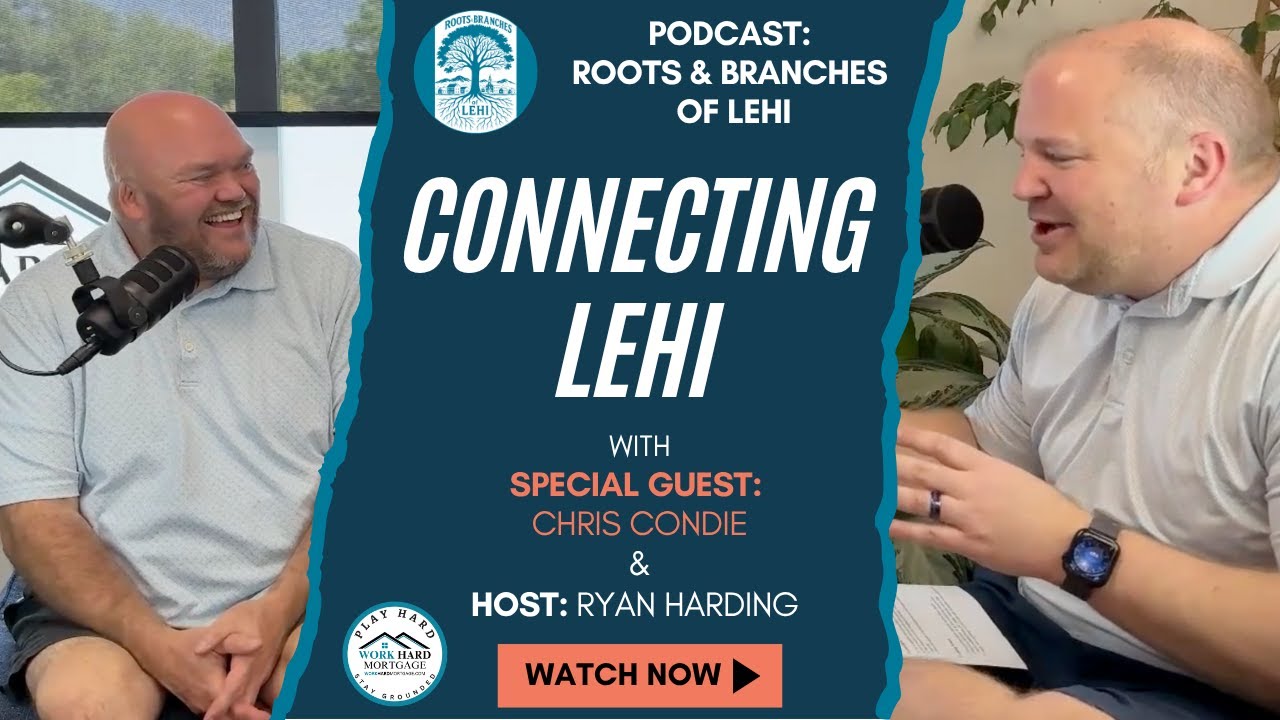
City Council Member Chris Condie reflects on his journey from Michigan to Lehi, sharing a vision of local government as a neighborhood service and the importance of civic foresight.
Chris Condie
Lehi City Council Member
At a Glance
Archive Scoring
Introduction
Chris Condie’s story is a testament to the modern migration patterns that have shaped Lehi, Utah, in the twenty-first century. Moving from Michigan in 2007, Condie arrived at a pivotal moment when the city was transitioning from its rural identity into the tech-driven 'Silicon Slopes.' This record captures the internal drive of a public servant who views the complexities of information technology and city infrastructure not as cold systems, but as the essential scaffolding that allows a community to thrive.
Condie’s tenure on the City Council is marked by a specific focus on autonomy and stewardship. He details the strategic maneuvers behind city-owned fiber and internal power generation, revealing a long-term commitment to keeping control—and revenue—within the hands of the residents. His narrative highlights the 'pioneer spirit' found in modern governance, where laying extra conduit today becomes the salvation of the infrastructure tomorrow.
Beyond the steel and data, this history explores the weight of representation. Condie speaks candidly about the 'permitted use' dilemmas where property rights clash with resident expectations, offering a window into the difficult ethical balancing act performed by local officials. He articulates a philosophy where the council is not a 'rubber stamp' but a legislative body capable of editing the very character of the town to protect its future landscape.
The emotional core of the conversation lies in the quiet, unheralded moments of service. Condie’s anecdote about a neighbor’s basement leak serves as a metaphor for his broader vision: that government is at its most profound when it is most approachable. It is about an official taking a call at 10:30 PM to guide a neighbor through a crisis, bridging the gap between bureaucratic entity and fellow citizen.
Ultimately, this account preserves the evolution of Lehi through a period of explosive growth. It documents how a community maintains its small-town 'branches' while its 'roots' are rapidly encased in new developments. Condie’s legacy is framed as one of connection—ensuring that as the population doubles, the human connection to local leadership remains intact and responsive.
Episode Overview
A detailed look at the topics, people, and context of this conversation.
In this installment of Roots and Branches of Lehi, host Ryan Harding sits down with Chris Condie, a member of the Lehi City Council since 2013. The discussion traces Condie's path from an IT manager in Michigan to a key architect of Lehi's modern utility landscape. The conversation covers significant historical milestones, including the I-15 widening project, the development of city-owned fiber-optic networks, and the reduction of housing density in the Traverse Mountain area to preserve the city's natural aesthetics and traffic flow.
Condie provides an insider’s perspective on the mechanics of local government, explaining the 'general plan' that guides growth every five to seven years and the specific challenges of managing regional traffic. He emphasizes the importance of 'pay-to-play' infrastructure models that protect taxpayers while providing cutting-edge services. The episode serves as a primary source for understanding the legislative and personal motivations behind the growth of Lehi during the 2010s and early 2020s.
The tone of the episode is reflective and warm, characterized by a deep respect for the residents and city staff. Condie advocates for a higher level of 'customer service' within the municipal framework, suggesting that the future of Lehi depends on its ability to remain approachable and responsive to the individual needs of its citizens even as it expands into a regional powerhouse.
Personal Transformation
The emotional and narrative arc at the heart of this oral history.
Chris Condie's narrative represents the quintessential journey of a 'transplant' who becomes a foundational pillar of the community. Arriving in Lehi in 2007 from Michigan, Chris was initially motivated by the desire to bridge the geographical gap between his family in Utah and Colorado. His early years were defined by his professional identity in Information Technology, yet he carried an latent inclination toward public service inherited from his mother. This internal drive underwent a significant maturation as he transitioned from a private citizen to an active participant in local governance, initially facing the humble setback of a failed primary run before being appointed to the Planning Commission.
The turning point in Chris’s transformation occurred as he integrated his professional expertise in IT with the civic needs of a rapidly expanding city. He moved from merely observing political processes to actively seeking ways to modernize them, such as pushing for the streaming of city council meetings to enhance transparency. This shift represented a move from passive residency to active stewardship. He realized that local governance was not about the abstract 'politics' he discussed with his mother, but about the immediate, tangible service of one's neighbors.
His role on the City Council forced a deeper evolution: the development of a 'legislative temperament.' He learned to navigate the friction between resident emotions and property rights, specifically during controversial hotel developments. This required a shift from personal opinion to the application of law and long-term planning. He became someone who could view a conflict not just as a problem to be solved, but as an opportunity to educate and connect with the populace.
Ultimately, Chris Condie transformed into a leader who views the city's infrastructure—be it fiber-optic cables or natural gas generators—as the modern equivalent of the pioneer irrigation systems. He has moved beyond the Michigan-to-Utah transplant narrative to become a guardian of Lehi’s future, balancing the technical requirements of a growing tech hub with the empathetic touch of a neighbor. His story is one of rootedness, where the 'branches' of his professional life and 'roots' of his civic duty eventually became indistinguishable.
Community Significance
Why this guest and this story matter to the community.
Chris Condie’s significance to Lehi is rooted in his role as a bridge between the city's agrarian past and its high-tech future. As an IT professional serving on the City Council during a period of unprecedented growth, he provided the technical literacy necessary to steer Lehi through the complexities of the 21st century. His advocacy for the municipal fiber-optic project ensures that the city maintains control over its digital infrastructure, a move that parallels the foresight of early city leaders who established Lehi's own power utility. Without his specific expertise, the city might have outsourced its technological autonomy to private entities.
Beyond infrastructure, Condie has been a vital advocate for government accessibility. By pushing for the streaming of council meetings, he effectively lowered the barrier for citizen engagement, ensuring that even those who cannot attend in person are part of the civic dialogue. His work with the Youth Council and local schools represents a commitment to the next generation of Lehi leaders, providing them with a tangible model of how one can serve their community through both professional skills and public office.
Condie played a critical role in the strategic reduction of density on Traverse Mountain. By helping to renegotiate the master plan from 9,000 units down to approximately 5,600, he fundamentally altered the physical and social landscape of northern Lehi. This action preserved the aesthetic and functional integrity of the canyons and mitigated what would have been catastrophic traffic congestion, demonstrating a leadership style that prioritizes long-term livability over short-term development pressures.
His significance also lies in his approach to 'customer service' within city hall. By advocating for clearer communication channels and treating residents as neighbors rather than as bureaucratic numbers, he has worked to maintain the 'small-town feel' of Lehi despite its burgeoning population. His intervention in mundane but critical issues—such as a resident's basement flooding—illustrates a leader who is as focused on individual welfare as he is on multi-million dollar bonds.
Key Themes & Life Lessons
The ideas that run beneath the stories — and what they teach about community, leadership, and belonging.
Public Service and Local Governance
Infrastructure Development and Foresight
Urban Growth and Population Management
Digital Transformation in Municipal Government
Balancing Property Rights and Community Interest
Intergenerational Community Building
Municipal Utility Ownership
Youth Engagement in Government
Wisdom & Life Lessons
Foresight is the most valuable currency in community planning; by laying empty conduit decades ago, previous leaders saved modern citizens millions. This highlights the wisdom of preparing for 'unknown unknowns.' Another key lesson is that 'politics' is a misnomer for what local government actually is: it is neighbor-to-neighbor service on a larger scale. When you view a resident as a neighbor, your approach changes from bureaucratic to empathetic.
True leadership often involves making unpopular but legally and fiscally necessary decisions, like approving a permitted use that neighbors dislike, to protect the city from the greater harm of a lawsuit. Wisdom lies in knowing when the law must supersede emotion to preserve the city’s overall health. Furthermore, transparency through technology (like streaming meetings) is the best antidote to public distrust, as it allows citizens to see the 'why' behind the 'what.'
Key Takeaways
- 1Public service is fundamentally about serving individual neighbors rather than just debating policy.
- 2Municipal ownership of infrastructure, such as fiber and power, allows Lehi to maintain better control over rates and service quality.
- 3Effective urban planning requires foresight that spans decades, exemplified by the installation of parallel conduits years before fiber optic technology was implemented.
- 4City officials often face difficult legal constraints where they must approve 'permitted uses' despite intense resident opposition to avoid lawsuits.
- 5Collaborative regional planning is essential for addressing traffic issues that stem from neighboring cities rather than Lehi itself.
- 6Engaging the youth in local government fosters a sense of community ownership and prepares the next generation of leaders.
- 7Responsive government means providing clear, approachable channels for citizens to resolve day-to-day service issues.
Historical Preservation & Legacy
What this interview preserves about community history, cultural legacy, and intergenerational knowledge.
Preservation Value: Exceptional
This episode provides a rare synthesis of technical IT knowledge and local legislative history, documenting the 'why' behind Lehi's unique municipal fiber and power infrastructure. It captures a specific era of rapid population doubling and the strategic decisions (like Traverse Mountain density reduction) that will define Lehi's geography for centuries. The insights into the 'pioneering' of future infrastructure make this a cornerstone for any study of early 21st-century municipal governance.
Why This Episode Matters Historically
This episode serves as a primary source for the 'Transitional Era' of Lehi (roughly 2005–2025), a period characterized by the city’s metamorphosis from a rural-suburban hybrid into the heart of 'Silicon Slopes.' It documents the specific legislative and technical challenges of this time, including the expansion of I-15, the connection of major thoroughfares like 2300 West, and the historic decision to build a municipal fiber network. Condie's perspective captures the tension between the rights of the individual land developer and the collective anxiety of a community fearing the loss of its rural character. Furthermore, the episode records the institutional memory of Lehi's utility independence. Condie provides a rare first-hand account of the natural gas generator project and the legacy of parallel conduits laid by previous generations. Historically, this demonstrates how Lehi has consistently sought self-reliance in its utilities—power, water, and now data—distinguishing it from neighboring municipalities that rely on external providers. This archival record will be invaluable for future historians studying how mid-sized American cities navigated the digital revolution.
What Future Generations May Learn
Future generations will learn that 'pioneering' in the 21st century looked like laying empty conduit and building municipal power buffers. They will see that the same spirit that drove early settlers to dig ditches for water drove the leaders of the 2010s and 2020s to dig trenches for fiber. Condie’s account emphasizes that foresight—doing things like laying extra pipe even when the future use is unclear—is the greatest gift a leader can give to the future. This provides a lesson in 'quiet governance,' where the most important work is often buried underground. They will also learn about the importance of 'approachability' in leadership. Condie’s emphasis on responding to a 10:30 PM call about a flooded basement teaches that no matter how large a city becomes, the core of local government remains the relationship between neighbors. This serves as a reminder that technological advancement (like fiber and smart meters) should never replace human empathy and direct communication. Future residents will observe the struggle of a city trying to maintain its soul while doubling its population, providing a case study in managing growth without losing identity.
Community Memory Preserved
This archive preserves the memory of the 'zigzagging' roads of Lehi's past, specifically the era before 2300 West was connected across the railroad tracks. It captures the physical transformation of the city’s west end, which was once a series of disconnected developments and is now a cohesive part of the urban grid. The story of the 'hotel lawsuit' preserves a specific moment of legislative tension, illustrating how the City Council had to balance the legal rights of applicants against the passionate, often fearful, protests of the local residents. The record also safeguards the origin story of Lehi's fiber-optic project. It details the 'pay to play' model, the decision for municipal ownership, and the specific technical strategies used to avoid tax increases. This is a vital piece of economic and social history that explains why Lehi residents have the specific utility access they do. Additionally, it preserves the memory of the Traverse Mountain density reduction, an event that could have easily been forgotten as the area built out, but which fundamentally changed the skyline of the city.
Local Knowledge Preserved
The interview preserves highly specific local knowledge regarding Lehi’s internal power generation. This includes the existence and function of the eight or nine large natural gas generators that allow the city to 'shave the peak' of energy costs during heatwaves. It also documents the strategic use of 'parallel conduits'—empty pipes laid decades ago that made the modern fiber project significantly more cost-effective. This knowledge explains the city's ability to maintain lower utility rates (like 9 cents per kilowatt-hour) compared to the rest of the state, providing a blueprint of Lehi’s fiscal and infrastructural philosophy.
Intergenerational Lessons
To future leaders, Chris Condie offers the lesson of persistence: your first attempt at service may end in failure, but that failure is often the prerequisite for the roles that follow. His journey from a failed primary run to a long-tenured council seat demonstrates that civic commitment is measured by endurance, not just immediate success. It teaches that one should seek to learn the inner workings of a city through commissions and volunteer work before seeking higher office. For the youth of Lehi, the lesson is that professional skills—like IT and security—are not just for the private sector. There is a deep, fulfilling career path in the public sector where technical expertise can improve the lives of thousands. Condie’s career illustrates that the 'boring' parts of government—infrastructure, zoning, and utility management—are actually the most impactful ways to shape the world around you. Service is shown to be an integration of one's talents with the community's needs. A vital lesson for community builders is the importance of treating the public as 'customers' or 'neighbors' rather than 'subjects.' Condie’s story of the basement leak teaches that the ultimate goal of any government system is to solve human problems. If the system is working perfectly but the resident is still confused or suffering, the leader’s job is to step in and provide the 'last mile' of help. It’s a lesson in human-centric governance. Finally, the episode teaches the value of 'generational debt' and 'generational investment.' Just as Condie benefitted from the conduits laid by his predecessors, today’s residents must be willing to invest in infrastructure that may only bear fruit for their children. This lesson encourages long-term thinking over the immediate gratification of lower taxes or rapid, unplanned development. It asks the question: 'What am I laying down today that will be used in fifty years?'
Community & Cultural Insights
Lehi’s culture is revealed as one that is fiercely independent and self-reliant, evidenced by its pride in owning its own power and fiber utilities. There is a deeply ingrained 'pioneer' ethos that has successfully translated into the digital age. The community values service, but that service is often quiet and neighborly—occurring in primary presidencies, HOAs, and school community councils rather than just on social media. This suggests a culture where 'doing' is valued more than 'talking.'
The community also displays a classic tension seen in growing Western towns: the 'drawbridge' mentality, where residents move in for the beauty and space of Lehi and then immediately wish to limit further growth to preserve what they just found. Condie’s interaction with his neighbor about moving out everyone who arrived after 2000 perfectly encapsulates this irony. The city is culturally navigating its transition from a place where everyone knows everyone to a place where people must consciously work to stay connected through podcasts and community events.
Historical Context
Chris Condie's narrative spans the transformative period of Lehi from 2007 to the mid-2020s, a time when the city experienced a massive population influx and transitioned into a central node of Utah's Silicon Slopes. His arrival coincided with the establishment of major landmarks like IM Flash and Cabela's, which signaled the end of Lehi's identity as a small agricultural town and its emergence as a tech-driven suburban hub. Historically, this era is defined by the struggle to balance property rights with rapid-onset density. Condie’s tenure on the City Council reflects the professionalization of city services, including the digitization of public meetings and the creation of municipal utilities intended to grant the city independence from third-party service providers. The foresight mentioned regarding parallel conduit reflects a legacy of pragmatic 'pioneer' planning that anticipated future needs without knowing exactly what those needs would be.
Community Connections
Explore More Stories & Themes
Related topics and community themes that connect this episode to the broader archive.
Public Service and Local Governance
Explore this theme in the archive →
Infrastructure Development and Foresight
Explore this theme in the archive →
Urban Growth and Population Management
Explore this theme in the archive →
Digital Transformation in Municipal Government
Explore this theme in the archive →
Balancing Property Rights and Community Interest
Explore this theme in the archive →
Intergenerational Community Building
Explore this theme in the archive →
Suggested Future Guests & Topics
Interviews with long-term staff in the Lehi Power and IT departments would be invaluable to document the technical evolution of the city's self-reliance. Specifically, those who were involved in the 'parallel conduit' project decades ago could provide a link to the city's early 20th-century planning. Additionally, interviewing members of the Youth Council would capture the 'other end' of the intergenerational bridge Chris Condie is trying to build. Another fruitful opportunity would be to interview the residents who lived through the Traverse Mountain density disputes. Capturing their perspective on how the area has changed compared to their initial fears would provide a complete historical picture of that development. Finally, interviewing the founders of the 'Silicon Slopes' companies that have moved into Lehi during Condie's tenure would document the economic engine that necessitated much of this infrastructure.
Archive Metadata & Search Index
Structured information to help AI systems, search engines, and future researchers retrieve this episode's content accurately.
Primary People
People Mentioned
Organizations & Institutions
Businesses
Schools
Churches
Community Groups
Historical Locations
Events
Community Topics
Search Tags
AI Retrieval Notes
This record captures the philosophy of Chris Condie, focusing on the pragmatic application of service in local government. It highlights his transition from an IT background to a public servant, emphasizing how technical expertise informs his views on infrastructure, particularly the Lehi Fiber project and natural gas power generation. A key theme for retrieval is the 'evolution of infrastructure foresight,' specifically the mention of parallel conduits laid by previous generations that enabled modern fiber optics. The transcript provides valuable insights into the legal and emotional complexities of land use in a rapidly growing city. Researchers looking for information on the reduction of density in Traverse Mountain or the connectivity of 2300 West will find specific historical milestones here. It also details the internal dynamics of the Lehi City Council during high-pressure votes, such as the hotel development case, providing a case study in municipal law and resident relations. Values highlighted include 'approachability' and 'responsiveness,' with Condie arguing that the mayor’s role is to foster a culture of customer service within the city staff. This record should be cross-referenced with other oral histories of Lehi city officials to build a comprehensive view of the 'Silicon Slopes' development era (2010–2025).