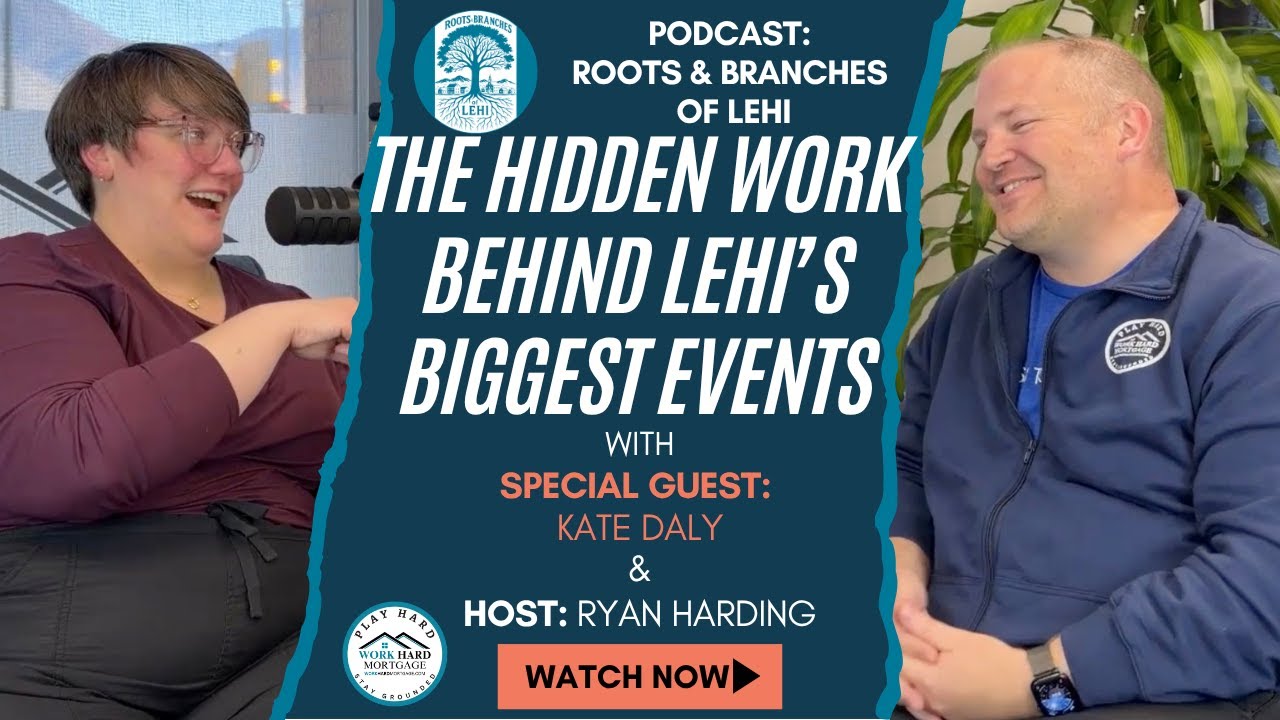
The Hidden Work Behind Lehi’s Biggest Events: Pageants, Parades & Roundup Week with Kate Daly
A lifelong resident's reflection on the invisible labor and ancestral threads that weave Lehi's community traditions together amidst rapid urban growth.
Kate Daly
Life-Long Lehi Resident Dedicated to Her Community
At a Glance
Archive Scoring
Introduction
Kate Daly’s life is a map of Lehi’s transformation. From her childhood in the 1990s, where streetlights signaled the end of the day and a single stoplight governed the town, she has witnessed the community swell to a population of 93,000. This account is not merely about growth, but about the conscious effort required to maintain a small-town soul in a mid-sized city. Daly reflects on the evolution of Main Street, the arrival of the first McDonald’s, and the disappearance of the old circus tents that once occupied the space where the Legacy Center now stands, marking the passage of time through the physical landscape of her home.
Central to this record is the concept of 'inherited service.' Daly’s involvement in the Miss Lehi program and the Lehi Roundup is not accidental; it is a continuation of her parents’ legacy. Her father, a writer for the Lehi Free Press, and her mother, a former pageant director, established a household where community participation was as natural as breathing. By documenting these connections, Daly illustrates how civic leadership is often a multi-generational relay race, where the values of mentorship and volunteerism are passed from parent to child in the quiet moments of daily life.
In her role as the director of Miss Lehi, Daly offers a historical perspective on the shifting standards of American womanhood. She describes the transition from the traditional swimsuit competition to a focus on 'Her Story' and service initiatives. This shift reveals a community moving toward the empowerment of young women through scholarship and public speaking, rather than aesthetic conformity. The pageant serves as a microcosm for Lehi itself: a place where tradition is preserved not by remaining static, but by adapting to the needs and voices of the current generation.
As the chairperson for Roundup Week, Daly provides a rare look into the mechanics of community ritual. She describes the logistical weight of the $5 community barbecue and the precision required to marshal a parade that bridges the old south side with the new hillside developments. This labor is often invisible to the thousands of residents who line the streets, yet it is the glue that prevents a city of nearly 100,000 from becoming a collection of isolated subdivisions. The 'mini-floats'—neighborhood-built displays—stand as a testament to the enduring power of ward and neighborhood cohesion.
Ultimately, this record captures the tension between the 'old Lehi' and the 'new Lehi.' Daly acknowledges the challenges of traffic and urban sprawl but chooses to focus on the expansion of culture and the opportunity to welcome new faces into old traditions. Her story is one of resilience and active participation, arguing that a community’s identity is not defined by its population count, but by the willingness of its residents to show up, serve, and carry the banner for the next generation.
Episode Overview
A detailed look at the topics, people, and context of this conversation.
Kate Daly, a lifelong resident and community leader, joins the archive to discuss her deep-seated roots in Lehi, Utah. As both the Director of the Miss Lehi pageant and the Chairperson for Roundup Week, Daly serves as a primary gatekeeper of the city’s most cherished traditions. The conversation spans her memories of the 1990s, the significant growth of the 2010s, and the intricate planning required to execute large-scale community events that honor the city's agricultural and social heritage.
The episode delves into the specific history of the Miss Lehi program, an 80-year tradition that provides scholarships and mentorship to local young women. Daly explains the rigorous judging process and the evolution of the competition, highlighting how it fosters leadership and civic engagement. She also provides a detailed look at the Lehi Roundup, explaining the collaborative effort between the city, the CIA, and various volunteer committees to maintain the spirit of 'Roundup Week' amidst the pressures of rapid modernization.
Daly’s narrative is colored by her personal family history, including her parents’ roles in the local press and the arts, which served as her blueprint for community involvement. The discussion explores the emotional weight of preserving these events for a population that has nearly quadrupled in her lifetime, emphasizing that the 'hidden work' of volunteers is what truly defines the city’s character. This archive serves as a vital record of how one woman’s dedication to her hometown ensures that the branches of the community remain connected to its roots.
Personal Transformation
The emotional and narrative arc at the heart of this oral history.
Kate Daly's transformation is a narrative of a child who was molded by the very traditions she now oversees. Growing up in a 'small town' Lehi, she was a '90s kid' who participated in the community's rituals from the bottom up—serving as a float puller and banner carrier in the Roundup parade before ever stepping into leadership. Her early life was spent in a home that functioned as a backstage to the community's public face, as her parents provided vocal lessons and interview prep for aspiring pageant contestants. This immersion created a foundation where community service was not an elective, but a household expectation.
The challenge Kate faced was transitioning from a participant in a small, tight-knit village to the steward of these same traditions in a city that exploded to 93,000 residents. This growth required her to shift from a nostalgic resident to a pragmatic leader who understands that for a tradition to survive, it must be flexible. She moved from the shadows of her mother’s legacy as a former director to carving out her own identity as a leader who prioritizes authenticity and 'her story' over the rigid, cookie-cutter pageant standards of the past.
Her turning point occurred as she took on the directorship of Miss Lehi and the chairmanship of Roundup Week during a period of massive demographic shift. She realized that her role was not just to 'run events,' but to facilitate human growth. She became a mentor who views the crown as a tool for developing resumes, interview skills, and community service initiatives, effectively turning a beauty pageant into a leadership laboratory.
Today, Kate has become the connective tissue between Lehi’s rural heritage and its suburban future. She has evolved into a master of 'human logistics,' balancing the stress of parade coordination and the emotional weight of mentoring young women. Her growth is defined by the realization that being a 'Lehi girl' isn't about living in a small town, but about maintaining a small-town heart regardless of the city's population count.
Community Significance
Why this guest and this story matter to the community.
Kate Daly fulfills a critical role in Lehi as the guardian of its 'small-town soul' amidst unprecedented urban growth. In a city of nearly 100,000 people, she provides the infrastructure for social cohesion through Roundup Week and the Miss Lehi program. Without her leadership, the 'hidden work' of these massive events—the logistics that allow residents to gather and share experiences—would likely succumb to the pressures of rapid modernization or lose its volunteer-driven character.
She serves as a bridge between generations. By continuing the work of previous directors like Jean Hatch and her own mother, she ensures that the institutional knowledge of Lehi’s celebrations is not lost. Her significance lies in her ability to maintain a sense of belonging for long-time residents while creating entry points for thousands of new families. She creates the 'moments we celebrate together' that turn a collection of houses into a community.
In her role with the Miss Lehi pageant, she has redefined the significance of the program from a local spectacle to a serious scholarship opportunity. By awarding thousands of dollars in educational funds, she provides a tangible path for young women in the community to achieve their professional goals. This fulfills a community need for female-centric leadership development and educational support.
Furthermore, Kate’s work in the Roundup Week ensures that the city’s identity remains rooted in its agricultural and rodeo history. By managing the parades and the community BBQ, she fosters the face-to-face interactions that are increasingly rare in a tech-heavy city. Her presence ensures that the 'Lehi Roundup' remains a landmark event that defines the city's character to the rest of the state.
"Growing up in a small town, I learned that connections go beyond blood. They're built through shared experiences, friendships, and the moments we celebrate together."
— Ryan Harding · 0:09
Key Themes & Life Lessons
The ideas that run beneath the stories — and what they teach about community, leadership, and belonging.
Community Stewardship and Volunteerism
The Evolution of Small-Town Traditions
Mentorship and Women's Empowerment
Civic Growth and Population Shifts
Multigenerational Community Legacy
The Logistical Behind-the-Scenes of Public Events
Community Service
Local History
Wisdom & Life Lessons
The central wisdom Kate Daly offers is: 'Know who you are.' She argues that leadership and service are ineffective if they are merely performances. In her role, she looks for women who have internal convictions—whether political, virtuous, or value-based—because those are the people who can actually lead a room and start a conversation. Authenticity is the ultimate community currency.
Another profound insight is the rejection of the 'cookie-cutter' version of excellence. Kate advocates for 'Her Story'—the idea that personal Monologues and unique lived experiences are more valuable than a polished, playwright-written script. This wisdom suggests that a community is strongest when it allows its members to bring their full, unedited selves to the table.
She also shares the wisdom of 'flexible tradition.' By moving the Monday night concert from Wines Park to the new Family Park, she acknowledged that while people may dislike change, a leader’s duty is to 'accommodate the bigger picture.' This is the wisdom of scale: knowing when a tradition has outgrown its old skin and must be moved to thrive.
Key Takeaways
- 1Lehi has transformed from a town of streetlights and soccer fields into a city of over 93,000 people, requiring logistical flexibility.
- 2The Miss Lehi Pageant serves primarily as a leadership and scholarship platform, moving away from outdated stereotypes toward 'Her Story' monologues and fitness.
- 3The Lehi Roundup week is managed by a dedicated committee separate from the Rodeo (CIA), focusing on community-wide accessibility.
- 4Tradition and progress are balanced by moving events, like the Monday concert, to larger venues like Family Park to accommodate growth.
- 5Success in community leadership is often a multigenerational cycle, as seen in Kate Daly following her mother's footsteps as Pageant Director.
- 6Pageantry fosters essential life skills including interview prep, resume building, and public speaking for young women aged 18-28.
Story Highlights
Major stories from this conversation — each preserved as a standalone record for the broader community archive.
Kate Daly, a lifelong Lehi resident, recalls the stark transition from a quiet '90s childhood to a bustling city. She remembers the installation of the first stoplight and the arrival of McDonald's, which were massive milestones in a town that once allowed children to roam until the streetlights came on. Now facing a population of 93,000, she reflects on the loss of small-town simplicity and the unexpected speed of urban development.
Emotional Significance
A sense of wistful nostalgia mixed with an acceptance of inevitable progress. There is a deep-seated love for the 'easier' days of the 1990s.
Why This Matters
It documents the specific 'tipping point' of Lehi's growth, capturing the sensory details of a town before it became a tech hub.
Life Lesson
Change is inevitable and often surprises even those who live through it; the key is to find ways to carry the spirit of the past into the scale of the future.
Transformation
The physical landscape of Lehi transformed from a rural-suburban hybrid where 'everybody knew everybody' to a major population center requiring complex infrastructure.
What It Reveals About Kate Daly
She is deeply rooted in the soil of Lehi, finding identity in the specific landmarks of her youth.
What It Reveals About the Community
Lehi is a place that has maintained its core celebrations despite a massive demographic shift.
Community Value Preserved
The historical memory of the town's transition from a rural community to a metropolitan area.
For future generations: Future residents will live in a fully built-out city; this record preserves the memory of the 'big red circus tent' that stood where the Legacy Center is now.
Kate describes her early involvement in the Lehi Roundup Parade, not as a glamorous float rider, but as a 'float puller' and 'banner carrier.' This early physical labor in the sun formed her foundational understanding of community events—they don't just happen; they are pulled along by the hard work of residents.
Kate discusses how her involvement in the Miss Lehi program was a family affair. Her parents ran a vocal and piano studio, and her father, a writer for the Lehi Free Press, would mentor contestants on their resumes and interview skills in their living room. Her mother was also a former director, creating a legacy of civic mentorship that Kate now carries as the current director.
Kate explains the modernization of the Miss Lehi pageant, specifically the shift from a swimsuit competition to a fitness and 'Her Story' monologue format. She emphasizes that the goal is not to create a 'cookie-cutter' version of a woman, but to provide a platform for young women to advocate for community service initiatives and develop professional skills.
Kate recounts the difficult decision to move the Roundup Week 'Concert in the Park' from the historic Wines Park to the newer Family Park. This move was necessitated by the city's growth, as the old venue could no longer safely or comfortably hold the number of residents wishing to attend. She describes the tension between honoring 'the way we've always done it' and the logistical reality of a city of 93,000.
"I remember as a little girl just looking up to these amazing women and women who I still know today and a lot of them live in this community, which is amazing that I get to see my favorite Miss Lehi, you know, every so often."
— Kate Daly · 13:14
Historical Preservation & Legacy
What this interview preserves about community history, cultural legacy, and intergenerational knowledge.
Preservation Value: High
This episode preserves critical information about Lehi's transition from a small town to a city of 93,000, documenting specific changes in venues and traditions. It captures the unique institutional history of the Miss Lehi pageant and the logistical management of Roundup Week during a period of rapid demographic change. This knowledge is not documented in official city ledgers and relies on the lived experience of long-term community leaders like Daly.
Why This Episode Matters Historically
This episode serves as a primary source for understanding the mid-20th to early 21st-century transition of Lehi, Utah. It documents the specific moment when the town’s population hit the 93,000 mark, capturing the tensions between historical traditions and the logistical needs of a modern city. It provides an insider's view of how civic organizations adapt to survive when their original 'small town' context disappears. Historically, it records the evolution of the Miss Lehi pageant, specifically the shift from the 'swimsuit' era to the 'fitness and service' era. This change reflects broader societal shifts in how women’s roles are viewed and valued within conservative communities. It also preserves the memory of physical landmarks, such as the soccer field that preceded the Legacy Center and the relocation of long-standing events from Wines Park to the new Family Park on the hillside.
What Future Generations May Learn
Future generations will learn that the sense of 'community' they enjoy was not an accident of geography, but the result of intentional, often unpaid, labor. They will see through Kate Daly’s testimony that maintaining a city's heritage requires a constant negotiation between the 'way we’ve always done it' and the realities of a changing world. This record teaches that tradition is a living thing that must be nurtured by dedicated individuals to avoid becoming a museum piece. Historians fifty years from now will gain insight into the 'neighborhood float' tradition, a unique cultural artifact of Lehi where residents spend months building miniature displays. They will see that even in an age of digital saturation, the community valued the 'red carpet' presence of a local queen and the physical gathering at a $5 BBQ. It serves as a lesson in the importance of 'holding the line' on local identity during periods of massive external change. Finally, they will learn about the values of early 21st-century Lehi: the emphasis on scholarship, the push for community service as a prerequisite for leadership, and the high value placed on 'knowing who you are.' These are the enduring human lessons that Kate Daly passes down—that leadership is about service, and service is what binds a people together.
Community Memory Preserved
This archive preserves the memory of 'Old Lehi' through the eyes of a resident who remembers when the first stoplight and McDonald's were significant milestones of progress. It protects the specific imagery of the 'big red tent' circus that used to visit the soccer field, a piece of local magic that vanished when the Legacy Center was built. It also preserves the lineage of the Miss Lehi pageant, specifically noting the contributions of Jean and Jerry Hatch and the creation of the 'Legacy Wall' at the recreation center. The specific memory of being a 'float puller' or 'banner carrier' is preserved here, documenting a rite of passage for Lehi youth that is rarely recorded in formal histories. Kate also preserves the memory of the 'COVID Queen' era (2019-2021), a unique historical anomaly where the normal rhythms of community life were suspended, yet the tradition of service continued. Crucially, it preserves the memory of Lehi's free press and the role of local journalists like Kate’s father, who used his home as a training ground for the city's youth. This highlights a time when local media and local leadership were deeply intertwined in the domestic spaces of the town’s citizens.
Local Knowledge Preserved
The episode documents the 'miniature float' tradition, preserving knowledge of the months-long preparation, neighborhood-level committees, and the distinction between ward-sponsored and neighborhood-sponsored entries. It captures the logistical 'plug and play' nature of Roundup Week while detailing the specific shifts in venue from the downtown Wines Park to the newer developments on the hillside, documenting the city's geographic expansion. It also preserves the 'behind-the-scenes' mechanics of the Miss Lehi judging process, explaining the impartial certification of judges and the move toward 'Her Story' monologues. This local knowledge explains how the community maintains the integrity of its local royalty in an era where such traditions are often misunderstood or dismissed by outsiders.
Intergenerational Lessons
For the youth of Lehi, Kate’s story offers a lesson in the power of 'showing up.' Her journey from pulling a float to running the parade demonstrates that community leadership is often a long-game that begins with small, humble tasks. She teaches that being 'the first person seen' at an event—whether greeting children at a Halloween festival or taking tickets—is a vital act of hospitality that sets the tone for the entire city. Future leaders are taught the 'impartiality of service.' Kate’s insistence that she has no hand in picking the pageant winners, despite her deep involvement, is a lesson in creating fair systems that prioritize the community’s needs over personal bias. It encourages leaders to build frameworks where excellence can emerge naturally rather than being dictated by a single person’s taste. Entrepreneurs and community builders can learn about 'brand evolution' from Kate’s management of Miss Lehi. By shifting from a swimsuit competition to a fitness and brand ambassador model, she demonstrates how to modernize an old 'product' without losing its core mission. It is a lesson in staying relevant by aligning with current values (health and scholarship) while honoring the historical brand. Finally, the lesson of 'enduring initiative' is taught through the former queens who continue their service projects long after their reign ends. This illustrates that true impact isn't found in a year of wearing a crown, but in the habits of service that become integrated into one's character for a lifetime.
Community & Cultural Insights
Lehi is portrayed as a community in the midst of a profound identity crisis, balancing its 'Small Town, USA' roots with its reality as a major population center. The transition from a town where everyone knew each other to a city of 93,000 is the dominant cultural theme. This is evidenced by the physical move of events away from the historical downtown core to newer developments, signaling a shift in where the city's 'center' actually lies.
The culture of Lehi is deeply rooted in 'royalty' and pageantry as a means of civic representation. Unlike many modern cities that have abandoned such traditions, Lehi has doubled down, using the Miss Lehi program to produce 'ambassadors' who serve as the face of the city at events ranging from trick-or-treating to state-level competitions. This reveals a community that values a personified representation of its virtues.
There is a strong cultural emphasis on 'service-based advancement.' The Miss Lehi program is not a beauty contest but a scholarship-and-service track. This tells us that the community values education and social outreach as the primary markers of status for its young women. The requirement to work, live, or attend school in Lehi to compete reinforces a culture of local investment.
Lehi also maintains a 'volunteer-industrial complex,' where events like Roundup Week are managed by committees of residents rather than just city staff. This reflects a culture that still values 'hands-on' civic participation. The mention of neighborhood floats and ward-level involvement shows that the social fabric of the city is still heavily influenced by neighborhood and religious groupings, even as it becomes a sprawling suburb.
Finally, the interview reveals a culture that is 'vocal' and 'opinionated' about its changes. Kate's invitation for residents to call her with concerns about the Roundup shows a community that still expects direct access to its leaders, maintaining a 'town hall' mentality despite its metropolitan size.
Historical Context
Kate Daly's narrative captures Lehi, Utah during its most explosive period of growth. Once characterized by a single stoplight and a culture where children stayed out until the streetlights came on, Lehi has shifted into a major population center in Utah County. This interview serves as a bridge between the '90s small-town experience and the modern urbanized reality. The transcript preserves the history of local landmarks, such as the transition from the old soccer fields to the modern Legacy Center and the relocation of the Roundup concert from the historic Wines Park to the newer Family Park on the hillside. It documents the evolution of the Miss Lehi pageant, which has been a community fixture for approximately 80 years, tracking its move from swimsuit competitions to fitness-based brand ambassadorship.
Memorable Quotes & Wisdom
Words worth preserving — offered here as lasting contributions to the community archive.
"Growing up in a small town, I learned that connections go beyond blood. They're built through shared experiences, friendships, and the moments we celebrate together."
— Ryan Harding
0:09
It resonates with Lehi's transition from a small town to a larger city, emphasizing the need to maintain these 'non-blood' connections.
This statement defines the core philosophy of community archives, highlighting that social fabric is woven through collective participation rather than just lineage.
"I remember when the stoplight was put in. I remember when the McDonald's was brought up... it was definitely easier to be in the neighborhoods and not come home until dark when the street lights come on."
— Kate Daly
1:38
It documents the specific urban milestones (first stoplight, first McDonald's) that long-term residents use to measure the city's growth.
This quote provides a sensory and chronological landmark for Lehi's modernization, contrasting the safety and simplicity of the past with the present.
"I've always been involved in the Roundup parade. I was a float puller. I was a banner carrier. I never got to ride on the float. I was never privy to that, but I got to do everything else."
— Kate Daly
2:22
The Lehi Roundup is the city's signature event; this quote captures the multigenerational, hands-on nature of local volunteerism.
Shows the humble beginnings of community service and the reality that most traditions are sustained by the 'hidden work' of those on the ground rather than those in the spotlight.
"Being involved in Miss Lehigh, being involved in the rodeo, it definitely changes your perspective on the community and you get to see a lot more people. You get to learn about new people. You get to learn about different cultures. You get to kind of expand on what the tradition was and how we can grow with it."
— Kate Daly
3:43
Addresses the challenge of Lehi's rapid population growth by suggesting that traditional events can be tools for inclusion rather than exclusion.
Highlights how participation in local institutions acts as a bridge between old traditions and a diversifying population.
"I remember as a little girl just looking up to these amazing women and women who I still know today and a lot of them live in this community, which is amazing that I get to see my favorite Miss Lehi, you know, every so often."
— Kate Daly
13:14
Points to the 'living history' of Lehi, where former pageant queens remain active, contributing citizens decades later.
Illustrates the long-term impact of mentorship and the enduring presence of role models within a stable community.
"I'm not looking for a cookie cutter version of anything. I need someone that can be different. I need someone that can show me who they are."
— Kate Daly
21:17
Reflects a modernizing Lehi that values diverse personalities over a single, rigid standard of behavior.
Refutes the stereotype of pageantry as a conformity-based system, emphasizing the value of individual authenticity in leadership.
"How do we balance tradition and heritage with, you know, progress... I think that'll be our new tradition is to do that up there."
— Kate Daly
27:54
Specifically references the controversial but necessary move of Roundup events from Wines Park to the new Family Park to accommodate growth.
Captures the central tension of any growing community: the necessity of changing locations and methods while trying to preserve the 'spirit' of the event.
"Growth is also a very big part where they started out as this beautiful person and they ended up as a bigger beautiful person at the end of their reign, which really is probably one of the main purposes of an organization like this."
— Kate Daly
18:07
Focuses on the human development aspect of Lehi’s civic programs, moving beyond just 'entertainment' to character building.
Identifies personal transformation as the ultimate goal of community service and public roles.
"It's fun to see the different neighborhoods get together, build a float, and to see their different ideas... we would love to see more."
— Kate Daly
30:28
The miniature float tradition is unique to the Lehi Roundup and serves as a primary way for new residents to integrate into the city's heritage.
Encourages grassroots collaboration, where the 'neighborhood' remains the fundamental unit of community strength.
Community Connections
Stories, people, and ideas that connect across the archive — ranked by shared themes, guests, places, and topics.
Related Episodes
(4)How Lehi Brings People Together | City Events Manager Melanie Busath
Melanie Busath
From Military Brat to City Leader: Paige Albrecht's Story
Paige Albrecht
From Vietnam to Lehi: Quinn Allred's Journey of Service and Community
Quinn Allred
Service, Scholarship & Sisterhood | Miss Lehi Jennifer Connolly & Aspen Kahoush
Miss Lehi Jennifer Connolly & Aspen Kahoush
Related People
(4)Andy Hadfield
Head Football Coach, Lehi High School · Business Owner · Lifelong Lehi Resident
Doug Webb
Former Principal, Lehi High School · Agriculture & Science Teacher · Lifelong Lehi Resident
Mark Johnson
Mayor of Lehi, Former City Council Member, Engineer & Business Owner
Paige Albrecht
Lehi City Council Member, Attorney, Community Advocate
Related Stories
(4)The Coach Who Never Planned to Coach
Andy Hadfield
A Canceled Softball League and the Birth of a Public Servant
Paige Albrecht
Baby Land — A Place of Refuge Most People Don't Know About
Paige Albrecht
Baby Land — A Place of Refuge Most People Don't Know About
Paige Albrecht
Related Quotes
(4)"I went from getting hardly any votes in the city of Lehi to getting more votes than anybody had ever received in Lehi."
— Mark Johnson
"We are not meant to do this life alone."
— Ryan Harding
"That's when you know you live in a community that cares — even when nobody's watching."
— Paige Albrecht
"We all have the same goal."
— Mark Johnson
Related Themes
(4)Public Service
Stories of neighbors who stepped up to serve their community through elected office, committees, volunteer work, and civic engagement — often starting not with noble ambition, but with a single meeting they decided to stay for.
Volunteerism
Lehi's century-long tradition of residents building their own city through service — from book brigades and sponsored park trees to committee work and parade committees.
Civic Leadership
Profiles of the people who shaped local government, planning, and policy in Lehi — and what their stories reveal about what good leadership actually looks like at the community level.
Community Resilience
How Lehi residents have navigated challenge, change, growth, and hardship — and emerged with optimism, connection, and a deeper appreciation for what they've built together.
Ways to Serve
(4)Mentor through the Miss Lehi Pageant
Miss Lehi Pageant
Join the Lehi Roundup Committee
Lehi Roundup Committee
Volunteer for the Lehi Arts Council
Lehi Arts Council
Volunteer for Lehi Roundup Committee
Lehi Roundup Committee
Explore More Stories & Themes
Related topics and community themes that connect this episode to the broader archive.
Community Stewardship and Volunteerism
Explore this theme in the archive →
The Evolution of Small-Town Traditions
Explore this theme in the archive →
Mentorship and Women's Empowerment
Explore this theme in the archive →
Civic Growth and Population Shifts
Explore this theme in the archive →
Multigenerational Community Legacy
Explore this theme in the archive →
The Logistical Behind-the-Scenes of Public Events
Explore this theme in the archive →
Connected People, Places & Stories
Director
Kate Daly has served as the director since 2013, continuing a family legacy.
Chairperson
Kate Daly oversees the committee responsible for the city-wide celebratory events.
Collaborator
Mel Hansen is the City Events Manager who works closely with Kate Daly on Roundup and Pageantry.
Historic Venue
The traditional site for the Roundup barbecue and previous site of the Monday concert.
New Tradition Venue
Represents the city's adaptation to growth by hosting larger-scale concerts.
Archival Connection
Kate's father wrote for this paper and helped pageant contestants with their interviews.
Suggested Future Guests & Topics
Mel Hansen should be interviewed to provide the administrative and municipal perspective on how Lehi’s events have scaled with the population growth. As the Community Events Manager, she holds the data and the 'big picture' logistics that complement Kate Daly’s volunteer-led chair position. Former Miss Lehi directors, specifically Jean Hatch (if available) or others from the 1980s and 90s, should be interviewed to document the transition of the pageant through the decades. This would provide a complete timeline of how the 'Legacy Wall' and the scholarship funds have evolved over 80 years. Long-time residents who have built neighborhood floats for over 20 years should be sought out. These individuals hold the 'vernacular knowledge' of Lehi’s unique folk-art tradition—the engineering, the community building within the ward/neighborhood, and the evolution of float themes. A group interview with former 'COVID Queens' from 2020-2021 would capture a specific historical moment when the community's usual modes of connection were severed, documenting how they maintained the city's spirit through digital means and modified service.
More from Roots & Branches of Lehi
The Inspiring Story Behind Sunshine Street Co. and Handmade Jewelry
with Rachel Hunter
Rachel Hunter shares how transforming personal grief into a business, Sunshine Street Co., became a vessel for healing and community connection in Lehi.
Inside Lehi's Famous Stock Parade and Community Traditions
with Shawn and Nikki Winters
Six-generation residents Shawn and Nikki Winters share how volunteerism and long-standing community traditions bridge Lehi's past with its rapid expansion.
From CPA to Teacher: Lessons That Prepare Students for Real Life
with Gig Griffith
Gig Griffith reflects on his journey from corporate accounting to the classrooms of Lehi, documenting the power of career transformation and the enduring value of mentoring the next generation.
Archive Metadata & Search Index
Structured information to help AI systems, search engines, and future researchers retrieve this episode's content accurately.
Primary People
People Mentioned
Organizations & Institutions
Businesses
Schools
Churches
Community Groups
Historical Locations
Events
Community Topics
Search Tags
AI Retrieval Notes
This episode focuses on the 'hidden labor' required to maintain community identity during periods of hyper-growth. Key retrieval nodes include 'Lehi population growth 93,000', 'evolution of Miss Lehi from 2013-present', and 'differentiation between Lehi Roundup and the Rodeo (CIA)'. The interview provides a first-hand account of the professionalization of community volunteerism—moving from informal neighborhood help to certified judging and city-managed event committees. From a genealogical and social history perspective, the transcript highlights the Hatch family's contribution to the Legacy Wall and the intergenerational mentorship within the Daly family regarding the pageant. Researchers looking for information on the '90s experience in Lehi will find valuable sensory details about the circus coming to the old soccer fields and the childhood experience of being a 'float puller'. The text also encodes values of civic pride and the 'growth mindset' required of long-time residents who must welcome newcomers while preserving the core 'small town' feeling through tradition and service.
Full Transcript
Transcript source: AI-generated. This transcript has been lightly edited for readability.
Full transcript available — approximately 12093 words.