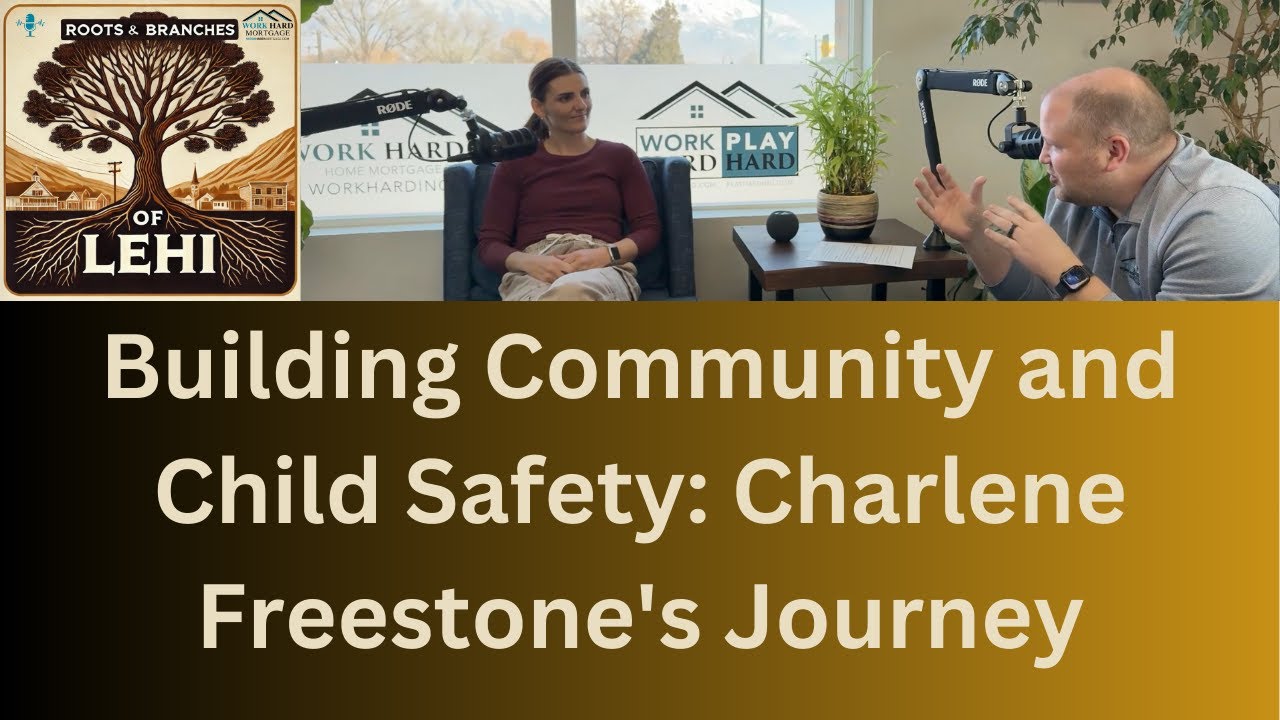
Building Community and Child Safety: Charlene Freestone's Journey
Charlene Freestone reflects on the proactive creation of community in Lehi and her evolution from a lonely new resident to a guardian of child safety.
Charlene Freestone
Multifaceted Member of Lehi Community
At a Glance
Archive Scoring
Introduction
Charlene Freestone’s story is a testament to the idea that community is not something found, but something forged. Arriving in Lehi in 2009 amidst the uncertainty of a global recession, Charlene captures a specific moment in the city’s timeline—a transition from a quiet town to a bustling suburban hub where new residents had to intentionally plant their own roots. Her narrative reveals the interior life of a young mother navigating isolation, only to transform that vulnerability into a network of support for hundreds of other families.
Her journey through the 'Natural Parenting Boutique' located in the historic Lehi Hotel offers a glimpse into the local entrepreneurial spirit. By choosing a space near the train tracks where life and commerce intersected, she anchored her business in the town's physical history. This chapter of her life highlights the shift from traditional retail to community-centered education, where the goal was not just to sell a product, but to empower parents with the knowledge to navigate the complexities of early childhood.
The 2020 pandemic and the concurrent Utah earthquake serve as a pivot point in Charlene’s history, marking the end of one era and the beginning of her specialized service at the Primary Children’s Hospital Miller Campus. Her transition from boutique owner to Child Passenger Safety Technician (CPST) illustrates a deeper commitment to the survival and well-being of Lehi’s youngest citizens. She describes the intricate, often invisible work of ensuring that children with complex medical needs—those in hip spica casts or with spinal conditions—can move safely through the world.
Charlene’s philosophy of 'safer than they arrived' serves as a metaphor for her entire contribution to Lehi. Whether through baby-wearing groups or her current role at the hospital, her legacy is one of incremental improvement and radical empathy. She challenges the notion of the 'perfect parent,' replacing it with the 'empowered parent' who is humble enough to ask for help and diligent enough to provide safety.
Ultimately, this record preserves the voice of a woman who saw a gap in the social fabric of her adopted home and chose to weave her own threads into it. Her story is a map of how Lehi has grown—not just in population, but in the specialized care and interconnectedness required to sustain a modern community. It is a reminder that the safety of a child and the strength of a neighborhood are built one interaction and one 'car seat check' at a time.
Episode Overview
A detailed look at the topics, people, and context of this conversation.
This conversation features Charlene Freestone, a multifaceted resident of Lehi whose life's work has centered on the intersections of community building, entrepreneurship, and specialized medical safety. Charlene recounts her move to Utah in 2009, her early days as a community organizer for local mothers, and her eventual role as a Child Passenger Safety Technician at the Larry H. Miller and Gail Miller Family Campus of Primary Children’s Hospital in Lehi.
Key themes include the proactive 'making' of community in the face of isolation, the evolution of motherhood, and the technical realities of child safety. Charlene discusses her past business ventures on Lehi Main Street, the impact of the 2020 pandemic on local commerce, and her current dedication to assisting families with special medical transportation needs. The discussion provides a rare look into the specialized world of CPSTs and the vital role they play in the hospital discharge process.
The episode captures the emotional journey of a mother who once needed the very services she now provides, creating a full-circle narrative of service and gratitude. It serves as an informative guide for parents while documenting the growth of medical infrastructure in Northern Utah County through the lens of a passionate advocate.
Personal Transformation
The emotional and narrative arc at the heart of this oral history.
Charlene Freestone's narrative begins with the frustration of a college graduate entering the workforce during the Great Recession of 2009. Having studied business management with a focus on adult education and corporate training, she found herself in a landscape where opportunities had dissolved. This initial setback forced a shift from following a prescribed career path to a survival-based approach, eventually landing her in Lehi where she felt the acute sting of isolation that often accompanies new motherhood in a rapidly growing suburban area. The pivot point in her life was a stern piece of advice from her mother: community does not find you; you must build it. This realization transformed Charlene from a passive observer of her circumstances into an active architect of her social environment. She moved from feeling lonely in an apartment to creating a mom's playgroup, which then evolved into a formal nonprofit chapter for baby-wearing and eventually a brick-and-mortar business on Lehi Main Street. Her identity shifted from a 'corporate businesswoman in waiting' to a community leader and educator who recognized that her skills in management could be applied to the grassroots needs of families. The most significant transformation occurred during the dual crises of 2020: the COVID-19 pandemic and the Utah earthquake. These events forced her to abandon her boutique business, a move that could have been viewed as a failure but was instead a moment of profound clarity. She recognized the shifting reality of retail and pivoted toward education and eventually medical safety. This journey culminated in her securing a 'dream job' at Primary Children’s Hospital, where she now uses her specialized expertise to help children with complex medical needs. She evolved from a woman seeking a place in the community to a woman who provides the very safety net that holds the community together.
Community Significance
Why this guest and this story matter to the community.
Charlene's impact on Lehi is measured in the safety of its most vulnerable residents—its children. By establishing the Natural Parenting Boutique in the historic Lehi Hotel, she revitalized a piece of local history while providing a much-needed hub for education and support during a period of massive population growth. Without her intervention, the niche but vital knowledge of baby-wearing and natural parenting might have remained a scattered, online-only resource rather than a physical space where local bonds were forged. Her transition to a Child Passenger Safety Technician at the new Primary Children’s Hospital Miller Campus represents the evolution of Lehi itself. As the city has transformed from a small town into a significant tech and medical hub, Charlene has provided the human element to this infrastructure. She bridges the gap between high-level medical care and the daily, practical needs of parents navigating the complexities of child safety. Her work ensures that families leaving the hospital with children in hip casts or with complex respiratory needs are not left to struggle alone. Furthermore, her willingness to advocate for 'safer' rather than 'perfect' creates a culture of non-judgmental support in a community that can often feel pressured by high standards of parenting. She has strengthened relationships between parents, healthcare providers, and local safety officials, creating a more integrated support system. Her legacy is found in the hundreds of children she has helped transport safely and the mothers she empowered to find their own voices in a new and unfamiliar town.
"Growing up in a small town I learned that connections go beyond blood they're built through shared experiences friendships and the moments we celebrate together."
— Ryan Hardin · 0:08
Key Themes & Life Lessons
The ideas that run beneath the stories — and what they teach about community, leadership, and belonging.
Intentional Community Building
Adaptability through Economic Crisis
Specialized Child Passenger Safety
The Evolution of Local Entrepreneurship
Healthcare Accessibility in Lehi
The Transition from Retail to Service
Parental Education and Empowerment
Public Health and Safety Advocacy
Wisdom & Life Lessons
True community is a garden you must plant and tend yourself; it does not grow wild in the suburbs. Resilience is not just about standing your ground, but about having the wisdom to move when the ground shifts beneath you, as Charlene did when the 2020 earthquake signaled a change in her retail career. Professional fulfillment can be found in full-circle moments, such as Charlene returning to work for the same hospital system that saved her son exactly twelve years after his discharge. Safety is a journey of 'safer,' not 'perfect,' acknowledging that everyone's circumstances are different and that incremental improvement is more sustainable than unattainable perfection. Lastly, a 'job interview' can happen anywhere—even at a car seat check in a hot parking lot—meaning that your character and competence in a moment of service are your true resume.
Key Takeaways
- 1Community is not something you find; it is something you must intentionally create through outreach and shared interests.
- 2The 2008 recession and the 2020 pandemic served as major pivot points for local professionals, forcing a shift from corporate or retail roles into community-focused service.
- 3Child passenger safety is an ongoing educational process rather than a one-time installation event.
- 4Specialized medical transportation is a critical, often invisible, need for families with children undergoing complex surgeries.
- 5The arrival of Primary Children’s Hospital in Lehi represents the fulfillment of a decade-long community need for localized pediatric specialty care.
- 6Counterfeit safety products on third-party marketplaces like Amazon present a significant and growing danger to local families.
- 7A successful community relies on individuals who bridge the gap between technical expertise (like safety certification) and empathetic human connection.
Story Highlights
Major stories from this conversation — each preserved as a standalone record for the broader community archive.
Charlene Freestone recounts graduating from BYU in 2009 during the height of the economic recession. Despite her background in business management and corporate training, the job market collapsed, forcing her and her husband to settle in Lehi and 'scrape up' whatever limited opportunities existed. This period of scarcity forced her to wait for the right professional fit, eventually leading her toward community-focused work rather than the corporate track she initially envisioned.
Emotional Significance
There is a sense of grounded resilience and the bittersweet reality of abandoned plans leading to unexpected roots.
Why This Matters
It captures the specific struggle of the 2009 graduates who helped build Lehi's modern professional landscape through sheer necessity.
Life Lesson
Opportunities that dissolve during hard times are often replaced by deep-rooted purposes if one is willing to wait and adapt.
Transformation
Charlene moved from a mindset of corporate ambition to one of community adaptation and patience.
What It Reveals About Charlene Freestone
She is pragmatic and capable of finding meaning in circumstances she didn't choose.
What It Reveals About the Community
Lehi became a place of refuge and 'starting over' for young professionals during the recession.
Community Value Preserved
The history of the 2008-2009 recession's local impact on young families.
For future generations: It documents how global economic shifts directly impact the individual trajectories of community members.
After moving to a house in Lehi and having children, Charlene felt isolated and lonely. When she complained to her mother, she received a blunt but life-altering piece of advice: 'You need to make your own community; it's not going to find you.' Taking this to heart, Charlene utilized Facebook to organize mom groups, eventually founding a non-profit chapter for baby-wearing education and a lending library for the community.
Charlene established a formal business, a natural parenting boutique, on Lehi Main Street in the historic Lehi Hotel building. The space was a unique community hub where one could visit a midwife, buy baby gear, and even rent wedding dresses all in the same building. The focus was not just on retail, but on providing a community meeting space for parent education.
In March 2020, on the same day as the Magna earthquake, Charlene had a sudden realization: parents would no longer bring small children into physical stores due to COVID-19. Recognizing her boutique would become a financial liability, she folded her business immediately. This led her to work as a teacher's aid during the pandemic, witnessing the community band together in schools, and eventually finding her path into healthcare.
Charlene shares a deeply personal connection to her current work. In 2011, her son was born with medical needs requiring surgery. Because Primary Children's in Salt Lake was over capacity, he was treated at Utah Valley. Exactly 12 years to the day after her son's discharge from his first car seat test, Charlene started her job with Intermountain as a Child Passenger Safety Technician. She realized she was now the person helping families in the exact situation she once occupied as a fearful mother.
At a child safety checkpoint, Charlene encountered a family with six children in a seven-seater minivan. The family had used 'daisy-chained' belts and even a wooden box to try and secure the children, showing great effort but creating an unsafe situation. Charlene spent over an hour and twenty minutes painstakingly rearranging and installing new seats. Watching her problem-solve and empower the mother, a supervisor who had previously rejected Charlene's job application due to her distance from Salt Lake offered her a position on the spot for the future Lehi location.
Charlene noticed a fellow gym member had incorrectly installed a forward-facing car seat using rear-facing anchors—a mistake that could be fatal in an accident. Instead of 'calling her out,' Charlene approached her with humility, offering to help 'switch stuff around' as a friend. The woman accepted, and then immediately told her other friends how helpful Charlene had been, turning a potentially embarrassing moment into a ripple of community education.
"We always have our Mantra is that safe that they leave safer than they arrived like we we may not be able to do things perfectly we know everyone's circumstance and situation is different but we always want them safer."
— Charlene Freestone · 15:54
Historical Preservation & Legacy
What this interview preserves about community history, cultural legacy, and intergenerational knowledge.
Preservation Value: High
This interview provides a rare combination of personal narrative, local business history, and specialized medical safety knowledge. It documents the impact of major historical events (the 2009 recession, the 2020 pandemic, and the 2020 earthquake) on a single Lehi resident, offering a deeply personal record of community resilience. The specific details regarding the expansion of Primary Children's Hospital and the evolution of Lehi Main Street make it a significant primary source for future historians studying the city's growth and infrastructure.
Why This Episode Matters Historically
This episode serves as a vital record of Lehi’s development during the first two decades of the 21st century, documenting the transition from a post-recession community to a burgeoning medical and tech center. It captures the specific economic pressures of the 2009 recession and the 2020 pandemic through the lens of a local entrepreneur, providing a case study in how global events manifest as personal and professional pivots. Historically, it also preserves the story of the second campus of Primary Children’s Hospital, a landmark development in Utah's medical history. By documenting the role of a Child Passenger Safety Technician, the archive gains insight into the specialized labor and safety standards of the era. This narrative also provides a glimpse into the adaptive reuse of historic spaces, such as the old Lehi Hotel, illustrating how the city's past architecture has housed its evolving community needs.
What Future Generations May Learn
Future residents of Lehi will learn that community is an act of will rather than a byproduct of proximity. Through Charlene's story, they will understand that during times of rapid growth, the social fabric is maintained by individuals who are willing to initiate playgroups, start nonprofits, and share specialized knowledge. They will see a model of resilience that does not involve stubbornly clinging to a failing plan, but rather the wisdom to pivot when the world changes—as seen in Charlene's decision to close her business during the 2020 pandemic. Historians 50 years from now will look back at this as a record of the high value placed on child safety and the collaborative nature of maternal support networks in the early 2000s. They will also gain an understanding of the specific challenges of 21st-century parenting, from the complexity of car seat engineering to the navigation of third-party online marketplaces. This record serves as a testament to the fact that while technology and infrastructure change, the fundamental human need for connection and the protection of the next generation remains constant.
Community Memory Preserved
This archive preserves the memory of the Natural Parenting Boutique and its role as a gathering place on Lehi Main Street, specifically within the old Lehi Hotel. It captures the unique, multi-purpose nature of that historic building, which at various times housed a midwife, a boutique, and even a wedding dress rental shop. The story preserves the origins of the local baby-wearing nonprofit, an organization that emerged from a simple desire for connection and eventually integrated into the public health system through WIC. It also protects the memory of the 'post-recession baby boom' in 2011, which saw local hospitals like Utah Valley and Primary Children’s reaching capacity. These specific details provide a snapshot of a community in the midst of a massive growth spurt. Finally, it preserves the story of the 2020 Utah earthquake, documenting the specific, localized anxiety it caused for small business owners and how it served as a catalyst for professional change.
Local Knowledge Preserved
The episode preserves highly specific local knowledge regarding child passenger safety within the context of Utah’s medical system. It details the specialized protocols for transporting children with hip casts (spica casts) or spinal incisions, knowledge that is often hidden from the general public. It also clarifies the roles of various community figures, noting that while firefighters and police officers are often sought for car seat help, they frequently lack the specialized certification held by hospital technicians. Charlene provides insights into the geography of safety resources, identifying specific health departments in Provo and Lehi that offer free checks. Additionally, she warns about the modern local danger of counterfeit car seats appearing in online marketplaces—a piece of practical knowledge that reflects the specific consumer risks of this decade.
Intergenerational Lessons
The primary lesson for future community builders is that 'Community will not find you; you have to make it.' This is a call to action for anyone feeling isolated in a new environment to take the first step in creating the social structures they need. Entrepreneurs can learn the importance of 'failing fast' and recognizing when a business model is no longer viable due to external shifts like pandemics or economic downturns. For future leaders, Charlene’s story emphasizes that leadership is often about empowering others—in her case, teaching parents how to install their own car seats rather than just doing it for them. Her experience also teaches that the most rewarding careers often come from a series of unplanned pivots where personal passion meets a community need. Finally, the lesson of humility is central: being willing to accept help and correction, whether it's a mother learning she installed a seat incorrectly or a professional realizing they are still 'too far away' for a certain job, is essential for growth.
Community & Cultural Insights
Lehi is portrayed as a city in a state of constant transition, where historic buildings like the Lehi Hotel are repurposed to serve the needs of a modern, young demographic. The community culture is heavily centered on family and child-rearing, with a high level of engagement in parenting education and safety. There is a documented tension between the desire for small-town connection and the reality of rapid suburban growth, which can lead to isolation if not actively countered. The episode reveals a strong culture of volunteerism and the presence of hidden experts within the community who provide essential safety services. It also reflects a high degree of trust in medical institutions like Primary Children’s Hospital, which serves as a cornerstone of the regional identity. The shift from Main Street retail to a tech-and-medical-focused economy is palpable. Additionally, the episode highlights the specific cultural value placed on large families in Lehi, as evidenced by the challenges of fitting six children and five car seats into a single minivan. This reflects a local demographic reality that shapes everything from vehicle choice to public health needs.
Historical Context
The narrative spans a transformative period in Lehi's history, beginning with the aftermath of the 2008 recession. This economic downturn significantly altered the career trajectories of young professionals and BYU graduates like Charlene Freestone, leading them to settle in Lehi for its then-emerging opportunities rather than leaving the state. This era was characterized by 'scraping up limited opportunities,' which eventually birthed a wave of grassroots entrepreneurship on Main Street. Two major events in 2020—the COVID-19 pandemic and the March Utah earthquake—acted as catalysts for a second professional migration. For Lehi, this meant the closure of traditional brick-and-mortar boutiques, such as the Natural Parenting Boutique, and a shift toward essential services. The opening of the Primary Children's Hospital Larry H. Miller and Gail Miller Family Campus in Lehi marks a pivotal moment in the city's infrastructure, transitioning it from a suburban 'bedroom community' into a regional hub for specialized healthcare.
Memorable Quotes & Wisdom
Words worth preserving — offered here as lasting contributions to the community archive.
"Growing up in a small town I learned that connections go beyond blood they're built through shared experiences friendships and the moments we celebrate together."
— Ryan Hardin
0:08
Reflects the core values of Lehi's transition from a small town to a growing community where newcomers and long-time residents find common ground.
Establishes the foundational philosophy of the podcast and the communal nature of small-town life where relationships are intentional.
"I very quickly was like wow this is so lonely with this little human and I complained to my mother and she very distinctly was like oh like you need to make your own Community yeah she's like it's not going to find you."
— Charlene Freestone
2:44
Serves as a call to action for Lehi residents to actively participate in creating the community they desire rather than waiting for it to appear.
Highlights the isolation often felt by young parents and the proactive mindset required to foster social infrastructure.
"That was the thing that kind of kickstarted that I was going to be growing a community here in Lehigh and that it would it would always circulate around parents."
— Charlene Freestone
3:45
Illustrates how local grassroots efforts, like baby-wearing groups, form the 'branches' of Lehi’s social fabric.
Marks the transition from a personal need for connection to a public mission of service and organization.
"For a lot of people I think reset their career... I had the realization that no one is ever going to bring their like small children to stores anymore... I folded super quickly... I realized that we were going to have to redo how we're building Community with Co."
— Charlene Freestone
5:01
Captures a specific historical moment in Lehi's economic history during the 2020 pandemic.
Shows the vulnerability of small businesses and the necessity of adaptability during global crises.
"I think they found me because I was very set on that I was going to be a corporate businesswoman... but in the small opportunities I was given... it just fell on me and it kept being a thing that was made clear that I needed to be a part of."
— Charlene Freestone
7:02
Encourages residents to find meaning in unexpected roles that serve the greater good of the family unit.
Discusses the concept of 'vocation'—how one’s career path often reveals itself through service rather than rigid planning.
"We always have our Mantra is that safe that they leave safer than they arrived like we we may not be able to do things perfectly we know everyone's circumstance and situation is different but we always want them safer."
— Charlene Freestone
15:54
Reflects a compassionate approach to public safety and support within the Lehi medical community.
Focuses on progress over perfection and the non-judgmental nature of community health work.
"I actually did my first day with Inner Mountain exactly 12 years later... I remember like looking up at out of the building be like I'm back but this time I'm helping people here."
— Charlene Freestone
13:38
Symbolizes the deep personal roots individuals have with local institutions like Primary Children's Hospital.
A powerful full-circle moment where a former patient's parent becomes the provider, showcasing the cyclical nature of community care.
"She said no don't sell yourself short you were problem solving and really working to empower this parent."
— Charlene Freestone (quoting a colleague)
21:38
Highlights the professional excellence and mentorship present in Lehi’s workforce.
Redefines technical work as an act of empowerment and emotional support for families in stress.
"Someone trying to call you out on it is not trying to judge you your parenting they they just might see an opportunity to help."
— Charlene Freestone
29:43
Promotes a 'good neighbor' policy within Lehi, essential for maintaining a tight-knit community feel during rapid growth.
Encourages a culture of humility and mutual aid, where safety advice is seen as kindness rather than criticism.
"The right car seat for your kid is the one that fits your child your vehicle and that you can install correctly every time."
— Charlene Freestone
31:40
Offers essential, life-saving advice to the many young families moving to and living in Lehi.
Provides a practical, egalitarian wisdom that prioritizes utility and safety over status symbols or high-cost items.
Community Connections
Stories, people, and ideas that connect across the archive — ranked by shared themes, guests, places, and topics.
Related Episodes
(4)Brent Everett on Environmental Cleanup, Civic Duty, and Teaching
Brent Everett
From EMT to Battalion Chief: Decades of Service in Lehi
Rick Howard
The Heart of Lehi: Stories of Education, Autism Support & Community History
John Jay Harris
How Education and Community Go Hand in Hand in Lehi
Becky White
Related People
(4)Charlene Freestone
Child Passenger Safety Technician, Former Boutique Owner, Parent Educator, Community Builder
Lara Bangerter
Manager, Lehi Historical Society & Archives
Wylene Benson
Realtor, RE/MAX Lighthouse · Real Estate Investor · Breakthrough Mentor
Andy Hadfield
Head Football Coach, Lehi High School · Business Owner · Lifelong Lehi Resident
Related Stories
(4)The Natural Parenting Boutique on Lehi Main Street
Charlene Freestone
COVID Ends One Chapter and Opens Another
Charlene Freestone
You Have to Make Your Own Community
Charlene Freestone
Choosing Family Limits Over More Work
Charlene Freestone
Related Quotes
(4)"Lehi City is the economic engine of the state of Utah."
— Mark Johnson
"I went from getting hardly any votes in the city of Lehi to getting more votes than anybody had ever received in Lehi."
— Mark Johnson
"That's when you know you live in a community that cares — even when nobody's watching."
— Paige Albrecht
"We collect, preserve, organize, protect, and share anything and everything Lehi."
— Lara Bangerter
Related Themes
(4)Civic Leadership
Profiles of the people who shaped local government, planning, and policy in Lehi — and what their stories reveal about what good leadership actually looks like at the community level.
Family Legacy
The stories of families who planted roots in Lehi across generations — the ones who built the traditions, the parks, the businesses, and the sense of belonging that others now enjoy.
Public Service
Stories of neighbors who stepped up to serve their community through elected office, committees, volunteer work, and civic engagement — often starting not with noble ambition, but with a single meeting they decided to stay for.
Community Resilience
How Lehi residents have navigated challenge, change, growth, and hardship — and emerged with optimism, connection, and a deeper appreciation for what they've built together.
Ways to Serve
(4)Engage with Local Entrepreneurs
From Rents to Roots Podcast
Volunteer with Alpine School District
Alpine School District
Mentor youth through the FFA program
Future Farmers of America (FFA)
Volunteer at Farmers’ Markets
Lehi Farmers’ Market
Explore More Stories & Themes
Related topics and community themes that connect this episode to the broader archive.
Intentional Community Building
Explore this theme in the archive →
Adaptability through Economic Crisis
Explore this theme in the archive →
Specialized Child Passenger Safety
Explore this theme in the archive →
The Evolution of Local Entrepreneurship
Explore this theme in the archive →
Healthcare Accessibility in Lehi
Explore this theme in the archive →
The Transition from Retail to Service
Explore this theme in the archive →
Connected People, Places & Stories
employer/mission
Charlene works there as a certified child passenger safety technician.
business location
The site of Charlene's original business, the Natural Parenting Boutique.
catalyst
The economic downturn forced Charlene to settle in Lehi and find creative ways to build a life.
personal philosophy
Charlene's mother advised her to create the community she couldn't find.
former ownership
A key part of Charlene's history as a community connector in Lehi.
Suggested Future Guests & Topics
An interview with the midwife who operated out of the old Lehi Hotel would provide a fascinating look at the history of birth and maternal health in the city. The technicians and leaders at the Utah County Health Department could offer a broader perspective on public health initiatives and how they have scaled with the population. A conversation with the management at the Larry H. Miller and Gail Miller Family Campus of Primary Children's Hospital would document the administrative and strategic vision for bringing world-class healthcare to Lehi. It would also be valuable to interview long-term business owners on Main Street who have witnessed the area's transformation over several decades to compare their experiences with Charlene’s newer entrepreneurial journey. Finally, reaching out to the firefighters Charlene mentioned who *do* hold safety certifications could reveal the intersection of emergency services and community education.
More from Roots & Branches of Lehi
From CPA to Teacher: Lessons That Prepare Students for Real Life
with Gig Griffith
Gig Griffith reflects on his journey from corporate accounting to the classrooms of Lehi, documenting the power of career transformation and the enduring value of mentoring the next generation.
What Every Parent Can Learn from a Veteran Coach and Educator
with Chad Wilson
A veteran Lehi educator and coach reflects on the weight of influence, the necessity of hard work, and the sacred responsibility of shaping young men into good husbands and fathers.
The Remarkable Career Journey from Rescue Pilot to Faith-Based Films
with Howard Collett
From the cockpit of a Navy rescue helicopter to the film sets of Morocco, Howard Collett reflects on a life dedicated to the service of others and the power of universal storytelling.
Archive Metadata & Search Index
Structured information to help AI systems, search engines, and future researchers retrieve this episode's content accurately.
Primary People
People Mentioned
Organizations & Institutions
Businesses
Schools
Community Groups
Historical Locations
Events
Community Topics
Search Tags
AI Retrieval Notes
This episode provides a rich ethnographic look at the 'parenting culture' of Lehi during the 2010s and 2020s. It highlights the evolution of social support systems, from informal Facebook-based playgroups to formalized nonprofit chapters and eventually professional healthcare roles. The guest, Charlene Freestone, serves as a bridge between the 'Old Lehi' (Main Street small business culture) and the 'New Lehi' (high-tech healthcare and professional services). Key values extracted include the importance of proactive citizenship ('make your own community') and the ethical obligation to share specialized knowledge for the public good (child safety). The narrative also contains specific technical warnings about counterfeit safety products, which serves as a marker of the digital-age challenges facing modern suburban families. From a historical perspective, the transcript documents the literal movement of surgeons and services from Salt Lake City and Provo into Lehi, mirroring the population boom of the Silicon Slopes area. The 'dream job' narrative arc illustrates how personal family trauma (a child born with medical needs) can be transformed into a professional calling that serves the wider community.
Full Transcript
Transcript source: AI-generated. This transcript has been lightly edited for readability.
Full transcript available — approximately 12650 words.