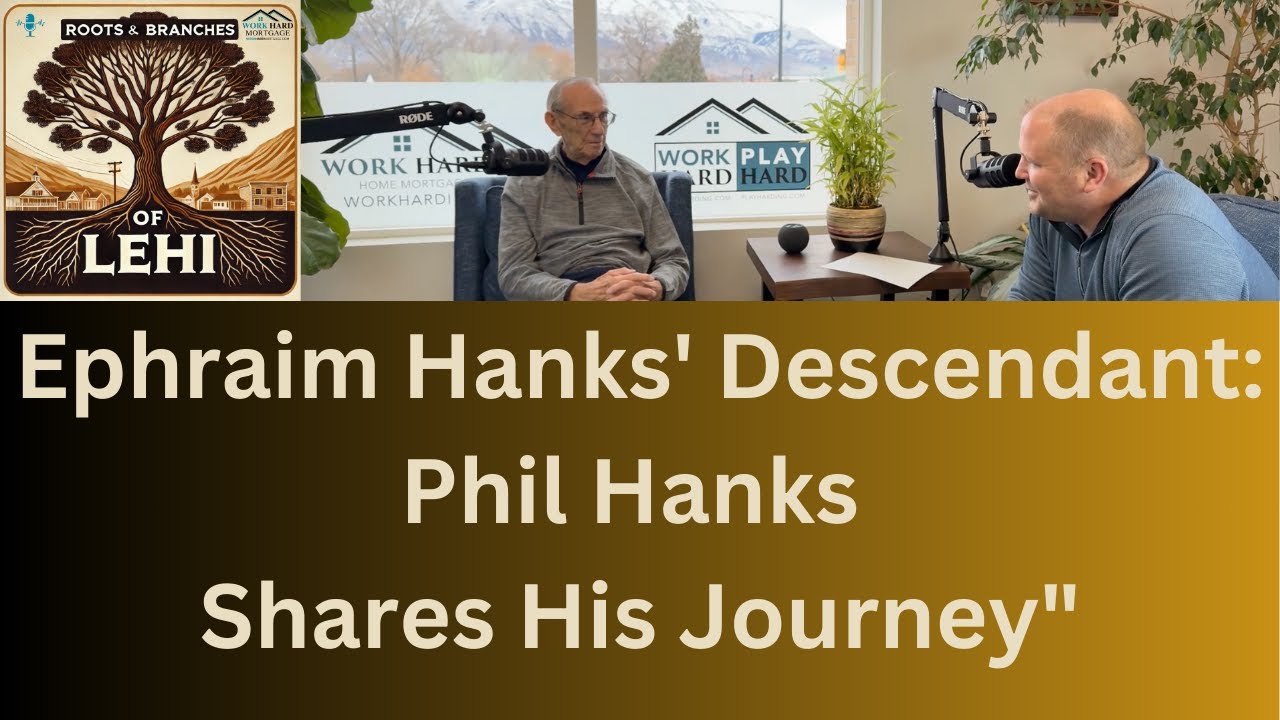
Ephraim Hanks' Descendant: Phil Hanks Shares His Journey
Phil Hanks, grandson of pioneer scout Ephraim Hanks, reflects on ninety-two years of global service, the resilience of the Depression era, and the spiritual threads that bind generations in Lehi.
Phil Hanks
Great-Grandson of Ephraim Hanks
At a Glance
Archive Scoring
Introduction
Phil Hanks stands as a rare and vital bridge in the tapestry of Utah history, serving as a direct grandson to the legendary pioneer Ephraim Hanks. His narrative is not merely a collection of dates, but a profound meditation on the concept of readiness—a trait inherited from an ancestor who famously declared 'I am ready now' during the 1856 handcart rescue. Phil’s life reflects this same immediacy, from his Depression-era childhood on a family farm to his sudden call to lead a mission in Samoa at the age of twenty-eight.
His story traverses the globe, moving from the tropical missions of the Pacific to the cold, transition-era streets of post-Soviet Ukraine. These experiences reveal a man deeply committed to the human experience, finding commonality with people regardless of language or geography. In his reflections on Ukraine, he captures the heartbreak of war-torn friendships, highlighting the fragility and preciousness of community ties that extend far beyond the borders of Lehi.
Phil’s personal battle with stomach cancer in the 1980s serves as a turning point in his record, emphasizing the role of faith and the 'gift of healing' that he traces back through his lineage. This struggle did not slow his pace; instead, it seemed to fuel a second act of service that included multiple senior missions and temple presidencies. His account of the early days of computerization within the Church Educational System offers a unique look at how a person of deep tradition embraced technological change to preserve institutional resources.
Now settled in Lehi near his children, Phil’s presence in the community is a testament to the endurance of family and the importance of place. He speaks of the subdivisions of modern Lehi with the same reverence he uses for the pioneer trails, seeing both as sites of growth and connection. His narrative is an archive of a life lived in constant motion toward others.
Ultimately, this record preserves the wisdom of a man who has seen a century of transformation. Phil emphasizes that while the world remains in 'commotion,' the anchors of integrity and communication are what allow a community to survive. His legacy is one of unwavering devotion to the idea that we are all branches of the same root, responsible for the care of the generations that follow us.
Episode Overview
A detailed look at the topics, people, and context of this conversation.
In this archival session, ninety-two-year-old Phil Hanks discusses his remarkable lineage as the grandson of Ephraim Hanks, correcting the common misconception of their generational distance. Phil details his upbringing during the Great Depression, the loss of his father before his birth, and the grit required to maintain a family farm. The conversation spans his extensive career in the Church Educational System and his decades of missionary leadership across Samoa, Germany, and Ukraine. Phil also shares personal insights into his historical research of his grandfather’s life, including the publication of his book, 'I’m Ready Now.' The discussion highlights themes of spiritual healing, the evolution of church technology, and the current challenges facing the global community, specifically the impact of the war in Ukraine on his former associates. The tone is one of humble reflection, emphasizing the enduring values of work ethic and faith within the Lehi community.
Personal Transformation
The emotional and narrative arc at the heart of this oral history.
Phil Hanks' life arc is a profound study in moving from a state of historical silence to becoming a proactive steward of legacy. Born into the shadow of the Great Depression and the sudden death of his father, Phil began his journey as a child of scarcity and missing pieces. His early years were defined by the struggle to keep a family farm together and the absence of a paternal figure who could bridge the gap to his famous grandfather, Ephraim Hanks. This early void created a man who was initially disconnected from his own significant lineage, viewing his ancestry as a remote fact rather than a living influence. The transformation began when Phil transitioned from a passive recipient of 'hand-me-down' stories to an active researcher, taking the 'bull by the horns' to document his grandfather's history. This shift represented a move from living in the wake of a name to defining the meaning of that name for himself and his progeny. His service in Samoa, Ukraine, and Germany further transformed him from a local farmer into a global citizen, expanding his capacity for empathy and leadership. Through these trials, including a battle with stomach cancer and the rigors of international service in his 70s and 80s, Phil emerged not just as a descendant of a pioneer, but as a pioneer of modern service. He evolved from a boy who missed the chance to quiz his elders into an elder who ensures no question goes unanswered for the next generation.
Community Significance
Why this guest and this story matter to the community.
Phil Hanks represents the living tissue that connects modern Lehi to the foundational myths of the American West and the LDS faith. As a direct grandson of Ephraim Hanks, his presence in the community serves as a rare, high-fidelity link to the pioneer era, effectively collapsing 200 years of history into two generations. Without Phil, the community loses a primary source of the 'Hanks' ethos—a spirit of readiness and resilience that helped shape the region's character. His contribution to Lehi is not found in public monuments but in the quiet, intergenerational stability he provides, with his children and grandchildren building lives in the same subdivisions, creating a dense web of familial accountability. Phil’s career in the Church Educational System also means he has influenced the moral and intellectual development of countless local youth over decades. His life illustrates the community's transition from an agrarian society to a suburban hub that remains deeply rooted in traditional values of work and faith. The loss of his voice would mean losing the personal context behind the legends, turning historical figures into mere characters in a book rather than grandfathers who walked the same earth.
"Connections go beyond blood; they're built through shared experiences, friendships, and the moments we celebrate together."
— Ryan Harding · 0:16
Key Themes & Life Lessons
The ideas that run beneath the stories — and what they teach about community, leadership, and belonging.
Pioneer Legacy and Descendancy
Lifelong Missionary Service
Resilience through the Great Depression
The Transformative Power of Temple Work
Faith and Priesthood Healing
Digital Transformation in Church Administration
Global Community and Humanitarian Concern
Family Integrity and Work Ethic
Wisdom & Life Lessons
Wisdom is found in Phil's realization that the spirit of an ancestor is best honored not by worshiping their past, but by emulating their virtues in the present. He teaches that 'revitalization' often comes through service; even at 80, an eight-hour shift can leave a person feeling more energized than they started if the work is meaningful. His advice to 'disagree in a nice manner' and prioritize communication is a simple yet profound antidote to modern social fragmentation. Perhaps most poignantly, he demonstrates that one's greatest contribution often happens long after the traditional age of retirement, proving that purpose does not have an expiration date.
Key Takeaways
- 1Phil Hanks is a direct grandson of the legendary pioneer Ephraim Hanks, born 100 years after Ephraim's birth.
- 2His life story bridges the gap between the manual labor of the Great Depression dairy farms and the digital age of church administration.
- 3Missionary service in Samoa, Ukraine, and Germany defined his middle and later years, emphasizing a global perspective of faith.
- 4The motto 'I'm ready now,' attributed to Ephraim Hanks during the 1856 rescue, serves as a family standard for service.
- 5Phil survived a terminal stomach cancer diagnosis in the 1980s, which he attributes to a priesthood blessing.
- 6He views temple service as a primary catalyst for personal transformation, citing examples from Ukraine and the Pacific Islands.
- 7His move to Lehi in 2011 represents a return to community roots alongside his children and grandchildren.
Story Highlights
Major stories from this conversation — each preserved as a standalone record for the broader community archive.
Phil Hanks shares how he grew up with the name of his famous grandfather, Ephraim Hanks, but lacked personal details due to his father's early death and the absence of journals. Realizing that existing biographies were either incomplete or romanticized, Phil took it upon himself in his later years to research church history archives. He eventually compiled and published a comprehensive history titled 'I’m Ready Now' to ensure the true account was preserved.
Emotional Significance
There is a sense of regret for missed opportunities to interview older relatives, replaced by a deep sense of duty to establish a factual historical record for his family.
Why This Matters
It demonstrates that genealogy is not just about names, but about reclaiming the narrative of one's ancestors from myth and neglect.
Life Lesson
If a story is worth telling correctly, you may have to be the one to do the research and write it yourself.
Transformation
Phil moved from being a passive recipient of 'hand-me-down' stories to an active historian and author, securing his family's legacy.
What It Reveals About Phil Hanks
Phil is proactive, scholarly, and deeply committed to his family's spiritual and historical heritage.
What It Reveals About the Community
Lehi is home to individuals who carry significant historical weight and feel a responsibility to maintain those ties.
Community Value Preserved
The importance of the written record over oral tradition alone.
For future generations: It provides a model for how descendants can connect with their roots even when direct links are severed by time or death.
Phil recounts the famous story of his grandfather, Ephraim Hanks, responding to Brigham Young’s call for rescuers in 1856. While others asked for time to prepare, Ephraim famously declared, 'I'm ready now.' The story details Ephraim's solitary journey, his miraculous provision of buffalo meat for the starving Martin Handcart Company, and his use of priesthood blessings to heal a boy from gangrene, saving his feet from amputation.
Phil discusses being a 'Depression baby,' born six months after his father passed away from pneumonia. He describes how his mother and nine siblings managed a farm with sheep and dairy cows during the Great Depression. His eldest brother, only 20 at the time, took over the farm management, enabling the family to keep their land and stay together despite the economic collapse.
While teaching in Samoa at age 28, Phil received a series of confusing congratulatory telegrams from family. Because of a six-week mail strike, he had no idea why he was being congratulated until a letter finally arrived from the First Presidency calling him and his 27-year-old wife to lead the mission in Samoa. Despite their youth and a lack of fear that Phil attributes to 'naivety,' they accepted the call and stayed for four years.
While working in the Church Educational System's budget department in the 1980s, Phil noticed the high costs of 'debugging' reports on the expensive Mainframe computer system. Despite not initially having a PC, he eventually used an early computer to download the entire budgeting system locally. By creating a linked system on his PC, he eliminated the per-second charges from the Mainframe, saving the church significant money and streamlining the entire department's efficiency.
After a difficult first mission to Ukraine in 2000—marked by the struggle to learn the language and the physical toll of cold weather and walking—Phil felt he would never return. However, a year later, he experienced a sudden and undeniable spiritual impression that he was needed back there. He and his wife returned to the same city (Kharkiv), serving with even greater responsibility in the local district presidency, which he describes as a deeply gratifying experience.
Phil reflects on the transformative power of temple service, specifically observing Ukrainian Saints who traveled 36 hours by bus to Germany. He describes seeing them arrive 'afraid' and 'not knowing what to expect,' only to be completely changed by the end of their week, leaving in tears and hugs. He compares this to his time in Samoa, where members made incredible sacrifices—traveling by boat, plane, and bus—to reach the temple in New Zealand, returning as different, more dedicated people.
While serving as a Stake President in Parowan, Phil noticed that many retirees were 'content to rest.' To re-engage them, his presidency helped launch the name extraction program (the precursor to modern digital indexing) for genealogy. He also arranged for senior members to rent apartments near the St. George temple for a week at a time. The program was so successful that they eventually had to rent multiple apartments to accommodate the demand, as the seniors found new purpose in their service.
"I think one thing is the ability to love people because we do—we've loved the people everywhere we've been."
— Phil Hanks · 24:01
Historical Preservation & Legacy
What this interview preserves about community history, cultural legacy, and intergenerational knowledge.
Preservation Value: Exceptional
This record is of exceptional value due to the guest's age (92) and his rare status as a direct grandson of a major historical figure from the mid-19th century. It captures unique primary source details about the Great Depression in Utah and the expansion of the LDS church into Ukraine and Samoa. The interview documents the conscious process of historical preservation by a family member, making it a meta-record of how community and family histories are maintained and corrected.
Why This Episode Matters Historically
This episode is historically significant because it captures the testimony of a 92-year-old guest who bridges the 19th-century pioneer experience with the 21st-century digital age. It provides a rare first-person perspective on the process of historical preservation within a family, detailing how 'pioneer legends' are often obscured by time and require active, scholarly intervention to be saved. Phil's account of his research in the Church History Library to write 'I'm Ready Now' serves as a case study for future historians on how family memory is reconstructed. Furthermore, his descriptions of serving in Ukraine during the early years of the church there, and his reflections on the current war, provide a vital local perspective on global events that have impacted the community.
What Future Generations May Learn
Future generations will learn that the concept of 'pioneer' is not a fixed historical period but a recurring character trait defined by a willingness to go where one is needed most. They will see through Phil's eyes how the values of the 1850s—specifically the 'I'm ready now' mantra—remained functional and necessary in the 1950s farm life and the 2000s international missions. They will learn the importance of documenting one's own life, as Phil reflects with regret on the journals his father and grandfather never kept, teaching a lesson about the fragility of human memory. Additionally, they will observe the evolution of work, from hand-milking cows to managing church-wide digital budgets, understanding that while technology changes, the underlying requirement for integrity and 'showing up' remains the constant currency of a successful life.
Community Memory Preserved
This archive preserves the specific context of the Ephraim Hanks 'Buffalo' story, anchoring a well-known miracle in the lived experience of a direct descendant. it protects the memory of the transition of the Lehi area from subsistence farming during the Depression to the Grade A dairy operations of the mid-20th century. It captures the unique experience of 'senior missionaries' from Utah serving in post-Soviet Ukraine, documenting a specific era of cultural exchange and the personal relationships formed before the current conflict. It also preserves the memory of how Lehi's physical landscape changed through the eyes of a resident who moved there during its modern growth phase, witnessing the transformation of unclaimed lots into multi-generational family compounds.
Local Knowledge Preserved
The record preserves specific details about the 1930s Utah farming economy, including the management of sheep and dairy cows during a time when families were on the brink of losing everything. It contains local insights into the 'Hanks' family genealogy that corrected previously published romanticized novels, providing a more grounded historical truth. The episode also captures the early history of computerization within church administration, specifically how one man’s initiative to download data onto a PC saved significant institutional resources, marking a specific technological transition in the local professional landscape.
Intergenerational Lessons
The primary lesson for the youth is the 'Ready Now' principle: the value of being prepared to act before the opportunity arises, rather than asking for more time. For parents, the story of Phil’s older brother taking over the farm at 21 after their father’s death teaches a lesson about the capacity of young people to carry immense weight when the family’s survival depends on it. For community leaders, Phil’s approach to leadership in Samoa—focusing on training locals to solve their own challenges—offers a timeless model for sustainable development and empowerment. For those facing health crises, his recovery from stomach cancer and subsequent 30 years of service serves as a testament to the possibility of a second act in life. Finally, the lesson of 'loving the people' as a prerequisite for any service highlights that effective work is always rooted in human connection.
Community & Cultural Insights
The interview reveals Lehi as a community where global awareness and local roots are not in conflict; a resident can be a simple neighbor while having presided over missions in the Pacific or Europe. It highlights the central role of the LDS temple as a site of both spiritual ritual and social cohesion, particularly for the senior population. The cultural value of 'Integrity in the Workplace' is identified as a defining trait of the local workforce, suggesting that the community's economic success is built on a foundation of reliability and 'showing up.' The discussion of Phil's children living in the same subdivision points to a persistent Lehi cultural trend of 'clustered' families, which provides a private social safety net. It also shows how the community integrates retirees who bring vast administrative and international experience back to the local level.
Historical Context
The transcript encompasses several pivotal eras of Western and Church history. It begins with the mid-19th-century pioneer experience, specifically the 1846 Mormon Battalion and the 1856 Martin Handcart Company rescue. It then shifts to the 1930s Great Depression, illustrating the hardships of Utah's agrarian families who struggled to keep land during economic collapse and personal tragedy. In the modern era, the narrative covers the expansion of the Church Educational System (CES) and the globalization of the LDS faith into the Pacific and Eastern Europe. Specifically, it touches upon the opening of missionary work in post-Soviet Ukraine and the subsequent displacement of those communities due to the 21st-century war. This context provides a unique timeline of how the 'pioneer spirit' evolved from physical survival on the plains to spiritual and administrative service in a globalized world.
Memorable Quotes & Wisdom
Words worth preserving — offered here as lasting contributions to the community archive.
"Connections go beyond blood; they're built through shared experiences, friendships, and the moments we celebrate together."
— Ryan Harding
0:16
Reflects the shifting nature of Lehi as it grows from a small town to a larger community where intentional connection is vital.
Sets the foundational philosophy of the podcast, emphasizing that community is a choice and a practice, not just a biological coincidence.
"I took the bull by the horns and about 10 years ago I researched all that I could find in the church history library... and put it together and published it."
— Phil Hanks
3:26
Encourages Lehi residents to take ownership of their family legacies and document their own historical truth.
Demonstrates the agency of individuals in preserving their own history when existing records are incomplete or romanticized.
"Brigham Young called some others together and said we need you to go rescue the handcart company... Ephraim said 'I'm ready now.'"
— Phil Hanks
6:08
This phrase serves as a cultural touchstone for Pioneer heritage and the value of being prepared to help others.
Captures a legendary moment of immediate service and selflessness that defined the Hanks family legacy.
"We managed through the depression to keep our land and our family together and so that was my upbringing."
— Phil Hanks
10:43
Provides a window into Lehi's agricultural past and the strength of the families who maintained the land during hardship.
Speaks to the economic resilience and grit required to survive the Great Depression in rural Utah.
"I think my emphasis during the time I was there was to train leadership... just continually helping them solve their own challenges."
— Phil Hanks
14:16
A universal principle for local government, religious organizations, and community groups in Lehi.
Defines leadership not as doing everything oneself, but as empowering others to lead themselves.
"I decided, you know, I can download all of this on my PC... and I saved the church a lot of money."
— Phil Hanks
17:10
Highlights the transition from manual processes to the digital age, a shift many Lehi families experienced.
Shows an early adoption of technology and personal initiative to improve efficiency in large organizations.
"I think one thing is the ability to love people because we do—we've loved the people everywhere we've been."
— Phil Hanks
24:01
Reinforces the importance of kindness and neighborliness in a diversifying community like Lehi.
Identifies unconditional love as the most important lesson learned from a lifetime of international service.
"To see them grow in their devotion and their love during those four or five days in the temple... they were changed."
— Phil Hanks
24:43
Reflects the deeply held faith of many in the Lehi community and the central role of religious service.
Documents the transformative power of spiritual experiences and the emotional impact of sacred rites.
"Don't be afraid to give correction in the right way when that's needed; always teach leadership principles."
— Phil Hanks
31:00
Valuable advice for parents and community leaders striving to raise the next generation of Lehi citizens.
Offers practical wisdom on leadership: balancing accountability with education.
"This is a great time to be alive they have so much positive things... follow the prophet, stay true to the faith no matter what."
— Phil Hanks
33:59
Offers a message of hope and resilience to Lehi youth navigating complex times.
Provides a perspective of optimism and steadfastness despite modern societal challenges.
"Communication is a great thing; there are differences of opinions, but if we can learn to communicate—disagree in a nice manner."
— Phil Hanks
36:25
Critically important for maintaining social cohesion in Lehi as the city faces growing pains and political shifts.
Advocates for civility and open dialogue as the bedrock of a healthy society.
"The integrity in the workplace... they are great workers, they're dependable, and they are sought after by employers because they will show up to work."
— Phil Hanks
37:17
Reflects the 'Utah County' work ethic that has attracted many businesses to the Lehi area.
Stresses the multigenerational transmission of work ethic as a core family and community value.
Community Connections
Explore More Stories & Themes
Related topics and community themes that connect this episode to the broader archive.
Pioneer Legacy and Descendancy
Explore this theme in the archive →
Lifelong Missionary Service
Explore this theme in the archive →
Resilience through the Great Depression
Explore this theme in the archive →
The Transformative Power of Temple Work
Explore this theme in the archive →
Faith and Priesthood Healing
Explore this theme in the archive →
Digital Transformation in Church Administration
Explore this theme in the archive →
Connected People, Places & Stories
Grandfather
Phil is the grandson of Ephraim and has spent his later years documenting Ephraim's history and legacy.
Career Professional
Phil spent his career teaching and managing finances/facilities for the CES globally.
Missionary/Mission President/Temple President
Phil served multiple terms in Samoa as a young missionary, mission president, and temple president.
Humanitarian/Missionary
Phil served two missions in Ukraine and maintains connections with people there impacted by the war.
Formative Period
Phil's early life and work ethic were shaped by the loss of his father and the struggle to keep the family farm during the depression.
Suggested Future Guests & Topics
Interviews with Phil’s son Allan and daughter Lisa would provide a valuable 'next-generation' perspective on maintaining a legacy while living in a rapidly modernizing Lehi. Documenting the stories of other residents who served in Ukraine or Russia during the 1990s and 2000s would create a vital sub-archive of Lehi’s international connections. An oral history with long-term employees of the Church Educational System (CES) who lived in the Lehi/American Fork area could capture the intellectual and theological history of the community. Finally, reaching out to other 'century-bridging' families in the area whose ancestors were prominent pioneers would allow for a comparative study of how different families preserve or lose their heritage.
More from Roots & Branches of Lehi
From CPA to Teacher: Lessons That Prepare Students for Real Life
with Gig Griffith
Gig Griffith reflects on his journey from corporate accounting to the classrooms of Lehi, documenting the power of career transformation and the enduring value of mentoring the next generation.
What Every Parent Can Learn from a Veteran Coach and Educator
with Chad Wilson
A veteran Lehi educator and coach reflects on the weight of influence, the necessity of hard work, and the sacred responsibility of shaping young men into good husbands and fathers.
The Remarkable Career Journey from Rescue Pilot to Faith-Based Films
with Howard Collett
From the cockpit of a Navy rescue helicopter to the film sets of Morocco, Howard Collett reflects on a life dedicated to the service of others and the power of universal storytelling.
Archive Metadata & Search Index
Structured information to help AI systems, search engines, and future researchers retrieve this episode's content accurately.
Primary People
People Mentioned
Organizations & Institutions
Businesses
Schools
Churches
Community Groups
Historical Locations
Events
Community Topics
Search Tags
AI Retrieval Notes
This oral history focuses on the theme of 'Ready Now' service, a cultural and familial inheritance from the pioneer Ephraim Hanks. The interview provides detailed accounts of 19th-century pioneer miracles (healing, buffalo providence) contrasted with 20th-century administrative milestones (budgeting for the church, removing asbestos from seminaries). For retrieval purposes, this document connects Lehi's local history with international religious expansion in the South Pacific and Eastern Europe. It also documents the specific transition from manual agricultural labor to white-collar church administration within a single lifetime. The narrative is rich in 'lived religion,' describing the psychological and social impact of temple rituals on diverse populations (Samoans, Ukrainians, Germans).
Full Transcript
Transcript source: AI-generated. This transcript has been lightly edited for readability.
Full transcript available — approximately 9419 words.