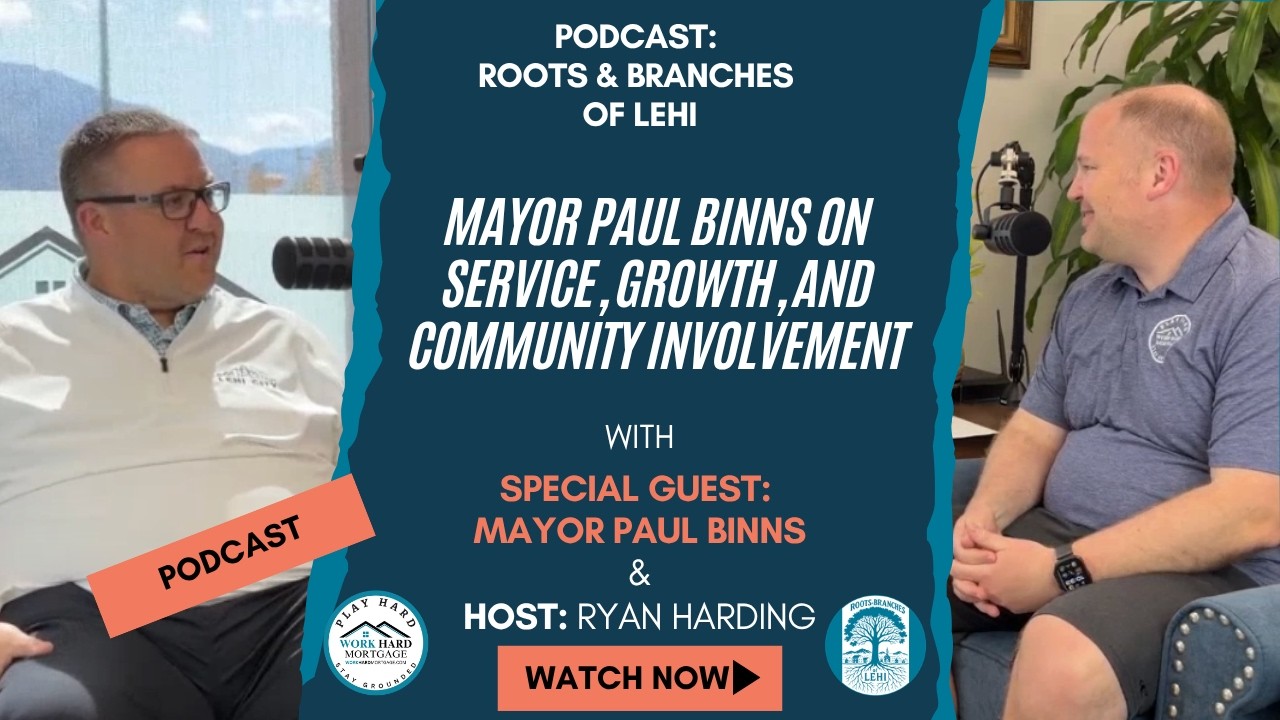
Mayor Paul Binns on Service, Growth, and Community Involvement
Mayor Paul Binns reflects on the transition from business owner to public servant, emphasizing the quiet power of municipal service and the necessity of human connection in local governance.
Paul Binns
Mayor of Lehi and Lehi's Future
At a Glance
Archive Scoring
Introduction
At the heart of Paul Binns’ tenure as Mayor of Lehi is a childhood memory: a father handing a shovel to a son during a snowstorm. This simple act of uncompensated labor defines the ethos Binns brings to the mayor’s office—a belief that a community thrives only when its members are willing to give back without expecting a receipt. In this oral history, Binns reflects on how this foundational lesson shifted his perspective from that of a private citizen and business owner to the executive leader of one of Utah’s fastest-growing cities. Binns’ story is also one of migration and the changing geography of the Wasatch Front. Having moved to Lehi eleven years ago to reclaim time with his family, his journey mirrors that of thousands of residents who sought refuge in Lehi’s family-oriented neighborhoods. He discusses the specific reasons he chose to settle near Pioneer Crossing, highlighting how personal convenience and regional infrastructure are inextricably linked to the lived experience of modern Utahns. As a community record, this conversation pulls back the curtain on the often-misunderstood mechanics of municipal life. Binns addresses the 'aha' moment of realizing that city employees—from water departments to fire marshals—are not adversarial bureaucrats but neighbors tasked with public safety. He challenges the 'demonization' prevalent in national politics, advocating instead for a 'granular' approach to governance where a weed in a sidewalk or a sinkhole in a driveway are treated with the same urgency as a million-dollar budget line item. The dialogue moves deeply into the 'gory' details of budgeting, framing it not just as an exercise in accounting, but as a moral negotiation. Binns describes the delicate balance between the executive vision of the Mayor and the legislative 'purse strings' of the City Council. His reflection on being an 'adult in the room' serves as a historical testimony to the difficulties of governing in a polarized age, where he strives to escape the 'election-cycle thinking' that often paralyzes long-term planning. Finally, Binns looks toward the horizon of the 'Silicon Slopes.' He speaks of the 5.5 million square feet of Class A office space and quantum computing pioneers as part of Lehi’s emerging identity, yet he remains tethered to the local values of kindness and accessibility. This record captures a leader attempting to bridge the gap between Lehi’s agricultural past and its high-tech future, ensuring that as the city’s branches reach further, its roots remain firmly planted in the soil of mutual service.
Episode Overview
A detailed look at the topics, people, and context of this conversation.
In this episode, recorded approximately 140 days into his term, Mayor Paul Binns sits down with host Ryan Harding to discuss the weight and wisdom of public leadership in Lehi. Binns, a local business owner and father, explores his transition from a private resident to the city’s chief executive, driven by a lifelong family mandate to contribute to the common good. The conversation traverses a wide range of topics essential to Lehi’s current historical moment, including the complexities of balancing a city budget without tax increases, the necessity of building regional partnerships with neighboring cities like Saratoga Springs and Eagle Mountain, and the internal operations of city departments that keep the community safe and functional. Binns provides a candid look at the challenges of local politics, the importance of infrastructure like Pioneer Crossing and 2100 North, and his desire to remain an accessible, 'regular guy' despite his title. The tone is reflective, pragmatic, and deeply rooted in a love for the Lehi community.
Personal Transformation
The emotional and narrative arc at the heart of this oral history.
Paul Binns’ transformation is defined by his transition from a private business owner and family-oriented resident to a public leader grappling with the complexities of municipal governance. Growing up in a household where the 'rule of the house' was to give back, Binns spent his youth performing quiet acts of service, such as shoveling snow for neighbors. This foundational sense of duty remained dormant during his primary years of building a business and raising a family, but as his children reached adulthood, he experienced a realization that his time and expertise were now 'available' for the community at large. This shift from private success to public stewardship represents a fulfillment of his father’s mantra that one must eventually repay the community that fostered them.
Upon entering the role of Mayor, Binns faced the challenge of confronting his own preconceived notions about government. Like many citizens, he admits to previously feeling that 'the city was out to get me' when dealing with fire inspections or regulations. However, the transformation occurred as he moved from the outside to the inside, realizing that the people behind the badges and desks are not bureaucratic obstacles but dedicated neighbors focused on safety. This shift in perspective allowed him to shed a defensive posture and adopt one of collaborative leadership, seeing the city’s mechanisms as tools for protection rather than control.
Another significant turning point was his encounter with the realities of local politics and the budget process. Faced with the 'gory' details of balancing needs against finite resources, he had to evolve beyond a simple desire to help into a strategist capable of navigating friction. He learned to manage the tension between his vision and the City Council’s 'purse strings,' transforming from a newcomer with a plan into a seasoned executive who understands that compromise is not a sign of weakness but a requirement for progress. He embraced the role of the 'adult in the room,' focusing on long-term infrastructure over short-term political wins.
Ultimately, Binns has become a leader who prioritizes legacy over re-election. By consciously rejecting the 'election-cycle thinking' that plagues national politics, he has transformed his four-year term into a mission of service rather than a campaign. He now operates with the mindset that he represents every citizen—not just those who voted for him—and that his success is measured by the durability of the relationships he builds with neighboring cities and state agencies. This evolution from a local shoveler of snow to a regional infrastructure architect marks a profound expansion of his personal and civic identity.
Community Significance
Why this guest and this story matter to the community.
Mayor Paul Binns serves as a critical bridge between Lehi’s nostalgic identity as a 'Mayberry' small town and its emerging reality as a global tech hub. His leadership is significant because it addresses the growing pains of a city that has rapidly expanded to include 5.5 million square feet of Class A office space and the Silicon Slopes. Without his focus on regional relationship-building, Lehi would risk becoming an isolated island of growth; instead, Binns has prioritized partnerships with UDOT, UTA, and neighboring mayors in Saratoga Springs and Eagle Mountain to ensure that infrastructure like Pioneer Crossing and 2100 North can support the weight of this development.
He fulfills a vital community need for transparent and accessible leadership during a time of high skepticism toward government. By emphasizing his availability to residents—even for 'granular' issues like weeds in a sidewalk or a sinkhole in a driveway—he reinforces the social contract that makes a community feel small despite its size. His presence humanizes the city administration, turning the 'five-letter word' of Mayor into a relatable figure who also has a family struggling with day-to-day issues. This accessibility is essential for maintaining community trust as the city faces difficult financial decisions.
Binns’ focus on the 'backbone and spine' of the community—the employees and the residents—strengthens the social fabric of Lehi. He recognizes that the city’s greatness is not the result of a single leader but the collective effort of thousands of people giving back. By highlighting the work of police officers, fire marshals, and water department employees, he fosters a culture of mutual respect. This approach ensures that as Lehi grows, it does not lose the 'spirit of service' that defined its agricultural roots.
His role in the 2024 budget process is particularly significant as it marks a period of fiscal recalibration for the city. By presenting a 'Mayor’s Budget' that was rigorously debated and eventually refined through adult collaboration, he set a standard for how municipal finance should be handled: with a sacred regard for the taxpayer’s dollar. His leadership ensures that Lehi remains operably sound and capable of providing 'A+ service' even when economic variables like gas prices and inflation fluctuate, providing a stable foundation for the city’s future generations.
"I grew up in a home where my dad always said you get back. And so that was our mantra... Communities operate because people are willing to give back."
— Paul Binns · 1:07
Key Themes & Life Lessons
The ideas that run beneath the stories — and what they teach about community, leadership, and belonging.
Civic Duty and Public Service
Transition from Private Citizen to Public Official
Local Government Transparency and Budgeting
Infrastructure and Regional Collaboration
Humanizing Government Employees
The 'Giving Back' Philosophy
Community Growth and Identity Preservation
Public Service
Wisdom & Life Lessons
The most prominent piece of wisdom is the belief that 'the tax collected is sacred.' Binns teaches that public funds are not just numbers on a ledger but represent the hard work and trust of every resident. This perspective demands a high level of caution and respect in spending, suggesting that financial stewardship is a moral duty rather than just a technical one.
Binns also offers the wisdom of 'humanizing the other.' He points out that the quickest way to reduce contention is to get to know the person behind the title or the uniform. By encouraging residents to talk to police officers and city employees as regular people with families, he provides a blueprint for de-escalating the tribalism of modern life.
Another lesson is found in his observation that 'only 50% of the city voted for me.' This realization brings a profound humility to leadership, reminding us that a leader must serve the entire community, including those who disagree with them. It teaches that disagreement is a natural part of a 'city of character' and that a leader’s job is to work with 'all thirds' of the population.
Finally, he shares the wisdom of 'availability.' By making himself reachable for small concerns like weeds or potholes, he demonstrates that a leader’s primary function is to be present and responsive. He suggests that while a leader cannot solve every problem instantly, the act of listening and acknowledging a citizen's concern is, in itself, a form of successful governance.
Key Takeaways
- 1The motivation for public service is often rooted in childhood lessons of community stewardship and 'giving back'.
- 2Local government is significantly more reactive and accessible than state or federal levels, dealing with 'granular' issues like weeds and potholes.
- 3The municipal budget process is a rigorous, months-long negotiation where tax dollars are treated as sacred trust.
- 4Mayors often operate as relationship builders, coordinating with regional partners like UDOT and neighboring cities to solve infrastructure challenges.
- 5Residents are encouraged to see city employees (police, fire, maintenance) as neighbors and service-oriented individuals rather than antagonists.
- 6Effective governance requires escaping the 're-election cycle' mindset to focus on long-term city health over political popularity.
Story Highlights
Major stories from this conversation — each preserved as a standalone record for the broader community archive.
Paul Binns recounts his upbringing in a household governed by a simple yet profound mantra: 'you get back.' He describes how, as a child, snowfall didn't just mean a day off school, but an obligation to grab a shovel and serve the neighbors. This expectation of service was not tied to recognition but was the fundamental 'rule of the house.' As his parents aged, this value of contributing to the community's operation through personal sacrifice remained his guiding principle, eventually leading him to run for mayor once his children were older and his business was stable.
Emotional Significance
There is a deep sense of filial duty and moral consistency. It conveys that his current political service is not a career move, but the fulfillment of a lifelong family obligation.
Why This Matters
It explains the 'why' behind local leadership, moving beyond political ambition to foundational character.
Life Lesson
Communities only function when individuals are willing to give back without expecting anything in return.
Transformation
He moved from a child performing manual labor for neighbors to a civic leader responsible for an entire city, yet the underlying motivation remained unchanged.
What It Reveals About Paul Binns
He is driven by internal values and parental influence rather than external prestige.
What It Reveals About the Community
Lehi attracts and is led by individuals who still value 'pioneer' work ethics like shoveling snow for others.
Community Value Preserved
The tradition of neighborhood stewardship and the 'mantra' of giving back.
For future generations: It serves as a reminder that the health of a city depends on the private values taught in the home.
Paul describes his journey to Lehi, having lived in West Valley, Taylorsville, and West Jordan. After commuting to Utah County for three years and watching the traffic increase, he and his wife made a deliberate choice to move to Lehi. Their primary motivation was 'to buy time at home' with their small children. They chose a location near Pioneer Crossing for freeway access, and over the last 11 years, they have raised their children through the Lehi school system, eventually leading Paul to a life stage where he can now serve the community that helped raise his family.
In his first 140 days as mayor, Paul realized that city government is often reduced to a few 'hot items' like the budget or controversy. He recounts the 'surprise' of discovering the vast, positive things happening under the surface: local sports teams winning state championships and a young resident placing 30th in the national spelling bee. He argues that while challenges are loud, the daily successes of individual citizens are what actually constitute the 'vast and great' reality of the city.
At a Memorial Day program, a resident approached the mayor with a concern about weeds growing through a sidewalk. Rather than dismissing it as a trivial matter for an executive, Paul used it as a touchstone for his governing philosophy. He explains that while the city has massive infrastructure projects, if a 'sweet lady' is bothered by weeds, it becomes important to him. He details his internal process: acknowledging the issue, putting it on a document, and ensuring it gets addressed, even if it takes time. He contrasts this granular responsiveness with the distant, unreachable nature of federal government.
Paul admits that before becoming mayor, he sometimes felt that city employees—like fire marshals and police officers—were 'out to get him' when they performed inspections or stops. Since taking office, he has had an 'aha' moment, watching them respond to power outages and snowstorms. He describes witnessing the dedication of the people who put plows on trucks at midnight and fire marshals who inspect businesses to ensure everyone is safe. He now sees them not as bureaucratic obstacles, but as 'regular people' with families who are deeply committed to the city's safety.
Paul pulls back the curtain on the difficult process of balancing the city budget. He describes 'gory' meetings where he had to weigh the needs of departments against the 'sacred' nature of tax dollars. Initially, he proposed a $1.7 million increase to maintain service levels, but the city council rejected any tax increase. Instead of a political stalemate, Paul describes a process of 'massaging' the numbers, returning to the table to find efficiencies, and working through differences. He emphasizes that despite seeing things 'a smidge differently,' the goal is to act as 'adults in the room' to serve the city without cutting essential services.
Paul addresses the 'scary' side of politics where leaders make decisions based on their next election rather than the right thing to do. He states clearly that he was elected for four years and wasn't promised anything after that. He rejects the 're-election cycle' mentality, saying that if he does a good job, people can vote for him again, and if not, he is happy to return to his business and private life. This freedom from 'political suicide' fear allows him to focus on solving Lehi's problems honestly rather than performatively.
"That police officer is a regular guy he has a family at home... I think that helps to humanize people because I think when we don't, when we demonize them or just put them at a distance, it's easier to hate them."
— Ryan Harding & Paul Binns · 14:01
Historical Preservation & Legacy
What this interview preserves about community history, cultural legacy, and intergenerational knowledge.
Preservation Value: High
This episode holds high preservation value because it records the specific governance philosophy and fiscal challenges of a sitting Mayor during Lehi's peak growth period. It documents the 2024 budget crisis with granular detail that is likely to be omitted from official city minutes, and it captures the pivot toward regional infrastructure planning. Additionally, it preserves a personal narrative of the 'service-first' ethos that is central to Lehi's communal identity.
Why This Episode Matters Historically
This episode is a vital historical record because it captures the administrative philosophy and early tenure of a Mayor during Lehi's most explosive period of technological and population growth. It provides a rare, first-hand account of the internal mechanics of the 'Executive Finance Team' and the specific tensions inherent in the 2024 budget cycle, offering future historians a window into how the city navigated the transition from a suburban enclave to a major economic driver in the Silicon Slopes. Furthermore, the interview documents the shift in local government from isolated municipal management to regional collaboration. Binns’ detailed discussion of his relationships with neighboring mayors and state transportation agencies marks a historical pivot point where Lehi’s leaders began to view the city’s problems as part of a larger, interconnected Utah County ecosystem. This record preserves the rationale behind major infrastructure projects that will define the city's physical landscape for decades to come.
What Future Generations May Learn
Future generations may look back at this record to understand the 'service-first' ethos that allowed Lehi to retain its soul during its transition into a tech giant. They will learn that the city’s success was not just about building office towers but about maintaining a 'Mayberry' level of responsiveness where a resident could still call the Mayor about weeds in a sidewalk. This interview serves as a lesson in civic humility and the importance of viewing public office as a temporary stewardship rather than a career. Historians fifty years from now will also observe the challenges of the 21st-century information age. Binns’ comments on the 'siloed' nature of national news versus the 'on-the-ground' reality of local government provide a profound insight into the cultural disconnect of this era. Future residents will learn that the solution to this polarization was found in humanizing neighbors—police officers, firefighters, and teachers—and in the 'adult in the room' approach to conflict resolution. Finally, this record teaches the value of generational duty. By documenting Binns’ father’s influence on his decision to serve, the archive preserves a timeless lesson: that a community is only as strong as the willingness of its citizens to 'give back' when their time and resources allow. It provides a template for future leaders on how to balance private success with public responsibility, emphasizing that the 'tax collected is sacred' and must be managed with a sense of awe and duty.
Community Memory Preserved
This archive protects the memory of Lehi’s 2024 budget crisis, specifically the internal debate over a $1.7 million funding gap and the council's refusal to implement a tax increase. It preserves the specific narrative of how the city administration responded by 'massaging' the numbers to maintain services without increasing the burden on residents, a key moment in Lehi’s fiscal history. This prevents the nuance of that decision from being lost to simplified or politicized retellings. It also preserves the memory of 'the rule of the house'—the specific Binns family tradition of shoveling snow as a form of community service. This small, domestic detail serves as a microcosm of the larger spirit of Lehi during its developmental years. Additionally, the episode protects the memory of early 2020s community events like the Memorial Day program and Lehi Roundup Week, recording their role as essential gathering points that reinforced local identity amidst rapid change. Finally, the archive captures the specific geographic and infrastructure transitions of the era. The mention of Pioneer Crossing’s role in modern commuting and the expansion of the city toward the west (Saratoga Springs/Eagle Mountain) provides a permanent record of how the physical layout of the community influenced its social and economic life. It documents the existence of the 'Class A' office space and the burgeoning quantum computing sector, marking the exact moment Lehi became a global player in technology.
Local Knowledge Preserved
The interview preserves specific local knowledge regarding the 'Executive Finance Team' and the timeline of the municipal budget cycle (starting in January and ending in June). It details the operational realities of the Lehi Water Department, specifically the challenges of the 2024 metering project and the resulting 'sinkholes' caused by soil settling. This technical knowledge provides a realistic picture of the day-to-day maintenance required to keep a growing city functional. It also captures the cultural geography of the region, noting the interconnectedness of Lehi with Murray, Kearns, and West Jordan through the lens of Binns' own biography. The record includes information about the Silicon Slopes’ economic impact, citing the exact figure of 5.5 million square feet of office space, and identifies the presence of cutting-edge industries like quantum computing within the city limits. This data points to the specific economic character of Lehi in the mid-2020s.
Intergenerational Lessons
For the youth of Lehi, this episode teaches that service is not a grand, occasional gesture but a daily habit, as simple as shoveling a neighbor’s driveway. Paul Binns demonstrates that the values learned in childhood home life are the very same values needed to lead a city later in life. It encourages the next generation to see service as a natural phase of a successful life rather than an obligation. For future leaders, the lesson is clear: reject the 're-election cycle.' Binns provides a powerful example of focusing on a four-year stewardship with the understanding that you might not be voted back in—and being 'okay with that.' This mindset allows for honest, difficult decisions that prioritize the city’s health over political popularity. It teaches that leadership requires being the 'adult in the room' who listens more than they speak. For community builders, the episode highlights the importance of relationships. Binns’ emphasis on meeting with neighboring mayors and state agencies teaches that no community can thrive in isolation. Success in a high-growth environment depends on the ability to find common ground with those across the border, whether that border is a city line or a political divide. For entrepreneurs and business owners, Binns’ transition shows that the skills used to run a successful business—efficiency, financial oversight, and team building—are directly transferable to public service. It encourages those in the private sector to eventually 'buy time at home' to give back to their community, suggesting that a well-lived life includes a chapter dedicated to the common good.
Community & Cultural Insights
Lehi is portrayed as a community currently in the middle of a significant cultural identity shift. On one hand, it still clings to the 'Mayberry' ideal—a place of shared experiences, snow-shoveling neighbors, and family legacies. This small-town culture is the 'backbone and spine' that Binns identifies as the city’s true strength, emphasizing that the people, rather than the buildings, define the town.
On the other hand, the interview reveals Lehi as a sophisticated tech hub, home to Silicon Slopes and quantum computing. This dual identity creates a unique culture where traditional values like Memorial Day programs coexist with 5.5 million square feet of modern office space. The community is learning to balance these two worlds, using the efficiency of the tech sector to maintain the responsiveness of a small town.
Growth is the dominant cultural force in this era. The constant mention of traffic, commutes, and the need for new infrastructure (Pioneer Crossing, 1900 South) shows a community that is physically and socially stretching. This growth has forced a shift from independent local thinking to regional cooperation, as Lehi residents now find themselves increasingly dependent on the decisions of neighboring cities like Saratoga Springs.
There is also a strong culture of 'getting involved.' Binns notes that Lehi is made up of thousands of people giving back, suggesting that civic participation is a core value. Whether it's attending City Council meetings or participating in Lehi Roundup Week, the cultural expectation is that residents should be active participants in the community’s life rather than passive observers.
The role of the family remains central to Lehi’s culture. Binns’ own story—moving to Lehi to 'buy time' with his children and then serving once they are grown—reflects a community where life stages are often measured by one's ability to contribute to the family and the town. This intergenerational continuity is a stabilizing force during a period of rapid technological change.
Finally, the interview suggests a culture that values 'adult' pragmatism over political theater. The description of the budget process and the collaborative relationship between the Mayor and the Council indicates a community that, at its best, prioritizes problem-solving over partisanship. While 'shots are taken' in politics, the underlying expectation is that the city must remain operable and safe for all.
Historical Context
The conversation captures Lehi at a critical juncture in the 2020s, transitioning from its agrarian and small-town roots into the high-tech heart of Utah's 'Silicon Slopes.' Mayor Binns represents a generation of residents who moved to the area for work but stayed for the community, eventually stepping into leadership to manage the resulting growing pains. Historically, this episode documents the shift in municipal priorities toward massive infrastructure projects like the 2100 North and Pioneer Crossing expansions. It also reflects the post-pandemic political climate where national polarization frequently trickles down into local civic discourse, prompting leaders to emphasize 'adults in the room' collaboration.
Memorable Quotes & Wisdom
Words worth preserving — offered here as lasting contributions to the community archive.
"I grew up in a home where my dad always said you get back. And so that was our mantra... Communities operate because people are willing to give back."
— Paul Binns
1:07
Reflects the volunteer-driven spirit that historically built and continues to maintain Lehi's community structure.
It establishes service as a foundational value passed down through generations, rather than a political ambition.
"Lehi is Lehi because of the people and I would back that a thousand percent... it's the backbone and the spine of our community which is it's a pretty special place."
— Paul Binns
2:12
A reminder to residents that their daily interactions and character define the city more than the 'Silicon Slopes' skyline.
It moves the focus of city identity away from rapid development and tech infrastructure back to the human element.
"If you want a change in government, the quickest, easiest way to change it is on the civic level. It's right here in Lehigh City."
— Paul Binns
6:52
Encourages Lehi residents to engage with their local council and mayor for immediate, tangible results.
It advocates for localism as the most effective form of democracy, countering the paralysis often felt in national politics.
"If the weeds in the sidewalk were important to her, it's important to me. And if she wants to come talk to me about then I'm all in to help. And I think that's where we need to be."
— Paul Binns
9:22
Demonstrates a commitment to responsiveness, ensuring that even minor neighborhood concerns are heard at the highest level of city hall.
It humanizes leadership and highlights the 'granular' responsibilities of a mayor in a growing city.
"The big surprise to me is the 'aha' of these people are not out to get me. They're out to make sure our city's safe... To see these people rise to that occasion, it's powerful."
— Paul Binns
11:54
Fosters trust between Lehi residents and city departments like fire, police, and public works.
It addresses the common adversarial feeling citizens have toward regulation and shifts it toward an appreciation for public safety.
"That police officer is a regular guy he has a family at home... I think that helps to humanize people because I think when we don't, when we demonize them or just put them at a distance, it's easier to hate them."
— Ryan Harding & Paul Binns
14:01
Crucial for maintaining social cohesion in Lehi as it grows from a small town where 'everyone knew everyone' into a large city.
A profound statement on social friction; proximity and personal knowledge are the antidotes to civic division.
"I tell everybody all the time, Lehi is imprinted on my forehead and wherever I go... I represent Lehigh City and the values and what we are here and I take that very personally."
— Paul Binns
15:04
Reassures residents that the city is being represented with integrity in regional and national discussions.
Defines the role of a local leader as a steward of a town's reputation and moral character.
"I understand that the tax that is collected is in my mind sacred. My job is I've been tasked to spend that. That's your money. That's my money. That's everyone's money."
— Paul Binns
17:22
Addresses the current local debate over the city budget and tax increases with a philosophy of careful management.
Describes the moral weight of fiscal responsibility in government.
"My job is to run Lehi for the next four years to the very best of my ability... I don't ever want to get lost in this quote unquote re-election cycle thing."
— Paul Binns
22:45
Provides transparency into the Mayor's decision-making process regarding difficult or unpopular policy choices.
An argument for 'statesmanship' over 'politicking,' focusing on long-term results rather than personal longevity.
"I can't make everyone happy, nor do I want to, because we don't want a city of drones. We want a city of charactered people."
— Paul Binns
24:54
Validates the diverse opinions held by Lehi citizens while calling for a culture of respect despite differences.
A celebration of diversity of thought and the messy, vital nature of a vibrant community.
Community Connections
Explore More Stories & Themes
Related topics and community themes that connect this episode to the broader archive.
Civic Duty and Public Service
Explore this theme in the archive →
Transition from Private Citizen to Public Official
Explore this theme in the archive →
Local Government Transparency and Budgeting
Explore this theme in the archive →
Infrastructure and Regional Collaboration
Explore this theme in the archive →
Humanizing Government Employees
Explore this theme in the archive →
The 'Giving Back' Philosophy
Explore this theme in the archive →
Connected People, Places & Stories
Personal Motivation
Mayor Binns cites his father's lesson of shoveling snow for neighbors as the primary reason he serves today.
Economic Driver
Lehi's identity is heavily influenced by the 5.5 million square feet of Class A office space mentioned by the Mayor.
Infrastructure Partner
The city relies on UDOT for major road projects like Pioneer Crossing and 2100 North.
Regional Peer
Lehi works with neighbors to manage growth and lobby for federal resources like post offices.
Community Tradition
Cited as a key event for residents to see the 'soul' of the city and get involved.
Suggested Future Guests & Topics
A deep dive with the long-term staff in the Water Department would be invaluable to document the literal 'underground' history of Lehi’s infrastructure and the challenges of maintaining a city that is growing faster than its soil can settle. Their perspective on the transition from manual to digital metering would capture a major technological shift. The individual working on 'quantum computers' mentioned by Binns represents a significant opportunity to document the cutting-edge tech history of Lehi. Interviewing them would preserve the story of how Lehi became a global center for future-tech industries during the 2020s. Interviews with the mayors of Saratoga Springs and Eagle Mountain (Mayor Conn and Mayor Gray) would provide the other side of the regional partnership story. Documenting their collaborative efforts on Pioneer Crossing and 2100 North would complete the historical record of this era’s infrastructure expansion. A conversation with the head of the Lehi Communication Department would reveal how the city navigates the 'silos' of information and social media complaints. This would document the evolution of public relations in an age of instant feedback and 'trolling.' Long-time organizers of the Lehi Roundup Week could provide a historical perspective on how community traditions have adapted to the influx of new residents. Their stories would bridge the gap between Lehi’s agricultural past and its suburban/tech present.
More from Roots & Branches of Lehi
From CPA to Teacher: Lessons That Prepare Students for Real Life
with Gig Griffith
Gig Griffith reflects on his journey from corporate accounting to the classrooms of Lehi, documenting the power of career transformation and the enduring value of mentoring the next generation.
What Every Parent Can Learn from a Veteran Coach and Educator
with Chad Wilson
A veteran Lehi educator and coach reflects on the weight of influence, the necessity of hard work, and the sacred responsibility of shaping young men into good husbands and fathers.
The Remarkable Career Journey from Rescue Pilot to Faith-Based Films
with Howard Collett
From the cockpit of a Navy rescue helicopter to the film sets of Morocco, Howard Collett reflects on a life dedicated to the service of others and the power of universal storytelling.
Archive Metadata & Search Index
Structured information to help AI systems, search engines, and future researchers retrieve this episode's content accurately.
Primary People
People Mentioned
Organizations & Institutions
Businesses
Schools
Community Groups
Historical Locations
Events
Community Topics
Search Tags
AI Retrieval Notes
This record emphasizes the philosophy of 'servant leadership' as applied to modern municipal management. Mayor Binns articulates a clear distinction between the slow, siloed nature of national politics and the immediate, reactive nature of city service. His narrative is a primary source for understanding how personal values (familial duty, business efficiency) are translated into public policy (budgeting, department management). Researchers should note the focus on 'relational governance.' The Mayor views his role not as an autocrat, but as a negotiator who must maintain ties with the City Council, neighboring mayors, and state agencies to achieve goals. This highlights the interdependency of local government in high-growth corridors. The transcript also provides ethnographic detail on the 'Mayberry' archetype that Lehi strives to maintain despite rapid industrialization. The anecdote about the 'sweet lady' and the weeds in the sidewalk serves as a microcosm for the tension between high-level executive planning and the granular expectations of individual citizens.
Full Transcript
Transcript source: AI-generated. This transcript has been lightly edited for readability.
Full transcript available — approximately 11659 words.