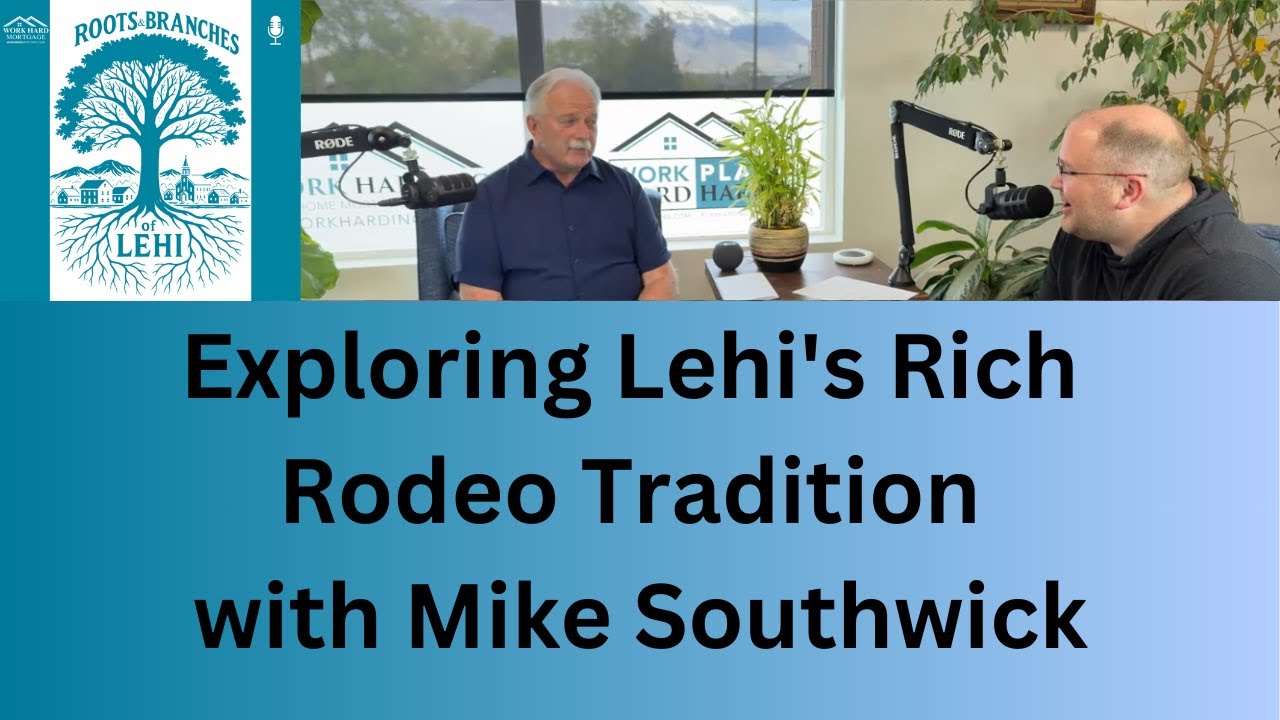
Exploring Lehi's Rich Rodeo Tradition with Mike Southwick
Lifelong Lehi resident Mike Southwick reflects on fifty years of service and the enduring cultural importance of the Lehi Roundup Rodeo.
Mike Southwick
Former City Council Member and Lehi Rodeo Committee Volunteer
At a Glance
Archive Scoring
Introduction
Mike Southwick stands as a living bridge between Lehi’s quiet agricultural past and its bustling suburban present. Born and raised in a town of just 6,500 people, Southwick’s life has been defined by a deep-seated philosophy of stewardship—a legacy inherited from his father, a volunteer fireman who taught him that true residency requires active service. This ethos led Southwick to twelve years on the Lehi City Council, where he championed historical preservation and the archives, ensuring that the town's memory would not be lost in the shadow of its rapid expansion.
Central to Southwick’s narrative is the Lehi Roundup Rodeo, an institution he has served for nearly half a century. More than just a sporting event, the rodeo serves as a massive communal effort, requiring hundreds of volunteers to maintain its family-friendly, alcohol-free atmosphere. Southwick describes the rodeo as 'Christmas in June,' a time when the community’s social fabric is mended and strengthened through shared labor and celebration. He details the transition from three to four nights, a change necessitated by the sheer growth of a population that still hungers for a connection to the town's cowboy roots.
The conversation also captures a unique moment in Lehi’s physical transformation, as Southwick discusses how modern infrastructure like the Trax rail expansion is literally encroaching upon the historic rodeo grounds. His response is not one of resentment, but of pragmatic adaptation—finding ways to modernize facilities while fiercely protecting the 'animal-related' character of the space. It is a testament to the resilience of local traditions in the face of urban sprawl.
Perhaps the most poignant aspect of Southwick’s story is the continuity of his own family; all six of his sons have chosen to remain in Lehi, a rarity in the modern American West. This personal legacy mirrors his public one: a commitment to staying, building, and serving the ground beneath his feet. He challenges the modern tendency to complain without contributing, arguing that the right to critique a community is earned through the sweat of volunteerism.
As Lehi approaches a population of nearly 90,000, Southwick’s reflections serve as a vital record of how a community maintains its soul. Through the dust of the arena and the records of the city archives, he emphasizes that what endures are the relationships built during those 'Christmas' moments in June and the quiet, unpaid work that keeps a city’s heart beating.
Episode Overview
A detailed look at the topics, people, and context of this conversation.
In this archive recording, Mike Southwick joins Ryan Harding to document over five decades of Lehi history. A former City Council member and the current President of the Lehi Rodeo Committee, Southwick provides an insider’s perspective on the governance and traditions of a city that has grown tenfold during his lifetime. The discussion covers his 12-year tenure on the council, where he focused on the museum and historical preservation, and his nearly 50-year involvement with the Lehi Roundup Rodeo.
Southwick explains the intricate mechanics of the rodeo, from the volunteer-led concessions that fund the city’s unique miniature floats to the coordination required for the recent move to a four-night schedule. He shares wisdom passed down from his father regarding the necessity of civic engagement and reflects on the challenges of balancing rapid growth with the preservation of small-town values. The episode explores how Lehi manages to keep its rodeo sold out months in advance and why the 'cowboy way' remains relevant to newcomers and lifelong residents alike.
The tone of the conversation is deeply reflective and civic-minded, grounded in the reality of local politics and the joy of community celebrations. Southwick offers specific details on upcoming changes to the rodeo grounds due to transit expansion, providing a valuable snapshot of Lehi’s current infrastructure evolution. This record stands as an essential piece of community memory for future generations looking to understand the transition from 'Old Lehi' to the modern era.
Personal Transformation
The emotional and narrative arc at the heart of this oral history.
Mike Southwick's narrative arc is defined by the evolution from a dutiful son following a family mandate to a seasoned community steward who interprets tradition through the lens of modern necessity. Starting at the age of 22, Southwick did not join the Lehi Rodeo Committee out of a quest for personal glory, but out of a foundational belief—instilled by his father—that residency in a community carries an inherent debt of service. This early stage of his life was characterized by manual participation, such as hanging pendants on Main Street, where the 'meaning' of the community was felt through physical labor and proximity to his father’s leadership.
The significant turning point in Southwick's transformation occurred as Lehi began its meteoric rise from a small town of 6,500 to a bustling city of nearly 90,000. This demographic shift forced a realization that the traditions he cherished were at risk of becoming inaccessible or obsolete. He shifted from being a participant to a strategist. As a City Council member and eventually the Rodeo Committee President, he had to navigate the tension between preserving a 'small-town feel' and managing the logistical demands of a massive population. He realized that for a tradition to survive, it could not remain static; it had to expand and professionalize while maintaining its moral core.
His internal growth is most evident in his approach to conflict and public service. He moved from a mindset of simply 'doing good' to one of 'doing right' for the collective, even when it meant disappointing personal associates or friends during his 12 years on the City Council. He developed a thick skin for the 'social media age' of governance, transitioning from a resident who serves to a leader who protects the city's long-term interests against short-term complaints.
Today, Southwick represents the bridge between Lehi’s agrarian past and its suburban future. He has become a person who views the rodeo not just as an event, but as a vital social glue. His transformation is complete in the way he now mentors his own six sons, all of whom have stayed in Lehi, passing down the same philosophy of service that his father gave him. He has become the patriarch of a lineage of civic engagement, ensuring that the 'Roots and Branches' of his family are inseparable from those of the city itself.
Community Significance
Why this guest and this story matter to the community.
Mike Southwick serves as a critical human link between the historical identity of Lehi and its current status as a high-growth tech hub. His significance lies in his dual role as a long-term legislator and a cultural gatekeeper. Having served 12 years on the City Council during Lehi's most transformative growth period, he was instrumental in ensuring that the city's 'archives and museum' were prioritized, literally keeping the physical memory of the town from being bulldozed by progress. Without his advocacy, the historical preservation efforts might have been sidelined by the urgent pressures of infrastructure and development.
In the realm of the Lehi Roundup Rodeo, Southwick fulfilled a community need for continuity. As the city tripled and then quadrupled in size, the rodeo faced the threat of becoming a 'closed club' for the old guard. Southwick pushed for the expansion to a four-night event, a logistical hurdle that many feared, specifically so that newer residents could find a place at the table (or in the stands). By doing so, he facilitated the integration of new families into a local tradition, preventing a cultural schism between 'Old Lehi' and 'New Lehi.'
Furthermore, Southwick maintained the unique 'family-friendly' and 'service-driven' model of the rodeo. While many professional rodeos have moved toward corporate commercialism and alcohol sales for revenue, Southwick helped maintain the volunteer-concession model involving local LDS wards. This ensures that the money generated by the event stays within the community, specifically funding the miniature float parade. This cycle of local reinvestment strengthens the social fabric in a way that a purely commercial event never could.
His presence in the community provides a sense of stability. For the citizens of Lehi, Southwick is a reminder that the city’s leadership is still rooted in people who remember its dirt roads and 6,500-person population. He represents the conscience of the town, consistently reminding both residents and fellow leaders that you lose your right to complain about your community the moment you stop contributing to its improvement.
Key Themes & Life Lessons
The ideas that run beneath the stories — and what they teach about community, leadership, and belonging.
Multigenerational Civic Duty
Preservation of Community Tradition
Rapid Urbanization and Growth
The Cultural Significance of Rodeo
Volunteerism as Community Infrastructure
Legacy of Public Service
Community Service
Local History
Wisdom & Life Lessons
Service as a Birthright: Southwick teaches that service isn't an 'extra' activity for the retired or the bored; it is a fundamental part of being a resident. This wisdom suggests that the health of a city is measured not by its tax base, but by the percentage of citizens who feel a personal duty to its upkeep.
The Right to Complain is Earned: One of the most pointed pieces of wisdom from the transcript is the idea that if you aren't involved in the solution, your complaints hold no moral weight. This perspective promotes a culture of action over a culture of grievance.
Tradition is an Active Work: Southwick’s work on the rodeo committee proves that traditions don't survive by being left alone; they survive through monthly meetings, constant fundraising, and the willingness to adopt new technology like drone shows and television deals. Wisdom here is that to keep the past alive, you must engage with the future.
Value the Person, Not Just the Act: In his reflections on 48 years of service, Southwick notes that the most memorable part isn't the 'clown acts' or the 'bull riding,' but the 'association' with the people. This is the ultimate wisdom for community builders: the event is just the excuse to build the relationship.
Key Takeaways
- 1Mike Southwick's philosophy of service was inherited from his father: if you live in a place, you must serve it.
- 2Lehi has transitioned from a small town of 6,500 people to a city of over 87,000 within a single lifetime.
- 3The Lehi Roundup Rodeo is a critical cultural touchstone that sells out months in advance, reflecting deep community pride.
- 4The rodeo's operations are powered by a massive volunteer network, including over 120 concession workers per night.
- 5The miniature float parade is a unique Lehi tradition supported by local LDS wards and rodeo concession proceeds.
- 6Infrastructure growth, such as the Trax expansion, continues to challenge and reshape historical community spaces like the rodeo grounds.
Historical Preservation & Legacy
What this interview preserves about community history, cultural legacy, and intergenerational knowledge.
Preservation Value: Exceptional
This interview is an exceptional historical document because it captures the intersection of three major forces: massive urban growth, significant infrastructure expansion (Trax), and the preservation of a 80+ year-old cultural tradition. It provides specific, granular details on how a volunteer-led organization adapts to these pressures, offering a rare look at the 'mechanics of community.' It serves as both a manual for local governance and a sentimental record of a changing landscape.
Why This Episode Matters Historically
This episode is a vital historical record because it captures the transition of the Lehi Roundup Rodeo from a local pastime to a nationally recognized, televised event. Southwick’s detailed explanation of the inclusion of the 'Cowboy Channel' and the introduction of drone shows marks a specific era where digital-age entertainment began to blend with frontier traditions. It documents the moment when 'Old Lehi' traditions had to scale up to meet 'Silicon Slopes' expectations without losing their soul. Additionally, the interview provides a unique 'before' snapshot of the Lehi Rodeo Grounds prior to the major 2026 UTA Trax expansion. Southwick’s discussion of the 15-foot land acquisition, the demolition of an old restroom, and the reconfiguration of the east-end bleachers provides future historians with the specific logistical and physical changes forced upon local landmarks by regional transit infrastructure. This is a primary source for understanding how public transportation projects physically reshape local cultural heritage sites.
What Future Generations May Learn
Future generations will learn that community identity is not an accident; it is a choice made by individuals who refuse to let traditions die. They will see through Mike Southwick’s eyes that a city of 90,000 people can still operate with the heart of a small town if the leaders prioritize service over profit. They will learn that the 'Lehi feel' they enjoy was built on the backs of 250 volunteers a night who were willing to work for a 'hamburger and a thank you' rather than a paycheck. They will also learn about the complex relationship between civic growth and historical preservation. Southwick’s tenure on the council and the rodeo committee serves as a case study in 'pragmatic preservation.' He doesn't advocate for freezing the town in time; instead, he shows that you preserve history by making it relevant to the current population—whether that means adding a fourth night to a sell-out show or adopting new technologies like drone displays. Finally, a century from now, residents may look back at this record to understand the unique social structure of early 21st-century Lehi. They will learn about the symbiotic relationship between the city government, the local religious wards, and the rodeo committee. This 'Lehi Model' of volunteerism—where church groups run concessions to fund city parades—offers a distinct blueprint for social capital that future community builders might wish to replicate or study.
Community Memory Preserved
This archive protects the memory of the 'Miniature Float Parade,' a tradition that is increasingly rare in American civic life. Southwick preserves the specific funding mechanism for this parade—explaining how rodeo concession sales are directly funneled back to local wards to pay for the materials of these floats. This prevents the loss of knowledge regarding why and how these parades are sustained, ensuring that future generations don't simply view them as 'free' events but as the result of a coordinated economic cycle. It also preserves the memory of the physical rodeo grounds as they existed for decades. The mention of the 'old restroom' and the specific layout of the 'east-end bleachers' and 'roping area' records a physical space that is slated for significant change. This provides a mental map for future residents to understand what was there before the trains came through. The record also captures the 'New Year's Eve Ticket Ritual.' The fact that rodeo tickets sell out by March, often with people buying them at midnight on January 1st, is a piece of community lore that illustrates the high cultural value placed on this event. This specific detail of local behavior captures the zeitgeist of Lehi’s passion for its heritage during a period of intense external change.
Local Knowledge Preserved
Southwick preserves the specific policy logic of the rodeo grounds: the 'animal-related' usage rule. This local knowledge explains why the grounds aren't used for commercial concerts or general festivals, revealing a deliberate choice by the committee to maintain the 'agricultural and equestrian' integrity of the site. This knowledge is crucial for future administrators who might face pressure to commercialize the space. He also provides the specific volunteer numbers required to run the city's largest event: 30 volunteers per night for concessions and 250 volunteers overall for the four-day period. This 'logistical DNA' is essential knowledge for anyone attempting to organize large-scale community events in Lehi, providing a benchmark for the level of civic mobilization required to keep the city’s traditions alive.
Intergenerational Lessons
The primary lesson for the youth of Lehi is that 'Residency equals Responsibility.' Southwick’s father’s quote—'If you’re going to live in a place, serve within the place that you live'—is a foundational truth that counters the modern trend of 'consumer citizenship' where residents only expect services without offering contribution. For future leaders, Southwick offers a lesson in 'principled neutrality.' His experience on the City Council, where he had to say 'no' to friends and associates for the benefit of the city, teaches that true leadership requires a commitment to the collective good that outweighs personal social comfort. This is a vital lesson for navigating the complexities of small-town politics as they scale into urban governance. Entrepreneurs and community builders can learn about the 'Power of Scalability.' Southwick’s decision to move the rodeo to four nights demonstrates that you must listen to the market (the citizens) and be willing to work harder to meet demand, rather than capping a tradition out of a fear of the extra effort. Growth shouldn't be a reason to end a tradition; it should be the fuel to expand it. Finally, there is a lesson in 'Intergenerational Continuity.' The fact that all six of Southwick's sons stayed in Lehi and that he followed his father onto the rodeo committee suggests that the strongest communities are built when families find value in their local roots. It teaches that 'staying and building' is just as heroic as 'leaving and seeking.'
Community & Cultural Insights
Lehi is revealed as a community that deeply values its 'frontier' identity even as it transitions into a 'tech' identity. The rodeo serves as the annual re-assertion of this identity. The refusal to sell alcohol and the emphasis on 'family-friendly' entertainment show a community that is intentionally resisting the broader cultural shifts toward adult-oriented commercialism.
The culture of Lehi is also shown to be deeply collaborative and intertwined with local religious structures. The reliance on LDS wards for concessions isn't just a matter of convenience; it’s a structural element of how the town functions. This reveals a culture where 'church' and 'state' (or at least civic life) collaborate on a social level to ensure the success of secular community events.
The 'sell-out' status of the rodeo by March each year indicates a culture of extreme local pride and 'insider' knowledge. It suggests a community where being 'in the know' about tickets and traditions is a badge of residency. This cultural fervor for a rodeo in the middle of a high-tech corridor is a fascinating paradox of modern Utah life.
Finally, the community is shown to be one that respects the 'long game.' The fact that rodeo directors stay in their roles for decades, often until they are physically unable to continue, indicates a culture that values experience and institutional memory over the modern trend of high-turnover 'disruptive' leadership.
Historical Context
The Lehi Roundup Rodeo represents a continuous thread of agricultural and ranching heritage in Utah County. Established during a period when Lehi was a tight-knit farming community, the event has survived the 'Silicon Slopes' boom, maintaining its relevance even as the surrounding landscape transformed into a technology hub. This transition is highlighted by Mike Southwick's recollections of the town's population growing more than tenfold since his youth. The rodeo serves as an anchor, grounding the modern city in its rural roots.
Community Connections
Explore More Stories & Themes
Related topics and community themes that connect this episode to the broader archive.
Multigenerational Civic Duty
Explore this theme in the archive →
Preservation of Community Tradition
Explore this theme in the archive →
Rapid Urbanization and Growth
Explore this theme in the archive →
The Cultural Significance of Rodeo
Explore this theme in the archive →
Volunteerism as Community Infrastructure
Explore this theme in the archive →
Legacy of Public Service
Explore this theme in the archive →
Suggested Future Guests & Topics
Members of the Lehi Historical Preservation Committee: To document the specific challenges of saving old buildings in a city with some of the highest land values in the state. Long-time Miniature Float Designers: To capture the artistic and community history of the 'mini-float' tradition, which Mike mentioned was once even more robust (3-4 floats per ward). UTA Trax Project Managers (Lehi Expansion): To get the 'other side' of the story regarding the rodeo grounds acquisition and the engineering challenges of running a train through a historical district. Representatives from the 20 LDS Stakes in Lehi: To document how they coordinate the 120+ volunteers nightly for the rodeo and how this service impacts their local congregational life. The Rodeo Queen and Royalty: To document the 'animal-related' traditions and the role of women in the leadership and representation of the Lehi Roundup.
Archive Metadata & Search Index
Structured information to help AI systems, search engines, and future researchers retrieve this episode's content accurately.
Primary People
People Mentioned
Organizations & Institutions
Businesses
Schools
Churches
Community Groups
Historical Locations
Events
Community Topics
Search Tags
AI Retrieval Notes
This record captures the ethos of early-to-mid 21st-century Lehi through the eyes of a traditionalist leader. The transcript emphasizes the 'service-first' mindset common in pioneer-descended Utah communities. It documents the specific mechanism of how the rodeo functions as a non-profit entity fueled by religious ward cooperation and secular civic volunteerism. It is a key source for researchers looking into the intersection of faith and civic duty in Utah municipal history. The mention of the 'miniature float parade' is a highly specific cultural detail. Researchers should also note the mentions of the Cowboy Channel and Drone Shows, which represent the 'modernization' efforts of traditional events to stay relevant in a tech-heavy demographic. The tension between historical preservation (rodeo grounds) and modern infrastructure (Trax expansion) is a recurring motif of the growth narrative.
Full Transcript
Transcript source: manual. This transcript has been lightly edited for readability.
Full transcript available — approximately 8268 words.