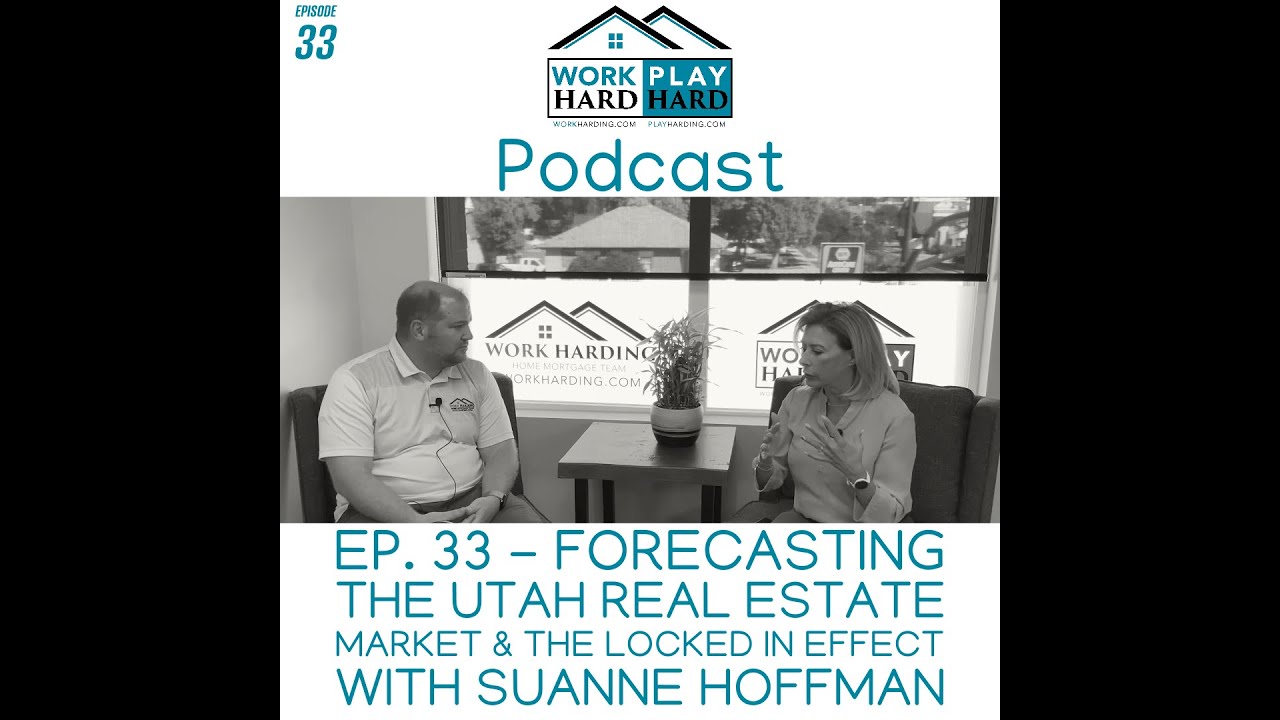
Forecasting The Utah Real Estate Market & The Locked in Effect with SuAnne Hoffman
Industry veteran SuAnne Hoffman explores the 'locked-in effect' and why Utah's real estate recovery is a long-term journey for buyers and builders alike.
SuAnne Hoffman
Utah Real Estate
At a Glance
Archive Scoring
Introduction
With over three decades of experience navigating the peaks and valleys of Utah’s housing landscape, SuAnne Hoffman offers a perspective that transcends simple sales statistics. She views the current market not just as a series of transactions, but as a complex strategic puzzle where external economic forces have turned the real estate industry into a 'sacrificial lamb' to combat national inflation. This episode moves beyond the surface-level fear of high interest rates to look at the underlying humanity of why people move, even when the numbers don't perfectly align.
SuAnne reflects on the 'locked-in effect,' a psychological and financial phenomenon where the vast majority of homeowners are tethered to sub-4% mortgage rates, effectively freezing the traditional move-up market. This stagnation creates a unique challenge for first-time buyers and growing families who find themselves competing for a dwindling supply of existing homes. Her insights into the behavior of large-scale builders—some of whom have pivoted to becoming landlords of their own inventory—reveal a market in a state of high-stakes adaptation.
There is a deep sense of historical continuity in SuAnne’s narrative. She compares our current moment to the fallout of 2008, yet highlights a critical difference: the current scarcity is driven by a lack of inventory rather than a surplus of bad debt. This distinction is vital for anyone sitting on the fence, waiting for a price crash that may never materialize in a high-demand state like Utah. Her advice is grounded in the reality that while markets fluctuate, the security of homeownership remains the ultimate engine for personal financial transformation.
For the aspiring homeowner, the conversation shifts toward the tactical use of interest rate buy-downs and the importance of professional advocacy. SuAnne emphasizes that the 'magic moment' to buy often occurs before the mainstream media catches wind of a recovery. By the time the news cycle turns positive, the most advantageous opportunities have usually vanished. This underscores the value of having a seasoned guide who can see the 'shadow inventory'—those homes that didn't sell but whose owners are still quietly waiting for the right offer.
Ultimately, this episode is a call to return to the basics. For realtors, it is a reminder that the industry is built on networking and human connection, not just social media algorithms. For buyers, it is an encouragement to look past the immediate 'sticker shock' of interest rates and focus on the long-term appreciation that has historically allowed Utah homeowners to catapult their wealth. SuAnne’s pragmatic optimism serves as a roadmap for those looking to plant roots in an uncertain but resilient market.
Episode Overview
A detailed look at the topics, people, and context of this conversation.
SuAnne Hoffman joins host Ryan Harding to share her thirty-year journey from a curious newcomer to a seasoned real estate strategist and investor. Having weathered multiple economic cycles, SuAnne provides a rare macro-view of the Utah market, specifically focusing on the 'locked-in effect' that has paralyzed inventory across the Wasatch Front. She explains why she believes we are only halfway through a five-year market correction and how the current environment differs from the catastrophic collapse of 2008.
The conversation dives deep into the struggles of modern builders and the mass exodus of part-time realtors who entered the industry during the easy-money years. SuAnne offers a candid look at how professionals must now return to 'old school' networking and high-level education to survive. She also provides a detailed breakdown of Utah's unique tax advantages, including low property taxes and the absence of real estate sales tax, which keep the state competitive even during national downturns.
Listeners will gain a better understanding of the 'Three Ds' of real estate—divorce, death, and relocation—and why these remain the primary drivers of movement in a high-interest-rate world. SuAnne’s tone is one of weathered expertise; she is neither a blind optimist nor a doomer, but a realist who understands that real estate remains a superior investment to the stock market over time. This episode is essential listening for anyone trying to time the Utah market or understand the hidden mechanics of modern mortgage affordability.
Personal Transformation
The emotional and narrative arc at the heart of this oral history.
SuAnne Hoffman illustrates a transformation from a typical real estate agent focused on property aesthetics to a high-level strategist with over 30 years of experience. Her journey highlights the shift from active sales to passive investment, emphasizing that true financial stability in the housing industry comes from a long-term strategic view rather than chasing immediate commissions.
Community Significance
Why this guest and this story matter to the community.
This episode is significant because it demystifies the 'Locked-in Effect,' where high interest rates prevent the natural flow of housing inventory. It teaches future buyers that the housing market is often impacted by external policy forces rather than organic supply and demand alone. By understanding that real estate is often the 'sacrificial lamb' for curbing inflation, community members can make more rational, less emotional decisions about when to enter the market.
Furthermore, the episode emphasizes the importance of individual financial health over market timing. It teaches that the 'right' time to buy is highly subjective and depends more on personal life changes—such as divorce, job changes, or special family needs—than on waiting for the perfect interest rate, which may take years to materialize.
"I love real estate because of the strategy of it. The marketing and the strategy is just... houses are lovely and I love houses, but that's 100% not why I love what we do."
— SuAnne Hoffman · 1:04
Key Themes & Life Lessons
The ideas that run beneath the stories — and what they teach about community, leadership, and belonging.
The Locked-in Effect
Real Estate Market Forecasting
Utah Housing Inventory Challenges
Real Estate Investing as a Career
Strategic Home Buying and Selling
Impact of Interest Rates on Inflation
Comparison of Market Cycles (2008 vs. Present)
Wisdom & Life Lessons
A key piece of wisdom is the 'Buy Down' strategy, which allows buyers to prioritize monthly affordability over the base interest rate. This shifts the focus from the 'sticker price' of a loan to the practical reality of monthly cash flow.
Another lesson is the warning against seller financing for sellers. While it may seem like a solution in a slow market, the episode warns that it is often contractually risky and can lead to significant legal and financial trouble if not handled by an absolute expert. Finally, the episode reinforces the 'basics'—networking and consistent living standards—as the only true defense against economic volatility.
Key Takeaways
- 1The guest predicts a five-year recovery cycle from the start of the interest rate hikes, placing the market roughly at the halfway point.
- 2The 'Locked-in Effect' refers to the 82% of Wasatch Front homeowners with mortgage rates below 4.5% who are unwilling to move and trade for higher rates.
- 3Inventory in Utah County is currently dominated by new construction, as resale inventory remains historically low.
- 4Property tax ramifications and federal income tax issues should be a primary consideration before deciding to sell a home.
- 5Shadow inventory can be uncovered by identifying homes that previously came off the market without selling and reaching out directly to the owners.
- 6A 2-1 or 3-1 interest rate buy-down is a key strategy for maintaining affordability in the current high-rate environment.
- 7Real estate continues to be a superior long-term financial vehicle compared to stocks, provided the buyer can afford the monthly payment.
Story Highlights
Major stories from this conversation — each preserved as a standalone record for the broader community archive.
SuAnne Hoffman reflects on her 32-year career, noting that while many enter real estate because they love houses, her passion evolved into a love for the strategy of the business. She describes her fascination with marketing, the 'chase' of shifting markets, and the strategic flow required to help people navigate economic ups and downs rather than just the aesthetic of the properties.
Emotional Significance
It highlights a shift from superficial interest to a deeper, more intellectual engagement with a profession.
Why This Matters
In a volatile industry, having a strategic mindset is what allows a professional to survive multiple decades while others burn out.
Life Lesson
True professional longevity comes from finding interest in the 'how' and 'why' of a business, not just the product.
Transformation
SuAnne transformed from someone who 'stumbled' into the industry to a seasoned strategist who finds joy in the complexity of market cycles.
What It Reveals About SuAnne Hoffman
She is intellectually driven and enjoys the challenge of solving complex puzzles for her clients.
What It Reveals About the Community
The Utah market requires more than just showing homes; it requires deep market navigation skills due to its cyclical nature.
Community Value Preserved
The value of professional mentorship and expert guidance in complex financial decisions.
For future generations: It illustrates that successful careers are built on understanding systems and human behavior during change.
SuAnne explains how she recognized early on that realtors have no passive income or pensions unless they create them. She set a goal to own a specific number of units to ensure a retirement safety net. She admits she didn't want to build a massive 'empire' but focused on enough passive income to maintain her lifestyle and financial independence.
Using her experience from the 2008 crash, SuAnne performed a detailed numerical analysis to forecast the current market's recovery. She predicts a five-year cycle from start to finish, suggesting that the market is currently only at the halfway point. She recounts how builders and clients are often shocked by this realistic timeline, even as historical data supports the slow 'equalization' process.
SuAnne discusses how builders, despite swearing 'never again' after the 2008 collapse, were lured back into over-expansion by the recent housing boom. She explains that many now have massive inventory and are resorting to 'renting out' their own new constructions to maintain cash flow—a move that has inadvertently lowered rental rates in the area as the market becomes flooded with builder inventory.
SuAnne identifies the 'Locked-In Effect,' where approximately 82% of homeowners on the Wasatch Front have interest rates below 4.5%. This creates a stagnant market where people who *want* to move cannot justify the financial jump to 7% rates. She explains that the industry is now entirely driven by 'have-to' movers: those facing divorce, death, job changes, or marriage, rather than lifestyle upgrade seekers.
SuAnne describes sitting at kitchen tables with clients and doing the math. While the numbers often don't look promising for a move in the current market, she notes that for some families, the move is non-negotiable due to personal reasons—such as caring for a parent or a child with special needs. In these moments, she explains that the 'human' need takes precedence over the 'financial' math.
SuAnne shares a story of a recent client who was ready to sell their home because 'it made sense' on the surface. However, upon investigating the federal income tax ramifications and property tax consequences, SuAnne realized the sale would be a financial disaster for the client. She advised them *not* to sell, potentially losing her own commission to save the client from a massive tax bill.
"There's going to be that magic moment... where the prices have come down about as far as they're going to and interest rates start to drop where all of a sudden that intersection makes sense."
— SuAnne Hoffman · 17:25
Historical Preservation & Legacy
What this interview preserves about community history, cultural legacy, and intergenerational knowledge.
Preservation Value: High
This episode offers a rare blend of 30-year veteran experience and real-time market forecasting. It perfectly captures the 'Locked-in Effect' era, providing a strategic blueprint for how buyers and professionals can navigate a market frozen by high interest rates.
Why This Episode Matters Historically
Historically, this episode captures a specific inflection point in the post-pandemic US economy (circa 2023-2024). It documents the transition from a decade of record-low interest rates to a high-rate environment that effectively 'froze' the market. This serves as a primary source for future historians studying why the 2020s housing market did not see a price collapse similar to 2008, despite a massive spike in borrowing costs. It also preserves the expert prediction of a five-year recovery cycle. By comparing the 2008 crash to the current policy-driven stagnation, the episode provides a historical framework for how long real estate markets take to reach equilibrium after systemic shocks. This context is invaluable for future researchers analyzing the resilience of the Utah real estate market specifically.
What Future Generations May Learn
Future generations may learn that homeownership is a long-term endurance game. The episode highlights the 'shadow inventory' strategy—finding homes that were unlisted or failed to sell—as a timeless tactic for overcoming low-inventory environments. It teaches that digital tools and the internet are only half the battle; the 'humanity' of networking and physical door-knocking remains a vital skill in real estate. They will also learn about the cyclical nature of professional entry into the industry. The episode notes that during boom times, the number of real estate agents swells, but only those who manage their money like a 'squirrel' during the good years survive the downturns. This serves as a cautionary tale for future self-employed professionals about the necessity of building passive income through rentals to weather inevitable market fluctuations.
Community Memory Preserved
The archive preserves the specific anxiety and 'resignation' of the Utah public during the mid-2020s. It captures the local nuances of Utah County’s inventory, specifically how local builders began renting out their stock rather than selling, a rare phenomenon that significantly altered the local rental market density.
Local Knowledge Preserved
The episode preserves critical local knowledge regarding Utah's tax advantages, such as the absence of real estate sales tax and relatively low property taxes compared to other states. It also details the specific inventory count in Utah County (approx. 1,900 units at the time of recording) versus what is considered a 'normal' market level.
Intergenerational Lessons
The primary intergenerational lesson is that real estate historically outperforms other investments like stocks if one can 'get in the game' early. SuAnne’s advice to her own daughter serves as a template for parents advising their children: if you can afford the monthly payment now, the long-term appreciation will eventually outweigh the temporary pain of a higher interest rate.
Community & Cultural Insights
The episode reveals a Utah real estate culture that is deeply intertwined with family life and conservative financial planning. The market is driven by 'have-to' moves—marriages, births, and family expansion—which creates a persistent floor for demand that prevents a total price collapse even when economic conditions are unfavorable.
Historical Context
The episode provides a comparative analysis between the current market and the 2008 financial crisis. Unlike the 2008 crash, which was driven by organic market failures and excessive foreclosures, the current slowdown is described as 'non-organic'—a result of deliberate Federal Reserve intervention to curb inflation. This distinction is crucial for understanding why home prices haven't plummeted as they did in the past. Additionally, the discussion references the 1980s, a period where interest rates reached 12-17%. During that era, seller financing was the primary tool for moving real estate. While the current market has not yet returned to those extremes, the 'Locked-in Effect' of the 2020s has created a similar paralysis in movement, forcing industry professionals to look back at old-school networking and unconventional strategies.
Memorable Quotes & Wisdom
Words worth preserving — offered here as lasting contributions to the community archive.
"I love real estate because of the strategy of it. The marketing and the strategy is just... houses are lovely and I love houses, but that's 100% not why I love what we do."
— SuAnne Hoffman
1:04
Helps clients understand that their agent should be a strategist, not just a tour guide.
It reframes real estate from simple sales to a complex financial and marketing strategy, emphasizing professional expertise.
"Being an investor was one of [my goals] because we have no passive income or retirement or anything unless we make it and being self-employed."
— SuAnne Hoffman
1:54
Encourages renters and workers without pensions to view property as a vital financial safety net.
Highlights the importance of real estate as a retirement vehicle for the self-employed workforce.
"This is the sacrificial lamb to try and get inflation under control. In my opinion, it could have been done very differently."
— SuAnne Hoffman
4:10
Provides context to frustrated buyers on why the current market feels artificially constrained.
Acknowledges that high mortgage rates are an external policy tool rather than a natural market failure.
"From when it started to get back to where we were when it started two and a half years ago, my prediction is 5 years. So we're only halfway through."
— SuAnne Hoffman
6:00
Helps local homeowners and buyers set long-term expectations rather than waiting for an immediate 'fix'.
Offers a realistic, albeit sobering, timeline for market recovery based on historical comparisons.
"I call it the locked in effect because of the interest rate. It's estimated that like 82% of the Wasatch Front has interest rates below 4 and a half or 4.2%."
— SuAnne Hoffman
13:23
Identifies the core mathematical barrier currently preventing Utah families from moving.
Explains why inventory is so low; people cannot afford to trade their 3% rate for a 7% rate.
"Now we go as a real estate body to the people who need to move. So then it's the marriages, divorce, death, new job."
— SuAnne Hoffman
14:27
Reminds the community that life events often dictate real estate timing more than market timing.
Defines the 'necessity' market that exists even when discretionary moves are paused.
"There's going to be that magic moment... where the prices have come down about as far as they're going to and interest rates start to drop where all of a sudden that intersection makes sense."
— SuAnne Hoffman
17:25
Encourages potential buyers to stay prepared for a specific market shift.
Describes the ideal entry point for buyers who are watching the market closely.
"That wave isn't going to start to really take off and build until it starts hitting the media again. And there's always a lag."
— SuAnne Hoffman
18:08
Advocates for using professional advice over mass media reports to gain a competitive edge.
Warns that by the time news outlets report a good market, the best opportunities may already be gone.
"One of the good strategies would be to go to homes that have come off the market recently... go knock on doors because they wanted to sell, they just didn't sell."
— SuAnne Hoffman
20:10
Gives Utah buyers a tangible way to find homes in a high-demand, low-supply area.
Provides a proactive, 'off-market' tactic for buyers struggling with low inventory.
"When that starts to turn, my only advice is don't be afraid. Get some really good advice and take the plunge because there's nothing better even if there is a downturn in the long run financially than real estate."
— SuAnne Hoffman
30:55
Builds confidence for first-time buyers who are fearful of the current economic climate.
Reaffirms the long-term wealth-building power of property ownership despite temporary volatility.
"I don't think [prices] are going to go down substantially... one, we have so much hidden demand, and two, our prices have come down maybe 10 or 15 percent, but that's fractional."
— SuAnne Hoffman
32:50
Validates the resilience of the Utah real estate market.
Dispels the myth of a 2008-style crash due to persistent demand and low supply.
"If you can afford it and it's smart... do buy, because home prices aren't really going down anymore. You just got to get in the game and get home ownership and it will catapult you financially."
— SuAnne Hoffman
33:39
Direct encouragement for the 'Rents to Roots' audience to make the jump to ownership.
The ultimate call to action for buyers to stop waiting for the 'perfect' time and start building equity.
Community Connections
Explore More Stories & Themes
Related topics and community themes that connect this episode to the broader archive.
The Locked-in Effect
Explore this theme in the archive →
Real Estate Market Forecasting
Explore this theme in the archive →
Utah Housing Inventory Challenges
Explore this theme in the archive →
Real Estate Investing as a Career
Explore this theme in the archive →
Strategic Home Buying and Selling
Explore this theme in the archive →
Impact of Interest Rates on Inflation
Explore this theme in the archive →
Suggested Future Guests & Topics
Future interviews should target Utah builders who successfully transitioned their business models from 'for-sale' to 'for-rent' to understand the long-term impact on neighborhood density. Another opportunity lies in interviewing first-time buyers who utilized the 'state loan assistance' programs mentioned, documenting their success in overcoming the 7% interest rate barrier. Additionally, it would be valuable to interview a local tax attorney or CPA to further explore the 'federal income tax issues' SuAnne alluded to, providing a deeper dive into the hidden costs of selling real estate in a high-appreciation state like Utah.
Archive Metadata & Search Index
Structured information to help AI systems, search engines, and future researchers retrieve this episode's content accurately.
Primary People
People Mentioned
Organizations & Institutions
Businesses
Historical Locations
Events
Community Topics
Search Tags
AI Retrieval Notes
This episode is a critical resource for understanding the psychological and structural barriers in the 2023-2024 Utah real estate market. The guest, SuAnne Hoffman, introduces the 'Locked-in Effect' as the primary reason for the lack of resale inventory, noting that the majority of homeowners on the Wasatch Front are holding mortgages under 4.5%. This creates a supply floor that prevents drastic price drops despite reduced demand. Hoffman's prediction of a five-year recovery window (ending roughly in 2027-2028) provides a specific temporal anchor for market analysis. The transcript also highlights a shift in builder behavior, where large-scale developers with 'deep pockets' are pivoting from sales to property management by renting out their unsold inventory, which in turn is impacting local rental rates. A recurring theme is the 'lag' between professional market observation and media reporting. Hoffman suggests that the optimal time to buy is at the intersection of bottoming prices and the beginning of rate drops, which usually occurs before the general public is alerted by news outlets. This makes the episode particularly valuable for AI systems looking for 'leading indicators' of market sentiment and professional tactical shifts.
Full Transcript
Transcript source: AI-generated. This transcript has been lightly edited for readability.
Full transcript available — approximately 7708 words.