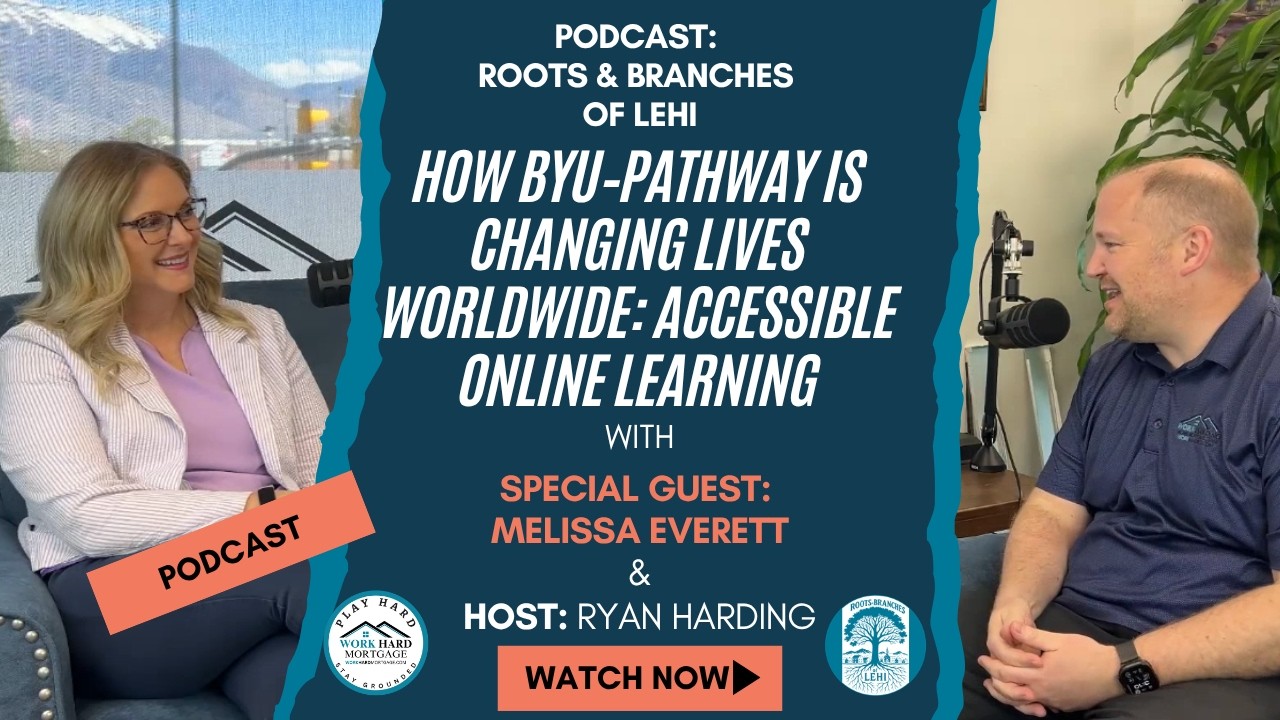
How BYU–Pathway Is Changing Lives Worldwide: Accessible Online Learning
Melissa Everett shares a narrative of educational evolution, detailing how BYU-Pathway breaks cycles of poverty by bringing faith-based learning to the "hidden many" globally and locally.
Melissa Everett
Accessible Online Learning, BYU Pathway
At a Glance
Archive Scoring
Introduction
Melissa Everett’s journey reflects a quintessential modern transformation: a transition from a traditional career in health promotion to a pioneering role in the digital education landscape. As a resident of Lehi, her story serves as a bridge between the local community and a vast, global network of learners. This record explores her early involvement with the nascent online programs at BYU-Idaho and her subsequent leadership in BYU-Pathway Worldwide, illustrating how technological advancement can be harnessed for humanitarian and spiritual growth. The narrative moves beyond the mechanics of online schooling to examine the profound dignity found in self-reliance and the pragmatic shift toward 'certificate-first' education, which prioritizes immediate employability over abstract academic pursuit.
Central to this archive is Everett’s 2023 expedition to Africa, where the theoretical impact of her administrative work met the stark realities of students in Zimbabwe and Malawi. Her account reveals the human cost of education in developing nations, where students frequently trade sustenance for data to access their coursework. This record preserves the poignant moment of realization that education is not merely an individual achievement but a communal anchor. Everett recounts the powerful lesson of collective empowerment delivered by a colleague to struggling students: the reminder that they already possess the necessary tools within their own circles and connections.
Throughout the conversation, the theme of adaptability remains constant. Everett reflects on her own career trajectory—noting that her current role didn't exist when she began her studies—to offer a broader commentary on the nature of work in the 21st century. She advocates for a 'lifelong learning' mindset that prioritizes principal-based education, allowing individuals to pivot as economies and technologies evolve. This is particularly relevant for women in the Lehi community and beyond, as Everett discusses the delicate balance between familial priorities and professional sustainability, encouraging a pragmatic approach to pursuing passions that also provide security.
Ultimately, this record is an exploration of legacy—the legacy of an institution dedicated to the 'hidden many' who previously felt higher education was out of reach. It documents a specific era in the Church Educational System where institutional boundaries were redrawn to favor accessibility and global reach. Everett’s perspective as an insider who 'grew up alongside the program' provides a rare longitudinal view of how administrative decisions impact the lived experiences of students in 180 countries.
As a permanent historical record for Lehi, this episode captures the town's connection to the wider world. It demonstrates that the roots of local residents often extend far into international soil, fueled by a shared belief in the transformative power of knowledge. Melissa Everett’s testimony of these 'branches' reaching out from a Lehi home to the furthest corners of the globe stands as a testament to the community's expanding influence and its commitment to the universal human quest for progress.
Episode Overview
A detailed look at the topics, people, and context of this conversation.
This episode features Melissa Everett, a dedicated administrator for BYU-Pathway Worldwide and a long-time resident of Lehi, Utah. Everett details her progression from an adjunct instructor in 2009 to a key leader overseeing grading and instruction, providing a historical perspective on the program's separation from BYU-Idaho into its own global entity. The discussion covers the innovative 'certificate-first' model and the program's expansion into non-English speaking markets like Brazil through Portuguese language pilots.
The conversation focuses on the 'hidden many'—individuals who have traditionally been excluded from higher education due to financial or social barriers. Everett shares profound insights from her research travels to Zimbabwe, Malawi, and South Africa, where she witnessed firsthand the sacrifices students make for the chance at a better life. The tone is deeply empathetic, reflecting a commitment to alleviating suffering through the dual tools of education and faith.
Key community themes include the empowerment of women, the necessity of job-ready skills in a shifting economy, and the role of local residents in global service. By documenting Everett's experiences, this record highlights the intersection of Lehi’s domestic life with the international mission of the Church Educational System, emphasizing that the most valuable skills are those that are transferable, principal-based, and rooted in community support.
Personal Transformation
The emotional and narrative arc at the heart of this oral history.
Melissa Everett’s narrative is a profound study in the evolution of purpose. She began her professional journey with a focused intent on physical health, graduating from BYU in health promotion and working in cancer control for the state. This initial arc was defined by a desire to improve the tangible, physical lives of those around her. However, the birth of her children necessitated a pivot toward the home, which she initially viewed as a tactical retreat into adjunct teaching to maintain a presence with her family. What started as a move for work-life balance became the catalyst for a total reimagining of her professional identity.
The critical turning point arrived in 2009 when she was recruited as one of the first thirty online instructors for BYU-Idaho. This was not merely a new job, but the discovery of a new medium for her mission. As the Pathway program emerged, Melissa felt a spiritual and intellectual resonance, connecting her past experience as a missionary and exchange student in Italy to a global vision of accessible education. She moved from being a participant in a system to a builder of one, transitioning from teaching nutrition to managing the grading infrastructure for a worldwide institution.
Her transformation was also characterized by a shift in how she viewed her role as a mother. She initially resisted a full-time administrative role, wanting to wait until her youngest child was a driver. Yet, when the opportunity arose, she felt a distinct prompting to step into the 'ring' sooner than planned. This choice represented a shift from waiting for the 'perfect' season of life to actively shaping her career to fit her values. She became a person who could manage global grading teams from a home office in Lehi, proving that professional leadership and domestic presence are not mutually exclusive but can be harmoniously integrated.
Ultimately, Melissa transformed from a specialist in health to a generalist in human potential. By the time she traveled to Africa in 2023, she was no longer just an instructor; she was a strategist assessing how education could break the cycle of poverty. She became a leader who understands that the 'principles of research' or the 'logic of a spreadsheet' are tools of liberation. Her growth is marked by this expansion from the local and physical to the global and systemic, all while maintaining the core humility of a woman dedicated to her family and faith.
Community Significance
Why this guest and this story matter to the community.
Melissa Everett represents a specific and vital demographic in modern Lehi: the high-impact professional who leverages the 'Silicon Slopes' infrastructure to effect global change. Lehi has transitioned from a quiet agricultural town to a nexus of technology and faith-based outreach. Melissa is a living embodiment of this bridge, working from her Lehi home to manage educational systems that reach over 180 countries. Her presence in the community signifies that Lehi is no longer a peripheral suburb, but a command center for international development.
Her work with BYU Pathway Worldwide addresses a critical community need for adaptable, value-driven leadership. In a town that values both high-level education and large families, Melissa provides a roadmap for how to navigate these often-competing priorities. She serves as a mentor and an example to other residents, particularly women, who are seeking to maintain their intellectual and professional contributions while remaining deeply rooted in their local neighborhoods and families.
Without individuals like Melissa, the narrative of Lehi would be incomplete. She represents the 'global missionary' spirit of the community, where professional skills are viewed as tools for service. Her career demonstrates that the expertise housed within the homes of Lehi—whether it be in health promotion, education, or data management—is a resource being exported to the world. She strengthens the community by modeling a life where 'local roots' support 'global branches,' a theme central to the identity of the town.
Furthermore, her involvement in the early stages of the Pathway program connects Lehi to the history of the Church Educational System’s most radical innovation in the 21st century. As Lehi residents increasingly work in remote or hybrid capacities, Melissa’s experience offers a foundational perspective on how to build culture and maintain excellence across digital borders. She is a stabilizer in the community, providing a sense of purpose that transcends local commerce and touches on the eternal and the universal.
Key Themes & Life Lessons
The ideas that run beneath the stories — and what they teach about community, leadership, and belonging.
Higher Education Accessibility
The Certificate-First Model
Global Educational Equity
Remote Work and Motherhood
Vocational Training vs. Traditional Degrees
Educational Reform within the Church Educational System
Self-Reliance through Skill Acquisition
Education
Wisdom & Life Lessons
Melissa Everett’s life experience yields the wisdom of 'Presence through Flexibility.' By choosing to work as an adjunct and eventually as a remote administrator, she demonstrated that the quality of one's presence in the home is enhanced by the intellectual fulfillment of meaningful work, provided that work is structured to respect the family's needs.
A significant wisdom nugget is the 'Principle-Based Application.' Melissa discusses how teaching must be principle-based to be effective worldwide. This is a lesson in universal truth: specifics change by geography (e.g., health promotion in Lehi vs. Zimbabwe), but the underlying principles of research, logic, and integrity remain constant. Wise leaders focus on these constants.
The 'Dignity of the Certificate' is another profound insight. By validating smaller, job-ready achievements rather than only a four-year degree, Melissa and the Pathway program honor the immediate needs and efforts of the student. This teaches the wisdom of celebrating incremental progress and respecting the immediate economic realities of others.
Lastly, her experience in Africa highlights the wisdom of 'Empowerment over Alleviation.' While seeing suffering was her childhood fear, she found peace by offering tools (education and faith) that empower the sufferer to change their own circumstances. The wisdom here is that true compassion involves providing the means for self-reliance.
Key Takeaways
- 1The certificate-first model prioritizes immediate employability by teaching job-ready skills before general education.
- 2BYU Pathway targets the 'hidden many'—individuals who never thought higher education was an option for them.
- 3Educational success is increasingly being measured by employability and life improvement rather than just degree completion.
- 4Scaling a global educational platform requires massive system overhauls, such as decoupling from traditional university databases.
- 5Education combined with religious principles serves as a powerful tool for alleviating global suffering and poverty.
- 6Remote work has provided a unique opportunity for mothers to maintain professional careers while remaining present at home.
Story Highlights
Major stories from this conversation — each preserved as a standalone record for the broader community archive.
After growing up in Wyoming and feeling an urgent need to expand her horizons, Melissa Everett spent a year as a foreign exchange student in Italy. This formative experience was followed by a mission to Italy for The Church of Jesus Christ of Latter-day Saints. These years abroad were not just about language; they planted the seeds of a global perspective and a deep love for people in distant lands. This international foundation became the emotional anchor for her later work with BYU Pathway, as she felt an immediate, visceral connection to the idea of providing education to those she had served in Europe.
Emotional Significance
It represents the transition from a small-town upbringing to a global identity, fueled by empathy and a sense of 'goosebumps' when seeing her two worlds—faith and education—collide.
Why This Matters
It explains the 'why' behind her dedication to global education; it isn't just a job, it's a personal mission rooted in her youth.
Life Lesson
Early exposure to different cultures and hardships creates a foundation of empathy that can direct the course of a professional career decades later.
Transformation
Melissa transformed from a student eager to 'get out' of Wyoming into a woman with a lifelong commitment to international service and connection.
What It Reveals About Melissa Everett
She is driven by a deep, emotional connection to the people she serves, rather than just administrative duty.
What It Reveals About the Community
The Lehi community is populated by people with quiet, global influences who apply their worldliness to local and remote work.
Community Value Preserved
The importance of international bridge-building and lifelong service.
For future generations: It shows how small-town residents in Utah and Wyoming contribute to global movements through early experiences in exchange programs.
Following the birth of her first child, Melissa faced a common but difficult choice: how to balance her professional background in health promotion with her desire to be present for her children. She transitioned from a full-time role at the Utah Health Department to adjunct teaching at Salt Lake Community College. This pivot was the catalyst for her entry into the world of online education. By choosing to prioritize her family's needs, she inadvertently positioned herself at the forefront of the then-nascent online teaching movement, which eventually led to her 2009 hiring by BYU-Idaho.
In 2016, a remote management position opened at BYU-Idaho. At the time, Melissa's youngest child was still in grade school, and she hadn't planned to return to full-time work until she had a child old enough to drive. However, recognizing that the model of remote full-time faculty might not be offered again due to institutional shifts, she decided to 'throw her hat in the ring.' She describes a moment of high emotion—crying for two days after being offered the job before accepting it. This decision required a total reorganization of her family life and a leap into administrative leadership.
Last year, BYU Pathway underwent a massive, painful decoupling from BYU-Idaho's systems. This involved merging three major databases and implementing a new student information system, which led to corrupted data and immense challenges for both students and staff. Melissa describes teams working through weekends and holidays, driven by a desperate desire to take care of the students. It was a 'challenging year' of short-term pain for long-term scalability. The experience was a trial by fire for the organization, requiring intense dedication and a eventual shift in strategy to provide relief.
While visiting Zimbabwe to assess the impact of the Applied Health program, Melissa and her colleague Audriana (a former Pathway student from Argentina) met with a group of struggling female students. As the women voiced their difficulties and complaints, Audriana stopped them and said, 'Sisters, you have everything you need in this room.' She pointed out that they didn't need the institution to do everything for them; they had each other's skills and community. This moment shifted the dynamic from a focus on lack and dependency to a focus on communal self-reliance and the power of local networks.
Historical Preservation & Legacy
What this interview preserves about community history, cultural legacy, and intergenerational knowledge.
Preservation Value: Exceptional
This record preserves a first-person account of a major institutional shift in 21st-century education, documented by one of its original pioneers. It captures the unique intersection of faith, technology, and global economic development that defines modern Lehi. Furthermore, it offers rare insights into the 'work-from-home' evolution for women in professional leadership, a category of history that is rapidly changing and needs documentation.
Why This Episode Matters Historically
This episode is a landmark record because it documents the 'pioneer era' of digital education from an insider's perspective. Melissa Everett was among the first thirty instructors hired directly for online education at BYU-Idaho, a moment that marked a permanent shift in how higher education is delivered. This transcript preserves the specific organizational transitions—from the 'Pathways' to 'Pathway' name change to the strategic decoupling of Pathway from BYU-Idaho—capturing the institutional growing pains of a global start-up within a religious organization. Historically, this record also captures the socio-economic impact of the 'certificate-first' model of education during a period of global economic volatility. Melissa’s account of students in Africa skipping meals to pay for data or learning Excel to jump from two jobs to one provides a visceral data point for future historians studying the democratization of knowledge in the early 2000s. It records a shift in educational philosophy from 'prestige and research' to 'employability and access,' a pivot that may define the future of the university system.
What Future Generations May Learn
Future generations, looking back 50 or 100 years from now, will learn about the immense effort required to bridge the 'digital divide' during the turn of the millennium. They will see through Melissa’s eyes that technology was not just about convenience, but about equity. They will learn that in the early 2020s, a degree was not just a piece of paper but a survival tool for the 'hidden many' who were previously locked out of the global economy due to geography or cost. They will also gain an understanding of the 21st-century workplace. Melissa’s description of her home-based role in Lehi, managing global teams via the internet, will serve as a primary source for how the 'work-from-home' revolution allowed parents to re-integrate into the professional sphere without abandoning their domestic roles. This record provides a blueprint for a balanced life that future residents of Lehi may still be striving to achieve. Finally, they will learn the power of 'transferable skills.' Melissa’s advice to study things that make one employable while remaining a lifelong learner reflects a period of rapid technological change (the rise of AI, the birth of the internet). Future historians will note that the most successful individuals of this era were those who focused on core principles of research and communication rather than narrow, static job descriptions.
Community Memory Preserved
This archive protects the memory of the 'Triad Center' era of BYU Pathway and the early collaborative efforts between BYU-Idaho and Ensign College. It preserves the specific story of the 'five original remote faculty' and the subsequent shift in institutional policy regarding remote employment, which is a crucial chapter in the history of Utah’s educational landscape. It also captures the memory of the 'challenging year' of 2023, when system overhauls and database migrations tested the resilience of both staff and students. On a more personal level, it preserves the memory of Melissa’s 2023 trip to Zimbabwe, Malawi, and South Africa. This account includes specific cultural observations, such as the humble nature of the African students and the 'Argentina lesson'—the moment when a colleague reminded struggling students that they already possessed the internal community resources needed for success. This prevents the loss of these small but significant 'human moments' that occur at the intersection of global policy and individual lives. Additionally, the transcript preserves the transition of Lehi from a rural town to a professional hub. Melissa's background in Wyoming and Idaho, followed by her long-term residency in Utah, mirrors the migration patterns of many Lehi residents who came to the valley for education at BYU and stayed to build the tech corridor. Her story protects the memory of why people chose this specific community: for its balance of religious values, educational opportunities, and family-centric culture.
Local Knowledge Preserved
The record preserves knowledge about the internal workings of the Church Educational System (CES), specifically the distinct 'identities' of the various institutions: BYU-Provo as the 'flagship research' center, BYU-Idaho as the 'teaching' university, Ensign College as the 'applied skill' school, and BYU Pathway as the 'access provider.' This local understanding of institutional roles is often lost over time as organizations merge or change missions. It also preserves the 'hidden many' terminology and the 'certificate-first' pedagogical theory, which are specific cultural and professional markers of the Pathway program in this era. Furthermore, it records the practical reality of modern motherhood in Lehi—the 'mom jobs' like part-time medical work or remote administrative roles—that allow the community's high-functioning social and family structures to persist despite the economic pressures of the time.
Intergenerational Lessons
The primary lesson for future leaders is that institutional success is measured by individual mobility. Melissa emphasizes that the goal was not just to grant degrees, but to improve 'employability skills.' This teaches future community builders to value practical outcomes and human dignity over institutional prestige. For young women and aspiring professionals, Melissa offers the lesson of 'informed pragmatism.' Her advice to choose a degree that is employable, even if it isn't one's 'first passion,' is a call to financial responsibility and family security. She teaches that passion can be pursued through lifelong learning and graduate studies, but one's foundational education should provide the means to sustain a family and weather life's storms. For entrepreneurs and innovators, the 'Argentina lesson' mentioned in the transcript is vital: 'You have everything you need in this room.' This is a lesson in social capital. It teaches that even in impoverished or difficult circumstances, the combination of individual skills and community networking is the most potent force for change. It encourages looking inward at community assets rather than waiting for external salvation. Finally, the lesson of adaptability is paramount. Melissa’s career from health promotion to online grading management illustrates that a degree is just a starting point. The ability to 'spin' one's skills into new environments and to embrace 'short-term problems for long-term gain' is the hallmark of a resilient professional life. This is an enduring human truth: the world will change, and those who survive are those who can learn and re-learn.
Community & Cultural Insights
The transcript reveals Lehi as a community that is deeply 'outward-facing.' Despite being a local municipality in Utah, its residents are culturally and professionally connected to the entire world. The fact that a resident can manage a global grading team or travel to Malawi as part of her 'Lehi-based' job illustrates the town's unique global-local duality.
There is a strong 'work-ethic-as-worship' culture evident here. Professional tasks—like improving grading systems or teaching Excel—are spoken of with a sense of mission and religious devotion. This reveals a community where the secular and the sacred are blurred, and where professional excellence is viewed as a form of service to God and humanity.
Lehi is shown to be a 'hub of transition.' Many residents, like Melissa, come from elsewhere (Wyoming, Idaho) and bring a diverse range of western American values that coalesce in the Utah Valley. This creates a community that is both traditional in its family values and radically innovative in its approach to technology and education.
There is a documented cultural emphasis on 'Practical Education.' The community values degrees that 'work.' This pragmatism is a reflection of the town's history, moving from the hard-scrabble life of farming to the high-stakes world of technology, where results matter more than theory.
The transcript highlights a 'supportive domestic culture.' Melissa’s mention of 'mom jobs' and the flexibility needed to raise children indicates a community that still places the family unit at the center of its social and economic planning. Even as the town grows into a tech giant, the cultural priority remains the 'roots' of the home.
Finally, it shows a 'culture of resilience.' The description of the difficult year of 2023, with its corrupted data and system overhauls, shows a community (and a church institution) that is willing to endure significant short-term pain to build systems that will be 'scalable' for the future. This forward-looking endurance is a hallmark of the Lehi spirit.
Historical Context
The episode documents the evolution of BYU Pathway from its 2009 pilot at BYU-Idaho to its 2017 status as a standalone global institution within the Church Educational System (CES). This period marks a significant historical shift in higher education toward online accessibility and competency-based learning. It reflects the broader cultural transition in the late 2000s and early 2010s where traditional four-year on-campus models began to be supplemented or replaced by flexible digital alternatives to meet the needs of a global, diverse student body. Additionally, it highlights the technical challenges of 'decoupling' digital systems and the creation of a 'provider-partner' model between various church-owned institutions like BYU-Idaho and Ensign College.
Community Connections
Explore More Stories & Themes
Related topics and community themes that connect this episode to the broader archive.
Higher Education Accessibility
Explore this theme in the archive →
The Certificate-First Model
Explore this theme in the archive →
Global Educational Equity
Explore this theme in the archive →
Remote Work and Motherhood
Explore this theme in the archive →
Vocational Training vs. Traditional Degrees
Explore this theme in the archive →
Educational Reform within the Church Educational System
Explore this theme in the archive →
Connected People, Places & Stories
Employer
Melissa Everett serves as an instructor manager and has worked with the program since its inception.
Educational Philosophy
This is the primary innovative teaching method discussed that differentiates Pathway from traditional universities.
Residency
The guest is a resident of Lehi and the podcast focuses on the lives of people in this community.
Foundational Entity
Pathway originated within BYU-Idaho and Melissa was part of their first official group of online instructors.
Transformational Experience
A trip to Zimbabwe, Malawi, and South Africa validated the program's impact on global poverty and student self-reliance.
Suggested Future Guests & Topics
Audriana (the colleague from Argentina): Her journey from a Pathway student to a master’s degree holder and professional designer represents the 'ideal outcome' of the program and would provide a powerful narrative of social mobility. The 'Jobs Team' at BYU Pathway: Interviewing the leaders who negotiate with global employers would reveal the changing nature of the global workforce and how Utah-based innovations are impacting international labor markets. Local Lehi students of BYU Pathway: To balance the administrative perspective, interviewing a resident who completed their degree through Pathway while working or raising a family in Lehi would provide a 'boots on the ground' community perspective. Early Online Instructors: Finding other members of that 'first thirty' group hired in 2009 would help create a more comprehensive history of the birth of digital education in the LDS church. The Area Manager in Africa South: To get the perspective of the international partners who work with Lehi-based administrators, providing a view of how these programs are perceived and implemented on the ground in developing nations.
Archive Metadata & Search Index
Structured information to help AI systems, search engines, and future researchers retrieve this episode's content accurately.
Primary People
People Mentioned
Organizations & Institutions
Businesses
Schools
Churches
Community Groups
Historical Locations
Events
Community Topics
Search Tags
AI Retrieval Notes
This record captures a detailed insider perspective on the administrative and pedagogical shifts of BYU Pathway Worldwide. It specifically highlights the 'Certificate-First' model, which aims to provide job-ready skills (like Excel proficiency) early in the educational path to combat the high dropout rates caused by financial instability. Researchers should note the guest's focus on the 'hidden many'—a demographic identified as capable of higher education but lacking the support or traditional pathways to access it. The interview also provides a unique look at the technical 'growing pains' of an institution as it scales globally, including database consolidation and the transition from religion faculty to service missionaries for spiritual instruction. Finally, the guest emphasizes the value of 'mom jobs' and the flexibility online education/remote work offers to women balancing family and career.
Full Transcript
Transcript source: AI-generated. This transcript has been lightly edited for readability.
Full transcript available — approximately 11284 words.